Determining if a quantum operation can be efficiently translated into a series of CNOT gates is now proven to be a remarkably hard problem. Kvantify research establishes that deciding whether a Clifford operator can be implemented with a specified number of these two-qubit gates is NP-complete, meaning a solution is easy to check but incredibly difficult to find.
This result establishes a fundamental limit on quantum circuit optimization, particularly because CNOT gates currently have higher error rates on quantum hardware. The findings have broad implications for areas including quantum chemistry algorithms and quantum error correction, where Clifford circuits are foundational.
CNOT Gate Minimization Defines Circuit Optimization Difficulty
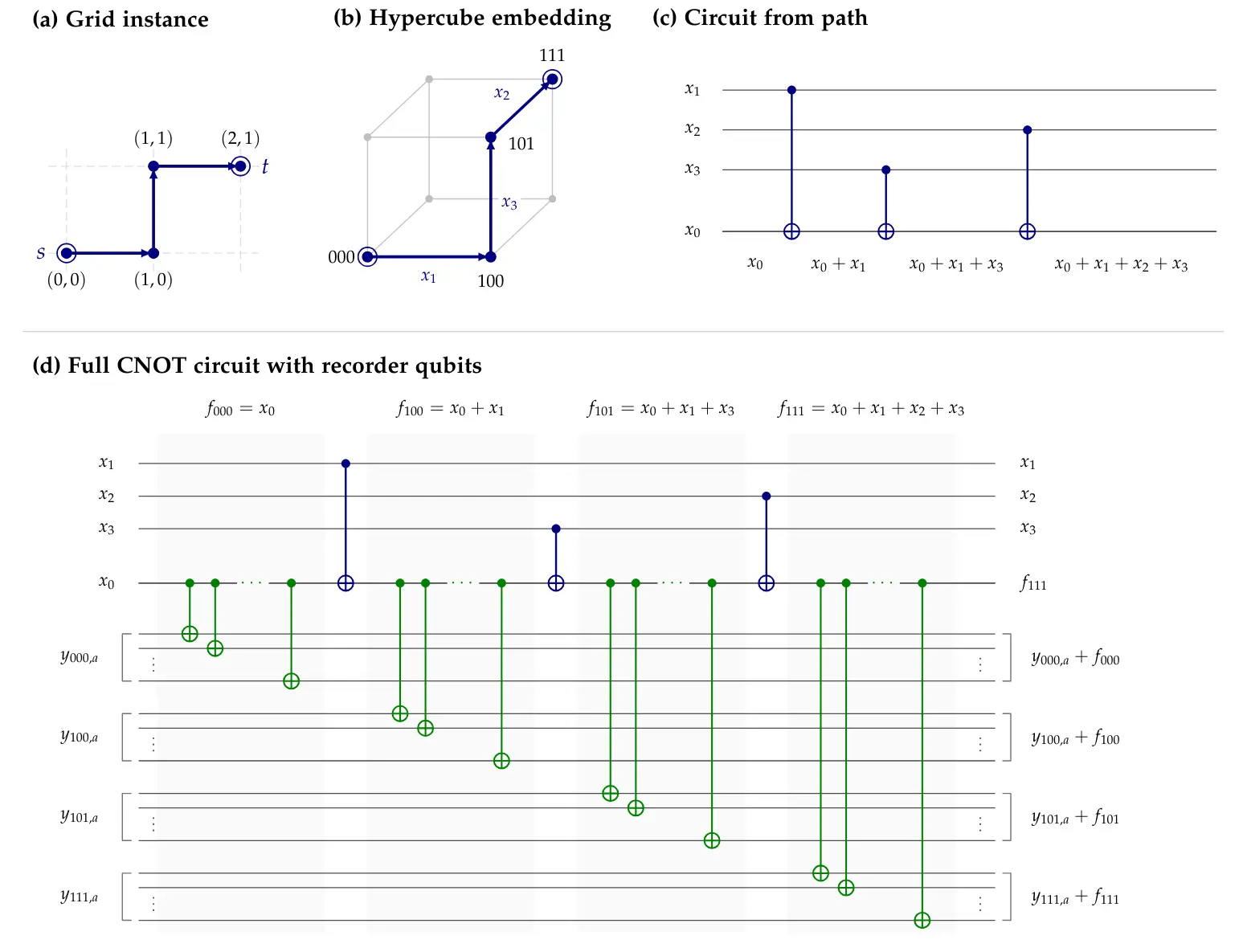
Kvantify researchers established this computational limit by demonstrating a direct link between Clifford circuit synthesis and the well-known NP-complete problem of finding a Hamiltonian path through a grid graph. This translation allows a solution to the path-finding problem to also solve the quantum circuit optimization problem, solidifying the inherent difficulty. The disparity in error rates emphasises the importance of efficient circuit design for achieving reliable quantum computation.
The research extends beyond a specific set of Clifford operators, indicating a fundamental limitation; unless P equals NP, an algorithm guaranteeing an optimal solution for every Clifford circuit cannot exist. “Checking whether a proposed circuit meets a given gate budget is computationally manageable, but finding such a circuit can be fundamentally difficult,” the Kvantify team reports. While finding mathematically perfect circuits may prove intractable, practical improvements remain possible, especially within larger quantum algorithms where Clifford circuits often serve as building blocks.
Quantum chemistry algorithms, for example, frequently combine operations representing molecular processes, and optimizing these components can reduce overall computational resource requirements. The same principle applies to quantum measurements, such as estimating molecular energies using commuting groups of Pauli operators measured with Clifford circuits. By integrating theoretical understanding with practical optimization techniques, Kvantify believes continued progress in quantum software is achievable even without guaranteed optimal solutions, the company says.
The team’s full technical video details the NP-completeness proof and its implications for quantum circuit optimization, available on the Kvantify website. Jørgensen, S. F. published the findings in 2026, formally establishing the computational barrier to efficient Clifford circuit synthesis.
Applications of Clifford Circuit Limits in Quantum Algorithms
Clifford circuits underpin several quantum computing applications, including quantum chemistry and error correction protocols, and their optimization presents a significant challenge. This result does not preclude circuit improvement, but it does define a hard boundary for fully automated optimization. The implications extend beyond theoretical computer science, directly impacting practical algorithm design. Optimizing these sub-circuits can reduce the overall computational resources required for complex tasks, such as simulating molecular behavior in quantum chemistry.
Algorithms representing molecular processes frequently combine numerous operations, and minimizing the gate count within each operation offers a pathway to greater efficiency. Similarly, quantum measurements, like those used to estimate molecular energies with Pauli operators, rely on Clifford circuits that benefit from streamlined design.
Kvantify believes that combining theoretical understanding with practical optimization techniques will continue to yield improvements, even if mathematically perfect circuits remain elusive, according to the company. The findings, published in 2026, formally establish this computational barrier, influencing the direction of quantum software development.




See today’s quantum computing news on Quantum Zeitgeist for the latest breakthroughs in qubits, hardware, algorithms, and industry deals.