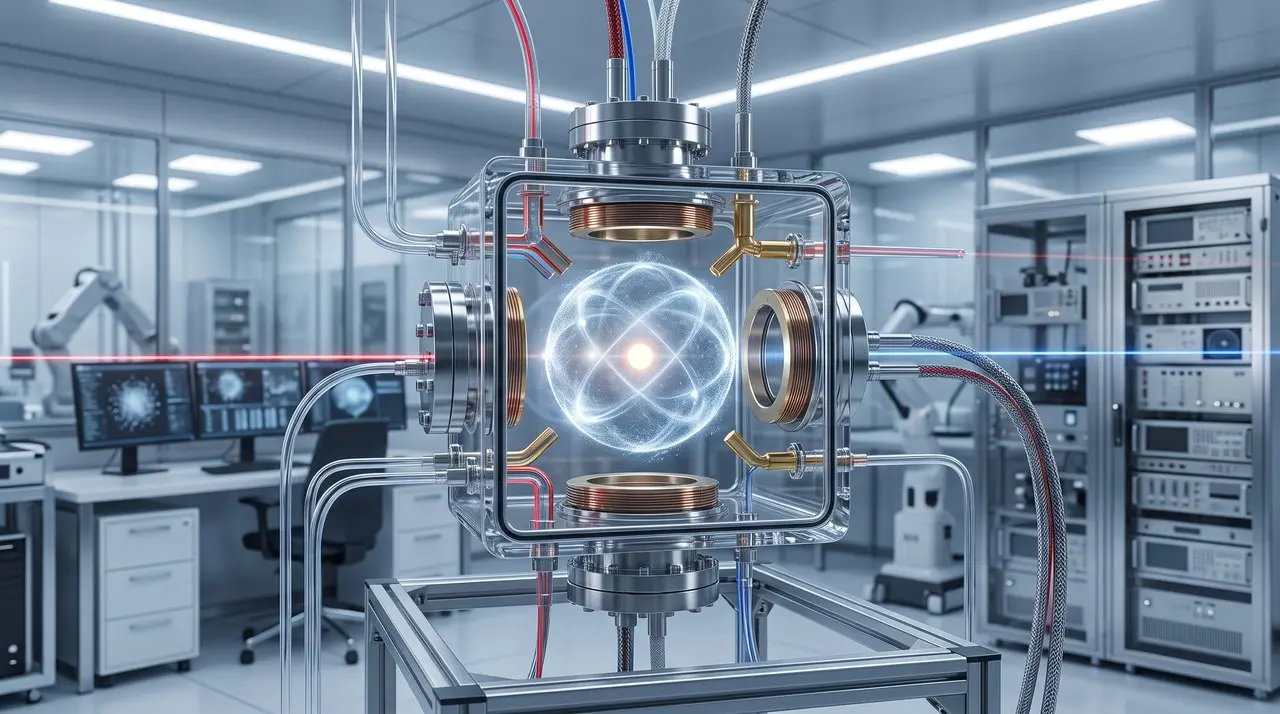
QuPrayog, a deep-tech startup incubated at IISER Pune’s I-HUB Quantum Technology Foundation, has built a laboratory-scale rubidium atomic clock prototype in seven months. The company achieved frequency stability of approximately 3 x 10⁻¹⁰ over one second with the system, a level of precision vital for applications like satellite navigation, QuPrayog says. This prototype improves the stability of an ordinary crystal oscillator by around 50 times over 1,000 seconds and represents a step toward India’s goal of building domestic precision-timing technology and reducing reliance on imported atomic clocks.
Rubidium-87 Prototype Achieves TRL 4 in Seven Months
QuPrayog completed a development-scale rubidium atomic clock prototype in seven months, a rapid timeline for complex deep-tech hardware development. This achievement positions the company to address reliance on imported atomic clocks and support an Indian supply chain for high-performance timing systems, a goal highlighted by the National Quantum Mission, according to QuPrayog. The prototype uses rubidium-87 atoms and a technique known as Coherent Population Trapping, essential for maintaining a stable time reference.
Beyond satellite navigation, where timing errors directly impact positioning accuracy, precise synchronization is critical for mobile and telecommunications networks. Defense and strategic systems also require dependable timing, particularly when satellite signals are unavailable or unreliable. The importance of the technology extends beyond navigation, emphasizing the broad applicability of accurate timing. Founded in 2024 by Jay Mangaonkar and Rahul Sawant, QuPrayog also receives incubation support from the IIT Madras Incubation Cell.
The company’s work aligns with the broader National Quantum Mission, which allocated ₹6,003.65 crore over eight years to support quantum sensing and precision measurement technologies. While the prototype remains scaled and has not yet been qualified for space applications, QuPrayog is targeting a miniature version by August 2027, indicating ambitions for wider deployment, the firm reports. The startup claims its clock could serve applications including GPS-denied navigation, though operational performance in those settings remains to be established.
Coherent Population Trapping Enables Clock Miniaturization
Unlike systems relying on microwave cavities, CPT employs laser light interacting with atoms to generate a stable frequency reference, a method the company believes will facilitate miniaturization. Laboratory tests recorded frequency stability of approximately 3 × 10⁻¹⁰ over one second, improving to around 2 x 10⁻¹¹ over periods ranging from 100 to 1,000 seconds, according to company reports. The CPT approach also yielded improvements when integrated with existing technologies; QuPrayog’s system enhanced the stability of a standard crystal oscillator by roughly 50 times over a 1,000-second interval.
The rapid development timeline, completing the prototype in just seven months, highlights the agility of the startup and the potential for accelerated innovation in this field, QuPrayog reports. India’s Space Applications Centre already developed an indigenous rubidium atomic clock for the NVS-01 satellite launched in 2023, and QuPrayog’s work contributes to a broader national effort to establish domestic precision-timing capabilities. The company is now focused on reducing the prototype’s scale, with a target date of August 2027 for a miniature version.



See today’s quantum computing news on Quantum Zeitgeist for the latest breakthroughs in qubits, hardware, algorithms, and industry deals.