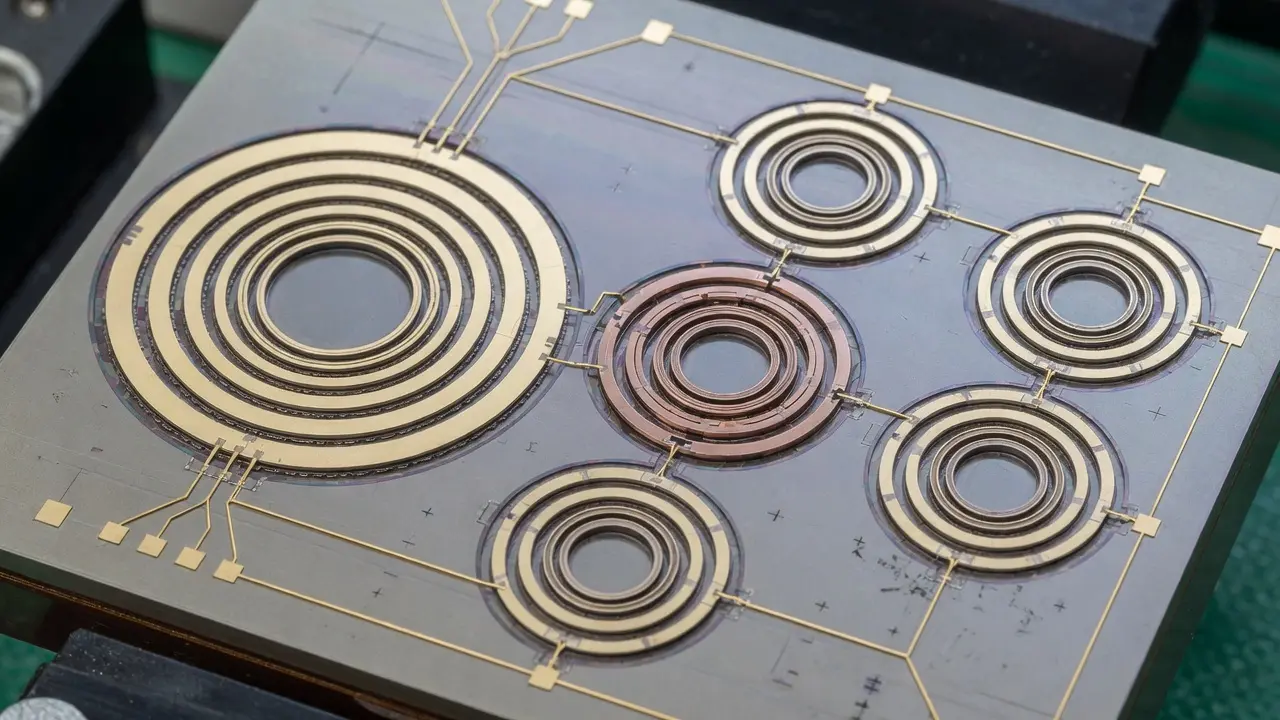
Researchers at Shenzhen University and City University of Hong Kong examine how device-specific compensation and task tolerance shape cross-chip performance. For squared operator loss, local analysis predicts that reducing own-chip error through compensation incurs an increase in expected loss on independent chips. Monte Carlo ensemble training (MC-ENS) reduces mean conditional process infidelity and increases postselection probability on unseen chips for tasks including CNOT synthesis and Ising dynamics.
Monte Carlo Ensemble Training for Shared Quantum Parameters
Local analysis reveals a counterintuitive challenge in scaling quantum photonic chips; attempts to reduce error on a single chip actually increase expected loss when those parameters are applied to independent chips, according to a new study. This finding highlights the difficulties of achieving consistent performance across batches of fabricated quantum devices. Researchers addressed this issue by developing Monte Carlo Ensemble Training (MC-ENS), an optimization method that uses a statistical model of fabrication-induced parameter errors to create a shared parameter set.
MC-ENS differs from traditional single-chip training by averaging losses over simulated chip realizations resampled from the established model. The team’s approach optimizes one shared parameter set for each task by simulating variations in chip fabrication, a technique that allows for training across a distribution of potential device imperfections.
This contrasts with methods like sharpness-aware training (SAT) and a covariance-informed variant (Σ-SAT), which focus on finding low-loss neighborhoods within a fixed parameter space. MC-ENS, however, actively resamples virtual chips during each optimization step within a quantum photonic neural network simulator. This process allows the system to account for the inherent variability in manufacturing, potentially leading to more robust and transferable results. For tasks such as CNOT synthesis and Ising dynamics, MC-ENS demonstrably improved performance on chips not used during training.
In classification tasks, high accuracy was maintained even with substantial changes in the optical transformation, indicating a degree of resilience to fabrication-induced variations. The researchers used sample-level decision margins in Banknote classification to explain when predicted classes remain unchanged despite fabrication-induced variations in optical outputs. The study modeled static fabrication errors using a parameter distribution incorporating available process statistics, prior device characterization, or engineering estimates.
This distribution, denoted as pη(ξ), represents the range of variability in fabrication parameters like coupler transmittances and propagation losses, with η controlling the magnitude of that variability. MC-ENS minimizes the mean task loss across these sampled chips, effectively training the system to perform well across a range of potential device imperfections. Σ-SAT, while an improvement over SAT, still relies on fixed-radius candidates, whereas MC-ENS uses the full distribution of potential fabrication errors.
The team found that for small, centered fabrication perturbations, the local model predicts that optimal device-specific compensation increases expected loss on independent chips by the same amount it reduces it on training chips. Shared training, as implemented in MC-ENS, avoids retaining a chip-specific correction and can reduce fabrication sensitivity, as observed for both CNOT and Ising tasks. The researchers write.
Differences in mean classification accuracy among the shared-control methods became apparent above η = 2.5, with MC-ENS retaining higher accuracy at larger variability levels. The trained shared parameters can therefore be reused without device-specific retraining on unseen chips drawn from the same fabrication distribution, offering a significant step toward scalable quantum photonic systems.
Fabrication Variability Impacts Cross-Chip Performance
For quantum photonic neural networks, a single set of trained parameters can be successfully reused across multiple chips despite fabrication-induced variations, according to new simulations detailed in a recent paper. This capability circumvents the need for individual optimization of each chip, a significant hurdle in scaling these systems. Local analysis within the study reveals a counterintuitive relationship between improving performance on a single chip and maintaining accuracy across a batch.
This suggests that a strategy focused solely on individual chip optimization is not optimal for large-scale deployment. The team’s simulations compared MC-ENS with three other training methods: per-device training, SAT and a covariance-informed variant called Σ-SAT. Analysis of decision margins shows when fabrication-induced score shifts are likely to change predicted labels.
QPNN Architecture and Programmable Optical Controls
This contrasts with traditional training methods that optimize parameters for individual chips, addressing a core challenge in scaling quantum photonic neural networks. The researchers examined how chip-specific compensation impacts transfer error and when fabrication-induced changes affect task performance, focusing on a six-mode, two-photon Fock-state quantum photonic neural network. This network comprises programmable linear-optical meshes separated by a Kerr nonlinear operation, with overall transformation denoted as S(θ;ξ), where θ represents programmable optical controls and ξ signifies the static fabrication parameters of a chip.
This distribution can be informed by prior device characterization, process statistics, or engineering estimates, treating fabrication parameters as fixed during operation. Numerical simulations compared MC-ENS against single-chip training, sharpness-aware training and a covariance-informed variant, revealing that MC-ENS achieved the lowest mean unseen-chip errors across the tested variability range. This diagnostic approach illuminates how even with alterations in optical transformations, the trained parameters can maintain predictive power.
Cross-Chip Transfer Evaluated via Task Fidelity
Researchers found that a method called Monte Carlo Ensemble Training (MC-ENS) maintains high performance even with substantial variations in chip fabrication. Local analysis revealed that reducing error on one chip through compensation introduces errors elsewhere in a batch, highlighting the challenge of achieving consistent performance across a manufacturing run.
Beyond these core quantum tasks, the team evaluated performance on a classification problem, finding that MC-ENS maintained 98.1% mean classification accuracy even at a fabrication variability level of η = 3. This level of stability is notable given that the mean circuit fidelity across the computational subspace was 58.7%, and the mean conditional output-state fidelity for the classifier’s input was 83.7%.
The researchers state, suggesting that the benefits of shared parameters outweigh the drawbacks of attempting to fine-tune each chip individually. The study also explored scenarios with misspecified fabrication statistics, finding that the transfer gains of MC-ENS and Σ-SAT were reduced when the assumed fabrication model did not accurately reflect the actual manufacturing process. This emphasises the importance of accurate characterization of fabrication variability for successful cross-chip transfer. The simulations used a pool of 1000 unseen devices for evaluation, reporting both the mean performance and a 95th-percentile error metric to capture the range of outcomes.
Decision Margins Predict Robustness in Classification
The study demonstrates 98.1% mean classification accuracy despite a mean circuit fidelity of only 58.7%, suggesting that precise replication of a designed quantum circuit is not essential for reliable performance. This resilience stems from a task-level robustness mechanism tied to decision margins, the difference between the predicted class and the next most likely one. The analysis focused on how fabrication-induced variations impact the margin, defined as the difference between the score for the true class and the maximum score for any incorrect class.
For each sample, the margin shifts on a chip due to fabrication imperfections, and predictions are more stable when the initial margin is large relative to this shift. The team’s work extends beyond simply achieving high accuracy. It also explores the limits of this robustness.
Despite this reduction in fidelity, the system maintained high classification performance, indicating a degree of inherent fault tolerance. “Predictions change less often when the decision margin is large relative to the fabrication-induced margin shift,” the study notes, highlighting the importance of margin size in preserving classification outcomes. This finding has implications for scaling quantum photonic neural networks, as it suggests a pathway toward reusing trained parameters across multiple chips without requiring device-specific optimization. Experiments combining measured fabrication statistics with in situ training could further quantify these transfer gains and associated measurement costs on actual hardware.
👉 More information
🗞 Cross-chip transfer in quantum photonic neural networks
✍️ Iqra Bashir and Keren Li (College of Physics and Optoelectronic Engineering, Shenzhen University, Shenzhen, China); Bikash K. Behera (Bikash’s Quantum (OPC) Pvt. Ltd., Mohanpur, WB, India); Qi Qin (Department of System Engineering, City University of Hong Kong, Kowloon, Hong Kong SAR, China)
🧠 ArXiv: https://arxiv.org/abs/2611.34313v1




See today’s quantum computing news on Quantum Zeitgeist for the latest breakthroughs in qubits, hardware, algorithms, and industry deals.