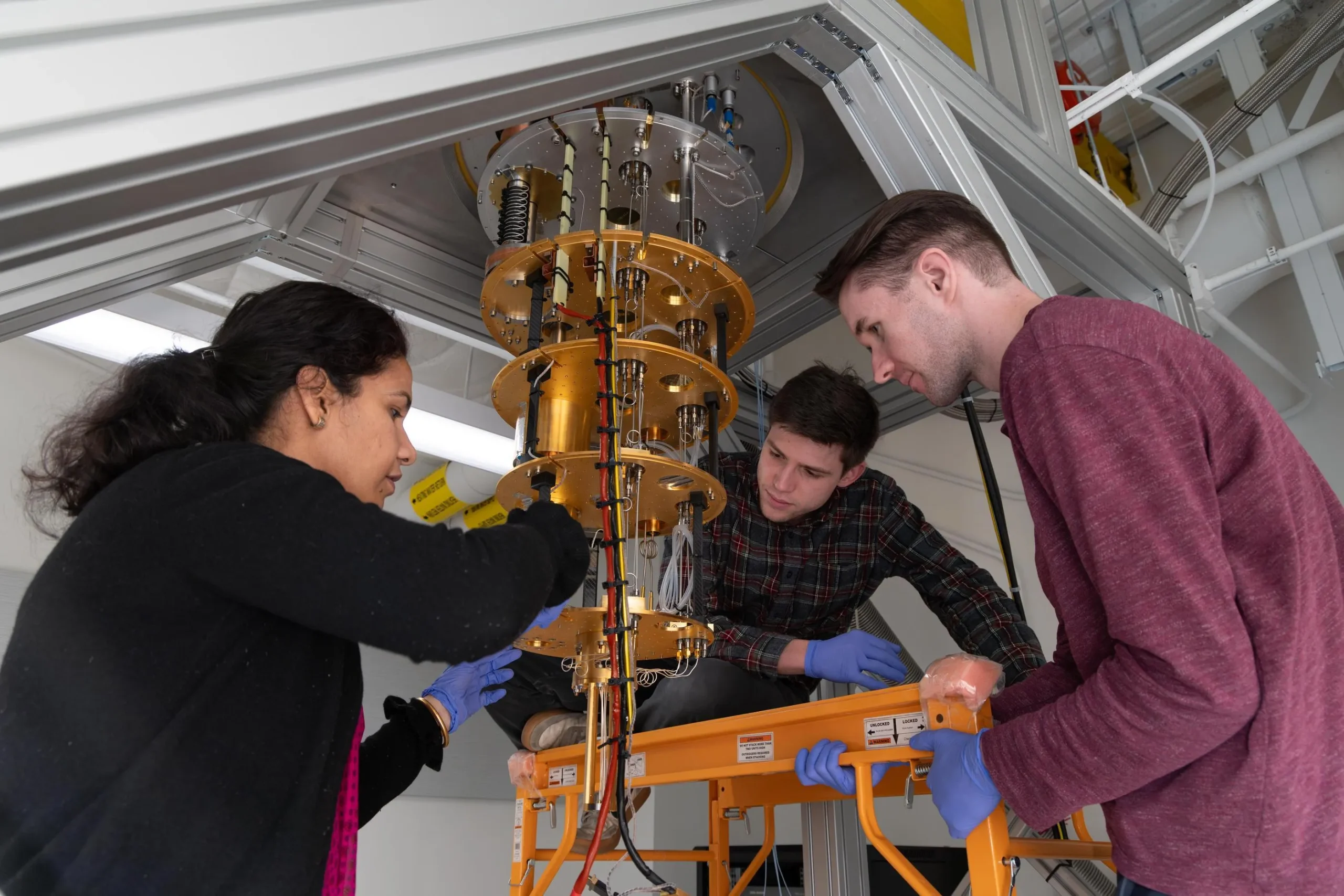
Colorado School of Mines researchers are accelerating the search for new quantum materials by automating the identification of materials just a single atomic layer thick. Dharmraj Kotekar-Patil, assistant professor of physics and Minghan Li, assistant professor of computer science, received a $50,000 seed grant from the CUbit Quantum Initiative at CU Boulder and the Colorado Office of Economic Development and International Trade to develop “AutoFlake,” a system designed to rapidly screen samples.
“By screening multiple samples automatically and consistently identifying promising materials, AutoFlake aims to significantly improve research efficiency,” Kotekar-Patil said, adding that the technology will allow researchers to focus on discovery and advance scientific knowledge. This funding is part of a larger $1.2 million program supporting the translation of quantum research into commercial technologies over the last three years.
AutoFlake Accelerates Quantum Material and Device Discovery
Dharmraj Kotekar-Patil and Minghan Li are streamlining the identification of these extremely thin materials, a traditionally slow process that limits progress in quantum research. The automated system, dubbed AutoFlake, addresses a critical bottleneck by removing the need for manual microscopic examination of samples, a task susceptible to human error and requiring significant expertise. The platform’s efficiency gains extend beyond speed. It is designed to improve consistency in identifying promising materials for quantum applications.
This automation is expected to free researchers and students from repetitive labor, allowing them to concentrate on analysis and the pursuit of new discoveries. Kotekar-Patil envisions the platform as a tool to not only accelerate discovery but also to support a more focused research environment.
By screening multiple samples automatically and consistently identifying promising materials, AutoFlake aims to significantly improve research efficiency, accelerate quantum material and device development, and lay the groundwork for scalable manufacturing of future quantum technologies.
Dharmraj Kotekar-Patil, assistant professor of physics, Colorado School of Mines
Strain Control Platform Advances Superconducting Qubit Performance
Zihuai Zhang, assistant professor of physics, is adapting a previously tested cryogenic strain platform for sensitive microwave measurements of superconducting quantum devices. He is using high-quality-factor microwave resonators to benchmark and refine the instrument’s capabilities. This adaptation moves beyond initial testing to focus on improving the performance of superconducting qubits, the fundamental building blocks of quantum computers. The modular design of the platform is intended to support both electrical and optical studies, expanding its utility beyond superconducting circuits to a wider range of quantum devices.
The project directly addresses a challenge in manipulating quantum materials. Mechanical strain offers a powerful method for control, but integrating it into delicate quantum experiments has proven difficult. By enabling precise application and measurement of strain, the platform aims to function as a new “tuning knob” for qubit performance, allowing researchers to optimize device characteristics.
The team’s approach centers on the use of microwave resonators, which minimize energy loss and provide a sensitive means of assessing the impact of applied strain. “Our goal is to make precision strain control a widely accessible tool for quantum research and technology development,” Zhang said, outlining the broader ambition of the project. Successful demonstration of this technology could unlock breakthroughs in multiple areas, extending beyond quantum computing itself.
The researchers note the platform has potential applications in experiments searching for axion dark matter, which require extremely sensitive measurements in high magnetic fields. The team envisions a future where precision strain control is a standard tool for both discovering new quantum materials and building the next generation of quantum devices.
Successfully demonstrating this technology will unlock major breakthroughs for systems operating in extreme magnetic environments, from advanced quantum computing to quantum experiments searching for axion dark matter.
Hung-Yu Yang, assistant professor of electrical engineering, Colorado School of Mines


See today’s quantum computing news on Quantum Zeitgeist for the latest breakthroughs in qubits, hardware, algorithms, and industry deals.