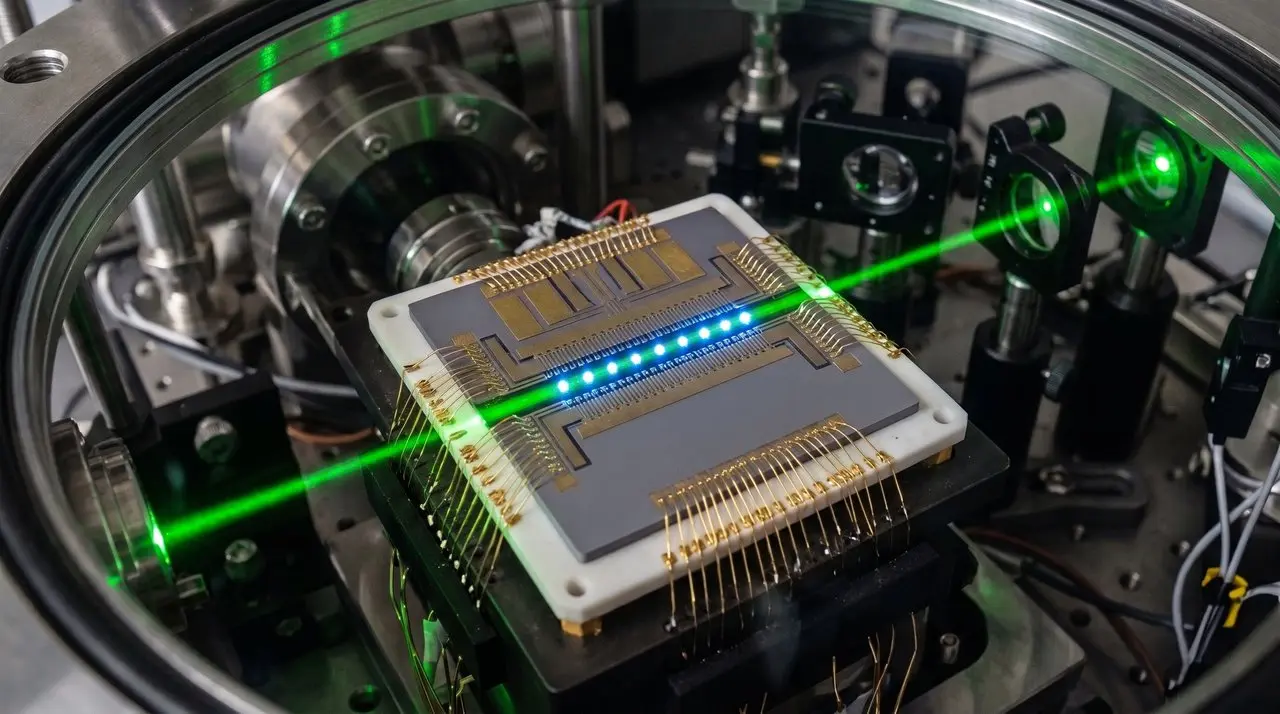
Quantum computers face challenges from heat generated during complex calculations. Software now enables more reliable computation with trapped ions by addressing how moving these qubits generates heat that causes errors. The technique pre-cools qubit pairs with auxiliary ‘coolant’ ions before operations, restoring expected improvements in logical error rates as calculation complexity increases, a capability previously limited by this transport-induced heating over tens to hundreds of microseconds.
New software simulates quantum computations using trapped ions, promising building blocks for powerful computers. Moving ions during calculations generates heat causing errors; however, “pre-cooling,” merging qubits with auxiliary ‘coolant’ ions before operations, counteracts this issue and maintains improvements in error rates even when calculations become more complex, offering key tools to design better error correction strategies needed for larger, reliable quantum machines.
These systems rely on physically moving qubits like an assembly line where individual parts (ions) are moved between workstations to perform tasks; this movement creates unwanted vibrations, measured as *mean phonon number*, which introduce errors into computations. The technique called “pre-cooling” merges problem qubits with auxiliary ‘coolant’ ions before operations, effectively reducing vibrational energy and restoring expected improvements in error rates even when calculations become more complex over tens of microseconds.
This is vital because transport-induced heating previously hindered progress towards larger, reliable machines capable of running sophisticated quantum algorithms. Researchers can now simulate entire programs using blueprints known as Stim circuits, testing designs without building expensive physical hardware.
Pre-cooling mitigates ion motion and unlocks major logic error reduction
Logical error rates dropped to 0.0039 for a code distance of three, nearly fourfold improvement compared to schedules lacking cooling, according to Keio University researchers. Previously, unchecked motional excitation during ion transport exceeding approximately 2.8 mean phonons prevented achieving such suppression. The team’s new software framework accurately models how moving ions in quantum charge-coupled devices generate vibrations that introduce errors; it reveals pre-cooling, merging qubits with ‘coolant’ ions before operations, restores the expected decrease in logical error as calculation complexity increases up to a code distance of thirteen.
Accurately modelling motional excitation and actively mitigating it through merged coolant ions enabled this sustained reduction in logical errors even as calculations became more complex, demonstrating potential scalability. Keio University researchers obtained just 0.0039 with a code distance of three; this represents nearly fourfold improvement over calculations performed without pre-cooling.
Simulating Qubit Transport Heat Enables Realistic Error Correction Assessment
The software framework developed by the researchers is an important step towards practical quantum error correction in trapped ion systems, accurately modelling heat generated during qubit movement. This allows for realistic evaluation of logical qubit performance under noisy conditions and offers valuable insights into system limitations. Current simulations rely on idealized cooling dynamics and assume uniform heating across all ions, a simplification that may not hold true in more complex architectures or diverse qubit types.
Acknowledging these simplifications doesn’t diminish the tool’s value but highlights clear areas for future refinement. This work demonstrably provides a strong set of tools to assess quantum error correction strategies before undertaking expensive hardware experiments. Unchecked motional excitation hinders expected improvements arising from those techniques; however, merging problem qubits with ‘coolant’ ions restores decreasing logical error rates as calculations become more complex, opening questions regarding optimal cooling strategies. Identifying how transport itself limits performance, and demonstrating pre-cooling as a potential fix, offers vital guidance while researchers build larger trapped ion systems with varied qubit designs, an important step towards building practical devices here. Extending these findings beyond single ion species or linear trap architectures remains an exciting area for future exploration.
This is valuable because motional excitation from this movement degrades the accuracy of quantum gates; existing simulations often oversimplify this heating process. Using their tool, they demonstrated that accounting for transport-induced heating allows logical error rates to decrease as calculations become more complex, achieving a rate of 0.0039 with a code distance of three, and showed pre-cooling can restore performance. The researchers intend to extend these findings beyond current system limitations like single ion species and linear trap architectures.
👉 More information
🗞 THeatA: Transport- and Heating-aware QEC simulation with Cooling Strategies for QCCD Trapped-Ion Systems
✍️ Eitaro Ishikawa, Noah Hirai, Hana Ebi, Kazufumi Tanji, Isamu Kudo, Masahiro Takeoka, Takahiko Satoh and Shin Nishio (Keio University); Koichiro Miyanishi (Qubitcore Inc); Kenji Toyoda (Osaka University); Hiroki Takahashi (Okinawa Institute of Science and Technology)
🧠 ArXiv: https://arxiv.org/abs/2611.30676




See today’s quantum computing news on Quantum Zeitgeist for the latest breakthroughs in qubits, hardware, algorithms, and industry deals.