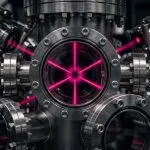
Germany’s first scalable photonic quantum computer, the ‘Paderborn Quantum Sampler (PaQS)’ at Paderborn University is being used to move beyond simply building large-scale quantum systems and investigate which quantum resources most impact performance. Researchers for Photonic Quantum Systems and the Department of Physics are examining how Gaussian Boson Samplers process complex light patterns, publishing their findings in the journal ‘PRX Quantum’.
“The results underscore that building useful quantum computers involves far more than simply scaling up a system,” explains Dr Michael Stefszky, who coordinated the project, adding that understanding properties like squeezed light is essential for developing the next generation of quantum technologies. The work combines expertise in integrated photonics, computer science and theoretical quantum optics.
Quantum Resources Influencing Performance in Gaussian Boson Sampling
The ‘Paderborn Quantum Sampler (PaQS)’ is enabling a detailed examination of the quantum properties that most influence computational power, moving beyond simply increasing the scale of photonic quantum systems. Researchers at Paderborn University are using the device to dissect the contributions of specific quantum resources to the performance of Gaussian Boson Samplers, a type of photonic quantum computer designed to process complex light patterns. This investigation, detailed in the journal PRX Quantum, focuses on how characteristics like squeezed light, photon statistics, and entanglement affect the ability of these computers to tackle challenging calculations.
PaQS achieves its analytical capability through a fully programmable photonic network, allowing researchers to reconfigure the system for diverse experiments rather than limiting it to a single task, Quantum Computing says. This capability is important for testing new approaches and exploring potential applications as the field of photonic quantum computing evolves. The system is currently undergoing expansion to support even more complex calculations and broaden the scope of potential applications.
By manipulating the network, the team can isolate and measure the impact of individual quantum resources on the sampler’s overall performance, a level of control previously difficult to achieve. The PhoQS research groups led by Prof. Dr Christine Silberhorn, Prof. Dr Jan Sperling and Prof. Dr Tim Bartley worked closely together as part of a Germany-wide research collaboration.
Determining the patterns generated by PaQS becomes computationally intractable for conventional computers as the number of photons increases and the network grows more complex; simulating these results on a supercomputer can require thousands of years for large systems.
This inherent difficulty highlights the potential of photonic quantum computers to solve problems beyond the reach of classical machines. The team’s work isn’t simply about demonstrating a large-scale quantum system, but about understanding how to optimize its performance by carefully controlling the underlying quantum resources, according to Quantum Computing. Michael Stefszky, head of the ‘Quantum Computing’ research group within Prof. Silberhorn’s team, coordinated the project.
The development of PaQS was supported by the ‘PhoQuant’ funding initiative, a 50 million euro investment bringing together 13 academic and industrial partners to strengthen Germany’s position in photonic quantum computing. This collaborative effort, which includes Menlo Systems, the IOF in Jena and Swabian Instruments, highlights the importance of combining expertise from different sectors to accelerate progress in quantum technologies. The initiative aims to pool German knowledge in photonics, quantum optics and computer science, supporting innovation and driving the development of practical quantum solutions.
The Paderborn researchers are contributing both a high-performance experimental system and new insights into the quantum resources that will determine the performance of future photonic quantum computers. The team’s ongoing work promises to refine the understanding of these resources, ultimately leading to more powerful and versatile quantum computing platforms.
The results underscore that building useful quantum computers involves far more than simply scaling up a system. A precise understanding of how properties such as squeezed light, photon statistics and entanglement influence computational performance is essential for the development of the next generation of quantum technologies.
Dr. Michael Stefszky, head of the ‘Quantum Computing’ research group within Prof. Silberhorn’s research team




See today’s quantum computing news on Quantum Zeitgeist for the latest breakthroughs in qubits, hardware, algorithms, and industry deals.