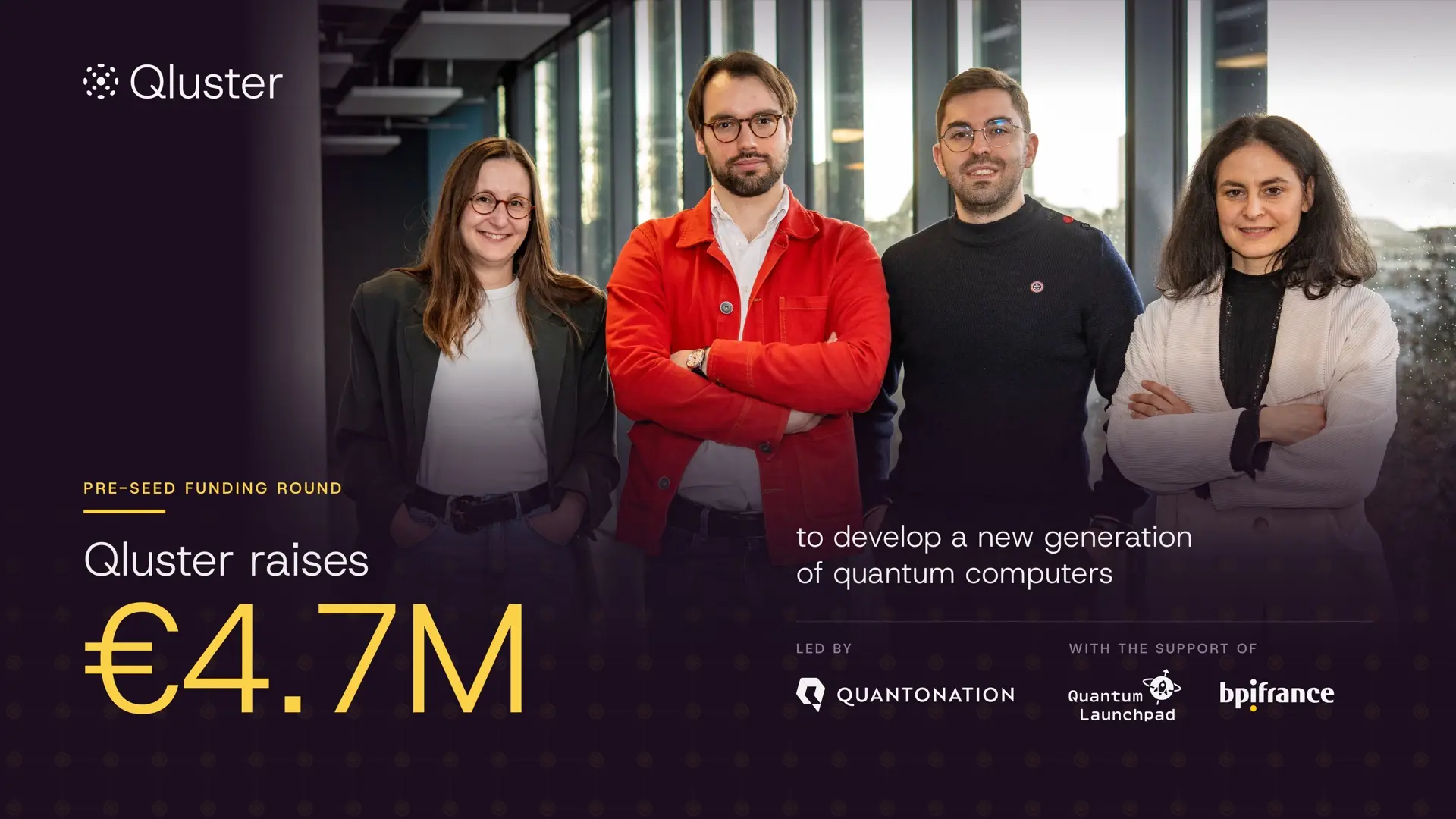
Quantonation led a €4.7 million pre-seed funding round for Qluster, a Paris-based startup building a new generation of quantum computers. Spun out of Laboratoire Kastler Brossel, a research institution associated with three Nobel Prizes in Physics, Qluster combines continuous-variable photonics with an “Architecture First” approach, designing machines around industrial needs rather than qubit limitations.
“For several years, the race to build quantum computers has largely focused on developing increasingly powerful qubits,” says the company, “But the challenge today is to ensure that the computing architecture can meet the needs of industry.” This funding will allow Qluster to establish a laboratory and expand its scientific teams, with the goal of developing a universal, fault-tolerant quantum computer by 2036.
€4.7 Million Seed Funding Fuels Qluster’s Quantum Development
Quantonation led a €4.7 million funding round for Qluster. This funding follows Qluster’s recent recognition with the 2026 i-Lab Grand Prize, supported by France 2030, marking early validation of its technology. Qluster distinguishes itself by combining continuous-variable photonic quantum computing with an “Architecture First” strategy, prioritizing industrial application needs during machine design. This approach diverges from conventional methods that begin with qubit technology and then attempt to adapt it to specific problems.
The company’s initial technological innovation, a miniature photonic source developed by Valentina Parigi and David Fainsin at Laboratoire Kastler Brossel, is a fundamental building block for its future architecture and has already been experimentally validated and published in a scientific journal, Qluster says. The “Architecture First” method translates business challenges into quantum circuits to determine the necessary resources for execution, including qubit count, circuit depth, speed and energy use.
Qluster then designs its machine architecture based on these specific requirements, a strategy gaining traction in North America and Japan but currently underdeveloped in Europe. This prioritizes the overall computational ability of the machine over the performance of individual qubits, addressing a key limitation in current quantum computer design.
This is the approach Qluster has adopted from day one, with the goal of developing an intermediate-scale quantum computer by 2032,” explains David Fainsin, co-founder and CEO of Qluster. The company’s continuous-variable photonic quantum computing uses light to carry information, exploiting the continuous properties of the electromagnetic field to encode it and generate entangled quantum states called clusters. This technology offers the potential for architectures capable of processing large numbers of quantum modes at room temperature, simplifying scaling and stabilization.
Qluster’s team, comprised of David Fainsin and Ambroise Boyer, both holding PhDs in quantum optics, Clarisse Thibault, formerly of CNRS Innovation, and Valentina Parigi, a physicist and professor at Sorbonne University who chairs the scientific advisory board, will focus on improving the performance of this photonic technology, according to the company. Quantum Launchpad and Agoranov have provided support since the deeptech startup’s inception.
By 2032, Qluster plans to deliver an intermediate-scale quantum computer capable of solving initial industrial problems, followed by a large-scale, fault-tolerant universal quantum computer by 2036 designed to tackle more complex challenges. “Our approach certainly does not eliminate the scientific and technological challenges that still need to be overcome to build a reliable quantum computer.
However, we believe it offers two major advantages: it builds on photonics, a field in which Europe has scientific and industrial expertise, and it offers particularly promising prospects for scalability. We want to build on these strengths, with humility and pragmatism, to contribute to advances in quantum computing and, ultimately, address the concrete needs of industry,” concludes David Fainsin.
Ylan Tran, Investor at Quantonation, emphasizes the significance of Qluster’s approach to scalability. “Scalability is currently the central challenge in quantum computing. Qluster is addressing it through a continuous-variable photonic architecture that uses nonlinear optics, opening up the prospect of millions of qubits operating at room temperature in systems that can be integrated into existing data centers. This approach, rooted in decades of research at Laboratoire Kastler Brossel, a world-renowned center for quantum optics, offers a credible path toward achieving a tangible quantum advantage. “We are proud to support the team on this journey,” Ylan Tran said.
For several years, the race to build quantum computers has largely focused on developing increasingly powerful qubits. But the challenge today is to ensure that the computing architecture can meet the needs of industry. This is the approach Qluster has adopted from day one, with the goal of developing an intermediate-scale quantum computer by 2032.
David Fainsin, co-founder and CEO of Qluster



See today’s quantum computing news on Quantum Zeitgeist for the latest breakthroughs in qubits, hardware, algorithms, and industry deals.