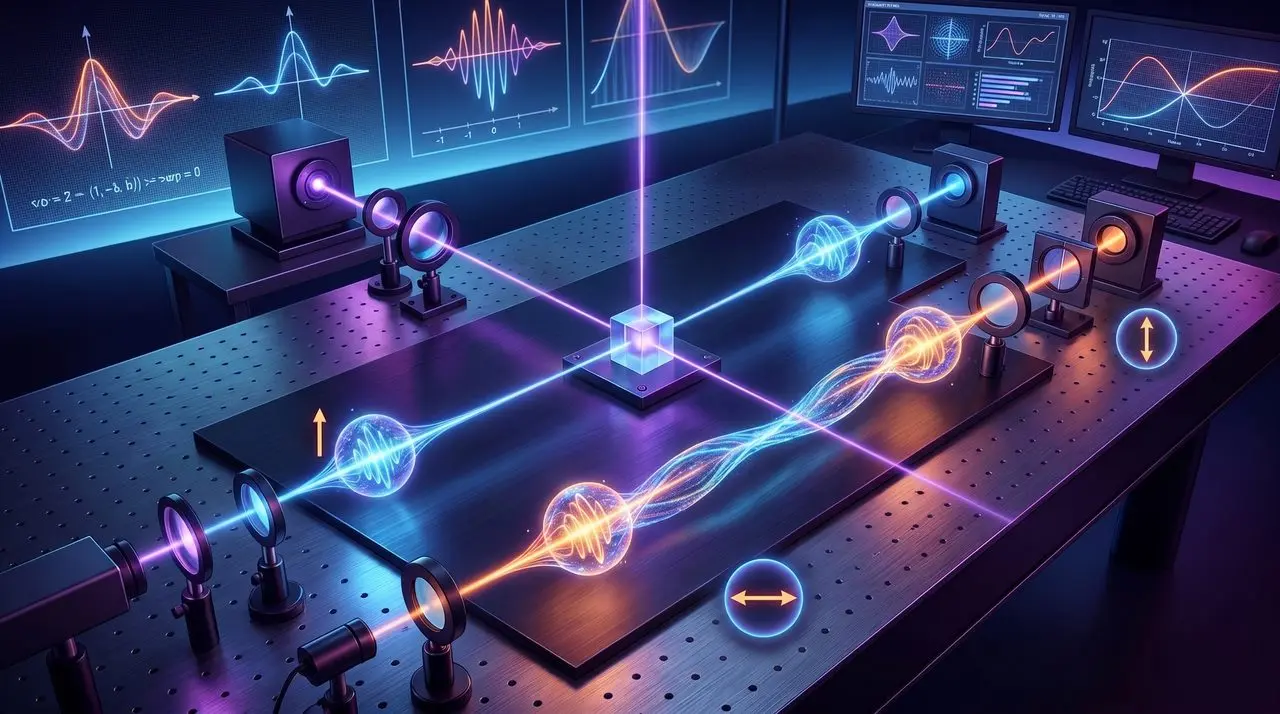
Researchers at ETH Zurich and partner institutions have demonstrated the teleportation of a logical qubit between two quantum processors using a superconducting circuit. This experiment used a fault-tolerant technique called lattice surgery to transfer logical information, an important step towards building larger, modular quantum computers. The work characterizes the step-by-step transfer of logical information, finding that repeated stabilizer measurements restore fault tolerance and improve fidelity. This achievement offers new insights into optimizing operations for scalable quantum computing architectures.
Superconducting Circuits Enable Logical Qubit Teleportation
The successful transfer of quantum information between logical qubits required the coordinated action of 41 physical qubits within a superconducting circuit. This scale demonstrates the significant hardware demands of even basic quantum communication protocols. The process begins by initializing two logical qubits, designated L1 and L2, and preparing an entangled state with a target qubit, forming what is known as a Bell pair. Researchers then merged L1 and L2 into a single logical qubit, L, by measuring stabilizers at the interface between the two original qubits, yielding a measurement outcome denoted as .
This merging process is foundational to the lattice surgery technique, allowing for the manipulation and transfer of quantum information. The teleportation protocol concludes with the application of Pauli frame updates on the target logical qubit, L2, conditioned on the measurement outcomes , and , which results from reading out a specific data qubit.
The team’s analysis of the time evolution of logical observables during teleportation revealed that errors are suppressed by repeated rounds of stabilizer measurements, highlighting the performance gains of fault-tolerant circuits over their non-fault-tolerant counterparts. These stabilizer measurements help maintain the integrity of the quantum information throughout the teleportation process, correcting errors that arise due to imperfections in the physical qubits and control operations.
The experiment demonstrated a higher logical fidelity for teleporting states |+⟩ and |-⟩ than for |0⟩ and |1⟩, a result stemming from a higher logical error rate on data qubit support in the Z basis. This asymmetry, detailed in the supporting documentation, highlights the importance of understanding the specific error characteristics of different quantum states during teleportation.
The researchers found that the modular implementation of the teleportation protocol, which expands and then shrinks the source logical qubit, allowed for the omission of stabilizer measurements in a resulting module while maintaining fault tolerance. Optimized circuits, retaining only the stabilizer measurements essential for preserving fault tolerance, further improved the fidelity of the teleported state. The team evaluated the performance of three distinct circuits implementing logical teleportation of |1⟩, |0⟩, |+⟩ and |-⟩, comparing measured results with simulations and ideal scenarios.
The analysis of error-corrected Pauli expectation values for each teleported state provided a quantitative assessment of the protocol’s effectiveness. The paper reports, emphasizing the subtle relationship between state preparation and error correction. The experimental setup involved mapping a regular three-by-seven surface code lattice to the arrangement of qubits on the quantum device, an important step in translating theoretical protocols into physical implementations.
Data qubits are represented as red circles, Z-type stabilizers as green plaquettes and X-type stabilizers as blue plaquettes, with logical operators depicted as black lines. This visual representation highlights the complex interplay between physical qubits and the logical encoding used to protect quantum information. The work offers new insights into optimizing fault-tolerant lattice-surgery operations, while also providing a comprehensive description of the physical device and gate sequences used. The detailed characterization of the teleportation process, from initialization to measurement, provides a valuable resource for future research in fault-tolerant quantum computing and distributed quantum networks.
Lattice Surgery as a Primitive for Logical Operations
This experiment characterizes the process of merging and splitting surface-code patches, a fundamental operation in lattice surgery, and provides detailed insight into the evolution of logical observables during these manipulations. The ability to implement logical operations helps build a scalable quantum computer, as it allows for the correction of errors that inevitably arise from imperfections in physical qubits.
Researchers achieved this by using lattice surgery to perform logical teleportation, a process that transfers the quantum state of one qubit to another without physically moving the qubit itself. The team’s approach successfully teleported logical states in the Z basis with a probability of 0.57 and in the X basis with a probability of 0.65, demonstrating the feasibility of transferring quantum information between distinct processing units.
Distance-Three Qubits Realized with 41 Physical Qubits
The realization of functional quantum computation demands the reliable transfer of quantum information, a feat now demonstrated with a superconducting circuit. The scale of this initial demonstration highlights the substantial overhead currently inherent in achieving fault-tolerant quantum operations. The core of this advancement lies in the implementation of lattice surgery, a technique for manipulating logical qubits encoded within a surface code. Unlike earlier experiments focusing primarily on the fidelity of the output state, this work systematically tracks the evolution of logical observables throughout the teleportation process.
This granular level of analysis provides a more complete understanding of the underlying mechanisms governing the process, informing future circuit design. The superconducting device itself features a planar architecture with three rows of qubits, alternating between data and auxiliary qubits.
Each qubit incorporates dedicated drive and flux lines, alongside a readout resonator with a Purcell filter, a design intended to enhance signal clarity and measurement accuracy. Physical single-qubit gates achieved a mean error rate of, as determined through randomized benchmarking, while two-qubit CZ gates exhibited a mean error rate of using interleaved randomized benchmarking. These benchmark results demonstrate the precision with which individual qubit operations can be controlled within the device.
The experiment involved encoding two distance-three logical qubits, designated L1 and L2, using nine data qubits each, alongside eight auxiliary qubits per logical qubit for stabilizer measurements. Logical operators were defined as = , = , = and = , where D represents data qubits.
Before initiating the teleportation protocol, the physical qubits were initialized by reading out their initial states and applying single-qubit rotations to establish the desired logical state. This careful initialization is important for ensuring the accuracy of the subsequent quantum operations. Following two rounds of stabilizer measurements, essential for maintaining fault tolerance, the logical qubit L1 was effectively “split” back into its constituent physical qubits, allowing for the readout of the source logical qubit’s measurement outcome, , of the logical operator .
The team then discontinued the measurements of stabilizers to complete the transfer. This demonstration of logical qubit teleportation represents a step toward building distributed quantum computing systems.
The researchers note that the fidelity improvements observed through careful protocol optimization highlight the potential for further advancements in this area. This level of transparency is intended to encourage collaboration and accelerate progress toward scalable quantum computing architectures.
Optimized Gate Sequences Improve Teleportation Fidelity
Repeated execution of stabilizer measurements following the merging of surface-code patches restores fault tolerance and improves the fidelity of teleported quantum states, according to a new analysis of lattice surgery protocols. The work, conducted with a superconducting circuit comprising 41 physical qubits, demonstrates that carefully timed stabilizer measurements are critical for maintaining the integrity of logical information during transfer. This finding directly addresses a key challenge in scaling quantum computers: reliably moving quantum data between processing units without introducing errors.
The researchers discovered that optimizing the sequence of operations, specifically reducing the number of stabilizer measurements, further enhances teleportation fidelity. By combining three elementary modules, initialization, merge-and-split and logical measurement, they streamlined the process and minimized the potential for errors. The team’s analysis quantified how these measurements actively reduce logical errors, highlighting their importance for high-fidelity logical operations.
Characterizing the time evolution of logical observables, the team evaluated the process step-by-step, revealing the impact of each gate sequence on the teleported state. They measured expectation values of observables during initialization and throughout the gate sequence, identifying how faults manifest as alterations in these intermediate measurements. This detailed analysis allowed them to pinpoint areas for optimization and refine the protocol for maximum performance. The experiment involved teleporting a logical qubit from a source to a target qubit, a demonstration of modularity important for building larger, distributed quantum systems.
The study compared the performance of a fully modular circuit with two optimized circuits featuring fewer stabilizer measurements, assessing the fidelity of teleported Pauli X and Z eigenstates. Results showed that the optimized circuits achieved improved logical performance, demonstrating the benefits of reducing measurement overhead without compromising fault tolerance.
The experimental setup involved initializing two logical qubits, labeled L1 and L2, with two rounds of stabilizer measurements. Following this merge, the researchers split L back into L1 and L2, enabling individual measurement of L1 and subsequent logical teleportation. The researchers also demonstrated the ability to measure logical qubit L1 individually after the split operation, a key step in realizing logical teleportation. This modularity allows for flexible manipulation of logical qubits and opens up possibilities for connecting separate quantum processors.
By carefully controlling the sequence of stabilizer measurements and optimizing the circuit design, the team achieved significant improvements in teleportation fidelity. The work’s findings emphasise the importance of optimizing gate sequences and reducing measurement overhead to achieve high-fidelity logical operations, an important step toward building practical and scalable quantum computers.
👉 More information
🗞 Teleportation of Logical Qubits using Lattice Surgery with Superconducting Circuits
✍️ Luca Hofele et al. (Department of Physics, ETH Zurich, Zurich, Switzerland); Áron Márton, Lukas Bödeker and Markus Müller (Institute for Theoretical Nanoelectronics (PGI-2), Forschungszentrum Jülich, Jülich, Germany); Jean Claude Besse
🧠 ArXiv: https://arxiv.org/abs/2611.23165



See today’s quantum computing news on Quantum Zeitgeist for the latest breakthroughs in qubits, hardware, algorithms, and industry deals.