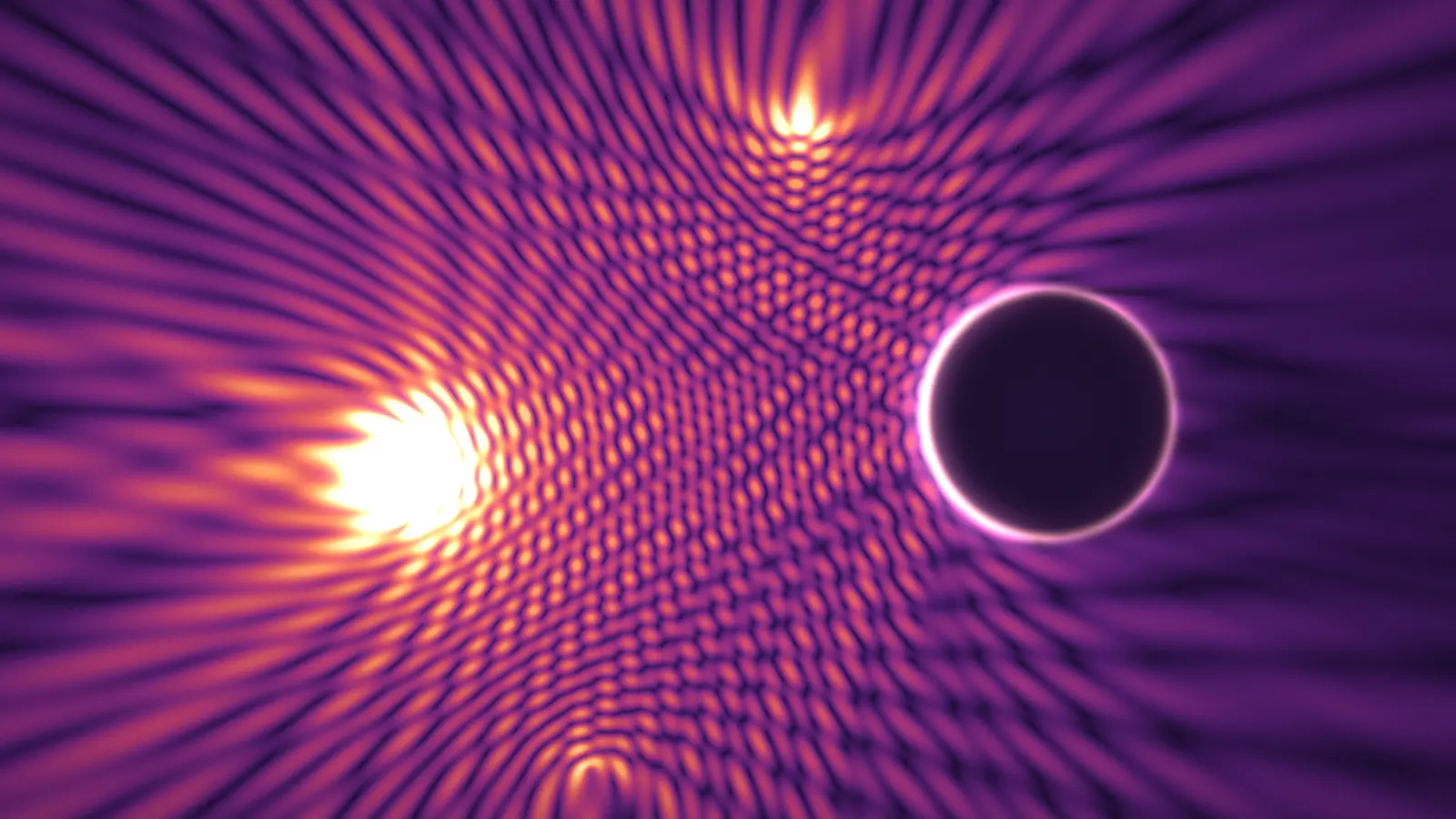
Researchers at Duke Quantum Center and Duke University’s Department of Physics have discovered unexpected “Airy distortions” appearing in their simulations of wave propagation within φ^4 theory. These oscillatory artifacts, stemming from interference between different momenta, are a visual consequence of the simulation’s construction, not a property of the theory itself.
Boyu Gao and Natalie Klco’s work details a method for preparing wave packets of arbitrary spatial extent using weighted sums of interpolating operators, while calibrating relative phases with Lorentz symmetry to ensure accurate results as simulations approach the continuum limit. The team identified conditions where these distortions weaken.
Real-Time φ⁴ Theory Scattering Simulation Approach
Single particle wave packet propagation through position space reveals oscillatory Airy distortions within simulations of φ⁴ theory, artifacts stemming from interference not inherent to the modeled theory itself. These distortions arise from interference between saddle point contributions at different momenta sharing the same lattice group velocity. Duke Quantum Center researchers identified these distortions while analyzing the propagation of localized excitations within the interacting theory, a key step in understanding non-perturbative scattering.
Scalable wave packet preparation within the simulation relies on weighted sums of an interpolating operator over lattice sites, enabling the creation of excitations with arbitrary spatial extent. This method bypasses the need for an interpolating operator ansatz to construct wave packets of any size, simplifying the optimization process.
The approach uses a quasiparticle ansatz to describe single particle momentum eigenstates on top of a matrix product state ground state, offering a variational description suitable for classical real-time simulations in (1 + 1) dimensions. This construction builds on the Haag-Ruelle scattering framework to approximate asymptotic incoming states, a technique applicable to both classical and quantum simulations of scattering events. To ensure accurate results as the simulation approaches the continuum limit, the team calibrated the relative phases among single particle momentum eigenstates using a relation derived from Lorentz symmetry.
The work demonstrates that with careful control of local field digitization and adherence to the Nyquist-Shannon sampling point, emerging evidence for physical inelastic processes in φ⁴ theory can be observed. The present constructions may provide new understanding of state preparation for the quantum simulation of scattering, offering a pathway toward modeling strongly coupled regimes where perturbation theory fails.
Haag-Ruelle Framework for State Preparation
The construction of accurate initial states is important for simulating quantum interactions, and researchers are using the Haag-Ruelle scattering framework to directly build these states from the interacting vacuum. This approach differs from methods that gradually activate interactions, instead focusing on identifying the fundamental local operators necessary for wave packet preparation.
This allows for the creation of localized excitations, serving as the foundation for more complex, extended wave packets within the simulation. To prepare physical-sized wave packets, the team bypassed the need to optimize a broad operator across the entire wave packet, instead focusing on identifying the local operator building blocks.
Localized Excitation via Fidelity Optimization
Researchers developed a method for constructing localized excitations within simulations of quantum field theory by jointly optimizing a superposition of single particle momentum eigenstates and a single site interpolating operator, maximizing preparation fidelity from the interacting vacuum. The researchers also propose a hybrid quantum-classical implementation where classical calculations of Φ inform the design of an operator capable of creating a wave packet in the vacuum for quantum simulations of sizes inaccessible to classical computers.
This method extends beyond simply creating localized excitations. It offers a pathway to systematically reduce quantum circuit depth when designing circuits for wave packet creation in quantum simulations of quantum fields. The ability to prepare wave packets of arbitrary spatial extent, combined with the optimization of the interpolating operator, provides a powerful tool for probing real-time dynamics and understanding non-perturbative scattering and interactions in quantum field theory.
Airy Distortions in Wave Packet Propagation
The work details how weighted sums of an interpolating operator, calculated across lattice sites, define these wave packets, offering a scalable method for establishing initial conditions for quantum interaction studies. The lattice dispersion, unlike its continuum counterpart, permits multiple momenta to exhibit identical group velocities, creating the conditions for this interference. These oscillations systematically weaken when approaching the continuum limit.
Artifacts from Lattice Digitization in φ⁴ Theory
Simulations of quantum field theory reveal unexpected distortions in wave propagation, specifically manifesting as “Airy distortions” during the analysis of single particle wave packets, according to work from Duke Quantum Center. The team’s analysis focuses on how truncating the continuum local bosonic degrees of freedom into a finite-dimensional representation impacts the accuracy of real-time simulations. The lattice dispersion relation, while approximating the interacting single particle spectrum when adjusted for lattice effects, also introduces an artifact that could skew analyses of inelastic processes.
Researchers found that the single particle dispersion relation on a finite size lattice closely mirrors results from lattice Monte Carlo studies of interacting scalar field theories, provided the bare mass is replaced by the lattice physical mass. This consistency offers a benchmark for assessing the impact of digitization artifacts, and is detailed further in Appendix An of the study. Sec.
IV. 2 examines how local field space digitization affects excess energy density and the Renyi-2 entropy, supporting ongoing efforts to identify genuine physical inelastic channels. This scalable method for wave packet preparation is a significant advancement for probing real-time dynamics and studying quantum interactions. The free scalar field calculations provide benchmarks for the MPS calculations and help assess digitization artifacts, as described in Sec. II.
The presence of Airy distortions is detailed in Section IV. 1 and Appendix D, while digitization artifacts affecting scattering are analyzed in Section IV. 2. Further scattering simulations, moving toward the thermodynamic and continuum limit of wave packet scattering, are presented in Appendix C. The work highlights the importance of carefully considering digitization effects and developing methods to mitigate their influence on simulation results.
The team’s approach offers a pathway toward more accurate and dependable simulations, ultimately advancing the field’s ability to model complex quantum phenomena. The connection between the dimensionless lattice scalar field theory and its continuum formulation is discussed in detail in Appendix A, providing a foundation for interpreting the simulation results.
Scalable Wave Packet Preparation with Interpolating Operators
This scalable approach moves beyond fixed excitation tensors, instead jointly optimizing both momentum-dependent excitation and a single-site interpolating operator to maximize fidelity when preparing states from the vacuum. The resulting localized excitation functions as an analogue to a position eigenstate within the interacting theory, offering a novel method for initializing quantum interaction studies. Two-particle scattering simulations in interacting scalar field theory are also implemented, revealing artificial inelasticity arising from coarse local field digitization or deviation from the Nyquist-Shannon sampling point.
👉 More information
🗞 Real-time simulation of scattering in $φ^4$ theory: localized excitation, scalable wave packet preparation, and peak-generating artifacts
✍️ Boyu Gao and Natalie Klco (Duke Quantum Center and Department of Physics, Duke University, Durham, NC, USA)
🧠 ArXiv: https://arxiv.org/abs/2611.18552v1




See today’s quantum computing news on Quantum Zeitgeist for the latest breakthroughs in qubits, hardware, algorithms, and industry deals.