University of Iowa physicist Michael Flatté will receive $750,000 to address a critical bottleneck in quantum computing: the 25-year reliance on the same materials for essential Josephson junctions. The funding, part of a larger $290 million National Science Foundation initiative, will support Flatté’s theoretical calculations into material combinations for these components, aiming to improve their reliability.
“This multidisciplinary framework forms a unique scaffold to bring new expertise and creative ideas to this longstanding challenge in quantum computing,” Flatté says. He joins researchers from nine institutions collaborating through the MARQUIS institute, which will receive $27.9 million over five years.
Flatté’s Research Advances Manufacturable Resilient Quantum Systems (MARQUIS)
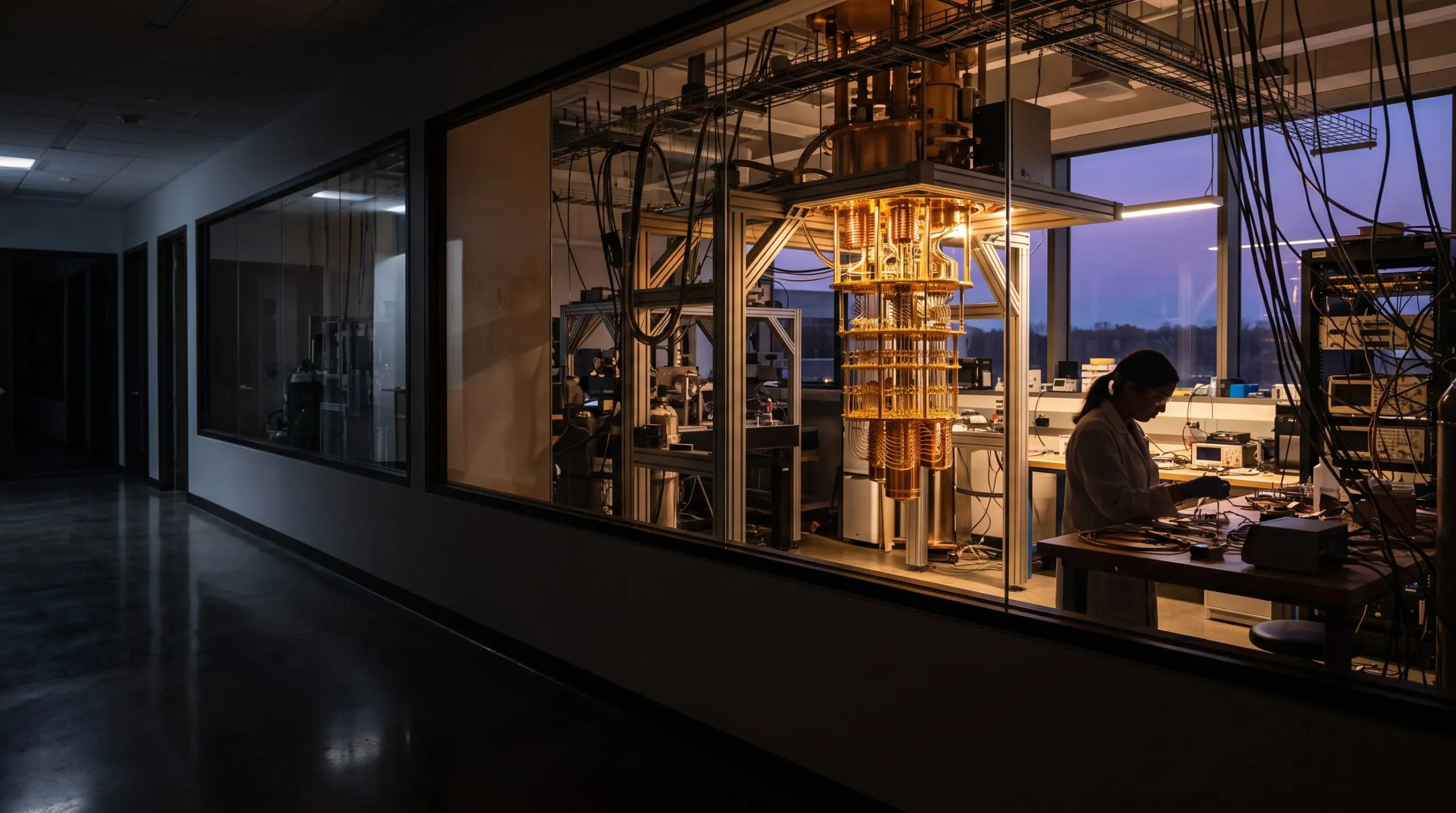
Josephson junctions, critical for building superconducting quantum processors, have remained reliant on the same core materials for roughly 25 years, now presenting a significant obstacle to scaling up quantum computing power. Flatté, a professor, is receiving $750,000 to address this bottleneck through theoretical calculations examining material combinations within these junctions. His work will specifically investigate how imperfections and impurities impact performance, and how to mitigate those effects.
The funding supports Flatté’s contribution to the Manufacturable and Resilient superconducting Quantum Information Systems (MARQUIS) institute, a collaborative effort receiving $27.9 million over five years. MARQUIS unites researchers from nine institutions to tackle the challenges of building larger, more stable quantum computers. Flatté’s research will focus on improving the reliability of qubits, a key step toward practical, large-scale superconducting quantum computing. The institute’s broader goals include advancing quantum education and developing a skilled workforce, recognizing that hardware innovation must be paired with human capital to realize the full potential of this technology.
This multi disciplinary framework forms a unique scaffold to bring new expertise and creative ideas to this longstanding challenge in quantum computing.
Michael Flatté, Professor in the Department of Physics and Astronomy at Iowa
Source: https://clas.uiowa.edu/news/2026/11/clas-physicist-receives-750000-quantum-computing-research


See today’s quantum computing news on Quantum Zeitgeist for the latest breakthroughs in qubits, hardware, algorithms, and industry deals.