Researchers have, for the first time, proven quantum memory in a minimal qubit system using a test requiring observation at three distinct points in time. The work demonstrates that standard methods, those comparing system evolution at just two times, can miss genuine quantum memory effects, establishing a hierarchy where increasingly complex tests are needed to confirm true quantum behavior.
The team derived an analytical “three-time witness” to certify quantum memory in a system where every pair of time points could be explained by classical physics. This realization on a superconducting-qubit platform confirms genuine multi-time quantum memory does not require complex, time-dependent controls.
Three-Time Witness Certifies Quantum Memory in Qubits
Existing methods for verifying quantum memory rely on comparing system evolution at only two distinct points in time, a limitation now shown to be insufficient for complete certification. The team constructed a specific qubit dynamics where every pairing of time points exhibited behavior consistent with classical physics, yet the three-time witness revealed an incompatibility with any single classical-memory explanation.
This finding highlights that quantum memory isn’t always immediately apparent and necessitates simultaneous consideration of multiple time points for accurate detection. Consequently, a violation of the witness, expressed as W3 < 0, definitively rules out any possible three-time classical-memory realization, as described in Eq. (2) within the paper.
The underlying principle centers on the idea that a non-zero displacement vector implies preferential preservation of distinguishability along a specific Bloch-sphere direction. Classical memory, the researchers explain, can retain information about at most one such direction. If highly distinguishable antipodal states reappear at later times along two incompatible directions, no single classical record can fully account for the observed dynamics.
The analysis revealed that the ellipsoid representing evolution at the third time point could not be reached from the ellipsoid at the second time point through a simple unitary rotation, visually demonstrating the incompatibility with classical explanations. The observability of quantum memory is also demonstrably dependent on the time domain considered, with effects undetectable in shorter intervals potentially becoming apparent with extended evolution times.
For driving strengths between 0.25 and 0.45, they minimized the three-time witness W3 across all ordered triples of time points (t1 < t2 < t3) for the measured dynamics within the specified time window. The quantities Ft(z) and Ft(x) were calculated directly from the reconstructed channels and combined according to Eq. (6) to form the witness W3, allowing for a detailed analysis of the quantum memory effects.
“In this Letter, we have demonstrated a strict hierarchy of multi-time quantum memory effects on the level of dynamical maps alone,” the researchers conclude. A quantum dynamical map that appears classically explainable when considering pairs of times can become incompatible with a classical decomposition when maps at three different times are considered jointly. They have developed a witness for three-time quantum memory and provided a prototypical discrete example for genuine three-time quantum memory, solidifying the need for more comprehensive tests to fully characterize quantum memory effects.
Pairwise Tests Fail to Detect Classical-Memory Dynamics
Researchers have demonstrated a qubit system where classical explanations account for behavior observed at any pairing of measurement times, yet a simultaneous analysis of three time points reveals definitively quantum behavior. The team’s analytical three-time witness, a mathematical tool designed to detect these multi-time correlations, certifies quantum memory in this minimal qubit example.
The implications extend beyond this specific qubit realization, establishing a principle applicable to broader quantum systems. The researchers found that classical-memory models capable of reproducing any two channels of the qubit dynamics are mutually incompatible, meaning they cannot be combined into a single, consistent description of the system’s overall behavior. This incompatibility is the signature of genuine quantum memory, irreducible to simpler, classical correlations. The researchers write, referring to the specific combination of channels tested.
Experimental verification of this hierarchy was achieved using transmon qubits on a superconducting chip. Channel tomography, a technique for reconstructing the system’s evolution, at different time points provided the data for the three-time quantum memory criterion. Explicit classical-memory models, constructed numerically for every pair of measured channels, failed to replicate the full dynamics, confirming that the quantum memory remained hidden from pairwise analysis.
The multi-time analysis, however, yielded a stronger signature, proving the existence of quantum memory based on the same tomographic data. This accessibility is significant because it shows that quantum memory effects can possess a multi-time structure, irreducible to correlations between pairs of times. While previous work established this concept at the level of process tensors and through experiments involving intermediate interventions, this study provides a direct, experimentally validated demonstration within a time-continuous realization.
The team shows that quantum memory can remain hidden from all pairwise tests and become detectable only when three or more times are considered jointly. This distinction highlights the subtlety of quantum memory and the need for increasingly refined measurement techniques to fully characterize its properties.
Superconducting Qubit Platform Enables Multi-Time Observation
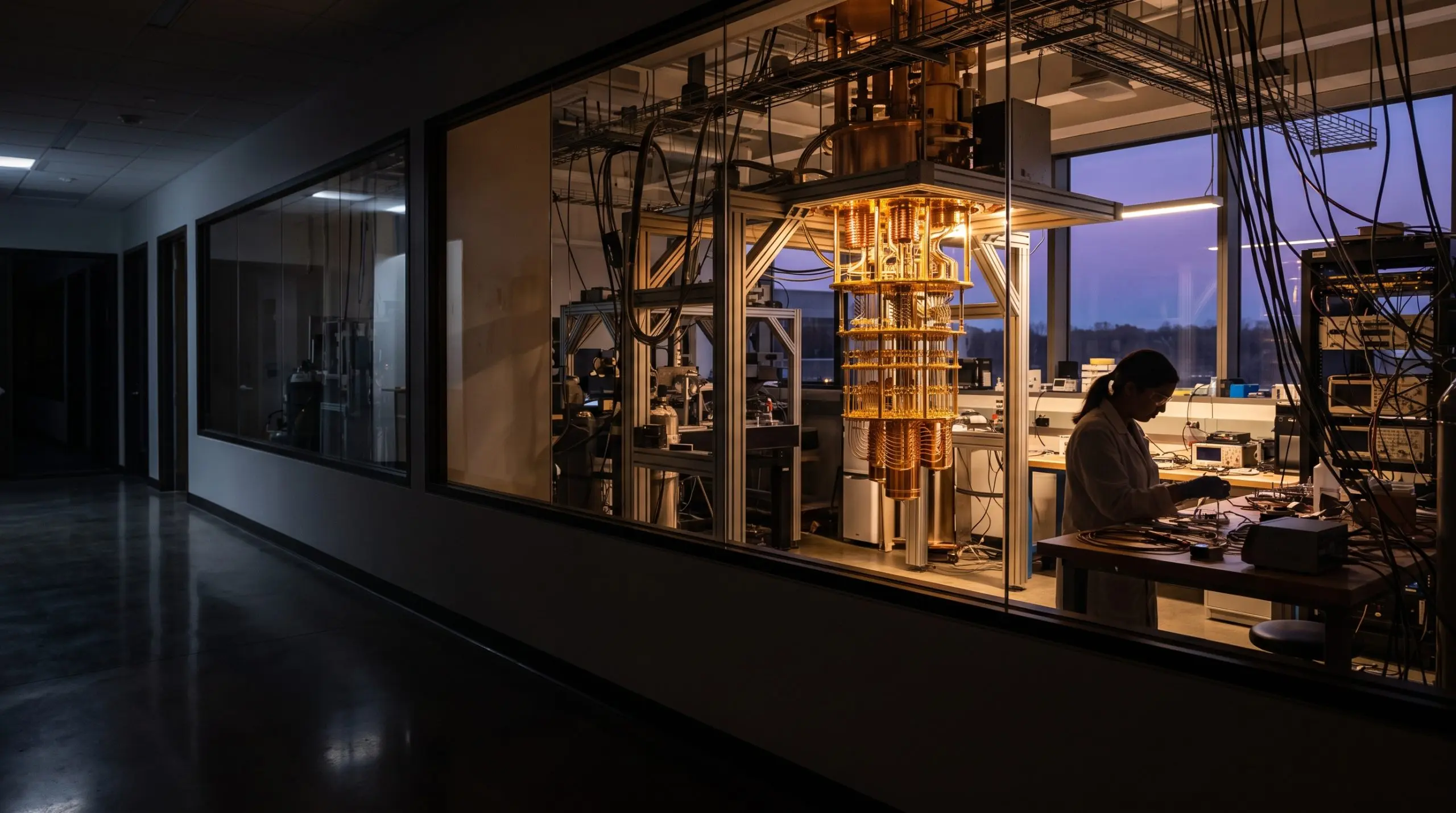
Experimental work at the University of California Berkeley and the Stevens Institute of Technology used transmon qubits to demonstrate a hierarchy of quantum memory effects, requiring analysis of system evolution beyond pairwise comparisons. The team’s realization of a time-continuous open quantum system relied on time-independent couplings between qubits on a superconducting chip, a departure from approaches demanding fine-tuned, time-dependent Hamiltonians.
The witness, applied to the experimental data, demonstrated that the observed quantum memory could not be attributed to any pairwise incompatibility, but instead arose from the impossibility of combining classical explanations into a consistent description of the full three-time dynamics. “Genuine multi-time quantum memory does not rely on fine-tuned time-dependent Hamiltonians or gate-based evolution,” the authors state, emphasizing the robustness of their findings. The minimal qubit example used in the study consisted of three qubit channels, each pairwise decomposable with classical memory, yet impossible to replicate with three-time classical memory when considered as a triple.
This analytical model, implemented on a two-qubit platform, is a concrete illustration of the concept. The experimental setup involved two fixed-frequency transmon qubits coupled through a flux-tunable transmon coupler, each individually controlled with microwave rotations and dispersively coupled to a readout resonator.
The team’s work demonstrates an accessibility advantage over previous methods requiring control interventions during dynamics and scaling exponentially with time steps. Their compatibility witness accesses a genuinely multi-time property of the process through the dynamical map alone, requiring no interventions and scaling linearly with the number of times probed. This is a significant advancement, as it simplifies the experimental effort needed to detect and verify quantum memory effects.
The researchers note that this accessibility is important for exploring quantum memory in more complex systems. The findings establish a strict hierarchy of quantum memory effects, where increasingly refined measurement techniques are needed to distinguish genuine quantum behavior from classical simulations. “In this form, the model can experimentally be implemented on a two-qubit platform,” the authors write, highlighting the feasibility of their approach for future quantum technologies.
Dynamical Maps Reveal Genuine Quantum Memory Effects
The work demonstrates that a dynamical map, a tool for tracking how quantum states evolve, can reveal quantum memory effects even when each pair of time points considered individually appears classically explainable. Researchers developed a specific analytical “three-time witness” to definitively certify quantum memory, moving beyond simply observing memory effects to proving their quantum nature. This witness, a mathematical formulation, determines whether three channels, representing the system’s evolution at different times, can be replicated using only classical memory models.
The team’s experimental realization employed a superconducting-qubit platform, allowing them to test the witness and confirm genuine multi-time quantum memory in a minimal qubit example. The experimental setup revealed a surprising result. A range of driving strengths existed where the three-time witness indicated quantum memory, while the standard two-time tests failed to detect it.
Specifically, the team found a window of intermediate driving strengths where genuine three-time quantum memory effects were present, but not detectable with previous methods. Bloch sphere visualizations, generated from channel tomography, further supported these findings, showing the evolution of qubit dynamics and highlighting the discrepancy between classical and quantum behavior. The error bars on these visualizations reflect the statistical uncertainty inherent in the measurement process.
The team verified that in their system, each pair of maps, representing the system’s state at different times, could be realized with classical memory, yet the combined triple exhibited genuine quantum memory effects. This confirms that the observed memory isn’t simply a consequence of classical correlations but arises from fundamentally quantum properties of the system.
Non-Markovianity vs. Quantum Memory: A Key Distinction
Genuine multi-time quantum memory, a resource for storing coherent quantum information in an environment, is not automatically implied by simply observing non-Markovian dynamics, as the same behavior can often be replicated with classical memory models. Establishing that a system truly stores quantum information requires demonstrating that reproducing its dynamics necessitates coherent quantum storage, effectively using the system as a probe of its surroundings’ quantum properties.
This inference relies on analyzing snapshots of the system’s dynamical map at multiple points in time, revealing correlations beyond what classical systems can achieve. The ability to distinguish between classical and quantum memory hinges on the number of time points considered; a system might appear to have classical memory when examining only two moments, yet reveal genuine quantum memory when analyzed across three or more.
This is analogous to the distinction between pairwise and genuinely multipartite quantum correlations, where more complex interactions reveal deeper quantum properties. Previous observations of multi-time quantum memory effects relied on intervening on the system at intermediate times, but this work demonstrates a pathway to inference through snapshots of the dynamical map itself.
This witness, derived from the system’s dynamical maps, identifies conditions under which the observed dynamics cannot be explained by classical memory alone. For a driving strength of ω/g = 0.32, the analysis yielded a witness value of W3 = -0.24 ± 0.03, indicating a strong signature of three-time quantum memory.
👉 More information
🗞 Observation of Genuine Multi-Time Quantum Memory
✍️ Konstantin Beyer and Igor Pikovski (Department of Physics, Stevens Institute of Technology, Hoboken, New Jersey, USA); Valentin Link (Institut für Physik und Astronomie, Technische Universität Berlin, Berlin, Germany); Surihan Sean Borjigin, Qian Cao, Orion Lee and Kater Murch (Department of Electrical Engineering and Computer Science, University of California Berkeley, Berkeley, CA, USA, .); Philip Taranto (Department of Physics & Astronomy, University of Manchester, Manchester, United Kingdom)
🧠 ArXiv: https://arxiv.org/pdf/2611.17268
See today’s quantum computing news on Quantum Zeitgeist for the latest breakthroughs in qubits, hardware, algorithms, and industry deals.