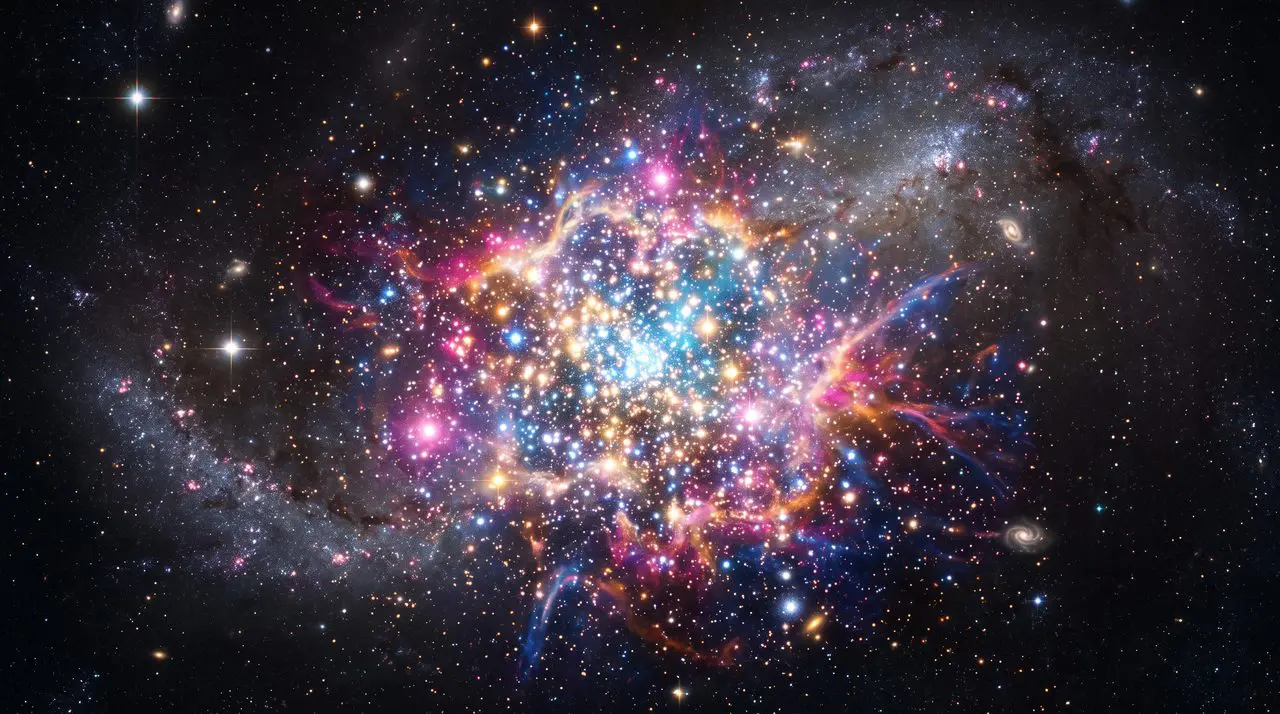
For the first time, researchers have identified a globular cluster stellar stream outside the Milky Way, locating it within an ultra-diffuse galaxy. The discovery, published in Nature, offers a new approach to studying dark matter, which constitutes 80-85 percent of the universe’s mass but remains largely mysterious.
“We have discovered a globular cluster stellar stream in another galaxy,” says PhD student Julie Kiel Holm of the Niels Bohr Institute, highlighting the excitement surrounding this previously unseen phenomenon. This finding demonstrates a new tool for mapping dark matter in distant galaxies and opens possibilities for future research into ultra-diffuse galaxies.
Globular Cluster Stellar Streams Detect Dark Matter in UGC9050-Dw1
The faint trail of stars stretching across the ultra-diffuse galaxy UGC9050-Dw1 represents a first: a globular cluster stellar stream detected beyond the Milky Way. This observation, detailed in Nature, provides a new method for probing the distribution of dark matter in distant galaxies, a feat previously limited to our own. “We show that a well-established tool from studies of the Milky Way can be used to understand other galaxies, where measuring the distribution of dark matter has traditionally been very challenging,” explains Holm.
The team’s analysis of UGC9050-Dw1 confirms the presence of substantial dark matter within the galaxy, aligning with expectations for this class of faint, diffuse systems. This consistency validates the new methodology, demonstrating its potential for broader application.
The discovery’s implications extend beyond a single galaxy; it opens avenues for mapping dark matter across diverse galactic types. “The insights into dark matter that we have previously been able to gain from globular cluster stellar streams have been limited to our own galaxy,” Holm states.
“Being able to observe these streams in entirely different kinds of galaxies opens the door to using them to build a much broader understanding of how dark matter behaves.” Associate Professor Sarah Pearson, formerly of the Niels Bohr Institute, adds that this finding “opens entirely new possibilities,” suggesting future measurements of dark matter content in numerous ultra-diffuse galaxies.
The team anticipates a surge in observable streams with the advent of new facilities like the Euclid Space Telescope and the Nancy Grace Roman Space Telescope, promising a more comprehensive understanding of this fundamental component of the universe.
Our results are consistent with previous studies and what they have shown about dark matter in this ultra-diffuse galaxy. We are measuring it with a completely new tool, demonstrating that this method also works beyond our own galaxy.
Julie Kiel Holm, PhD student at the Niels Bohr Institute
Tidal Stripping Reveals First Extragalactic Stellar Stream
The ultra-diffuse galaxy UGC9050-Dw1 now hosts the first confirmed stellar stream originating from a globular cluster outside the Milky Way, a discovery reshaping how astronomers approach dark matter studies. Previously, globular cluster stellar streams served as dark matter mapping tools exclusively within our own galaxy, limiting the scope of these investigations. The detection within an ultra-diffuse galaxy is particularly noteworthy given these galaxies’ inherent faintness, making the stellar stream’s identification a significant technical achievement; these galaxies emit very little light, compounding the difficulty of spotting the already subtle signal of a stellar stream.
“This is the first time such a stream has been observed outside our own galaxy, the Milky Way, which makes the discovery particularly exciting,” says Julie Kiel Holm. The process responsible for creating these streams, tidal stripping, occurs when a galaxy’s gravity pulls stars away from a globular cluster, forming a long, narrow trail. This finding establishes a new technique for estimating the mass distribution within galaxies, a crucial step in understanding the nature of dark matter, which comprises 80-85 percent of the universe’s total matter.
“Our results are consistent with previous studies and what they have shown about dark matter in this ultra-diffuse galaxy. We are measuring it with a completely new tool, demonstrating that this method also works beyond our own galaxy,” Holm adds.
We have discovered a globular cluster stellar stream in another galaxy. This is the first time such a stream has been observed outside our own galaxy, the Milky Way, which makes the discovery particularly exciting.
Julie Kiel Holm. Globular
See today’s quantum computing news on Quantum Zeitgeist for the latest breakthroughs in qubits, hardware, algorithms, and industry deals.