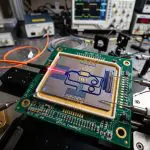
A $25 million investment from Massachusetts will be combined with $25 million in federal funds and additional MIT donations to construct a new Quantum Systems Laboratory, signaling a multifaceted approach to bolstering the state’s position in a rapidly evolving technological field. The facility, expected to create approximately 220 permanent jobs, will be open to researchers beyond MIT, fostering collaboration with other academic institutions and the private sector; this follows Google’s acquisition of local quantum startup Atlantic Computing last year, demonstrating growing commercial interest in the Massachusetts quantum computing scene. “This is an opportunity to really put a stake in the ground and become the global hub for quantum research, and all that comes from that,” Governor Maura Healey said Thursday after announcing the investment. MIT president Sally Kornbluth added that Greater Boston has the greatest concentration of quantum talent anywhere in the world.
Massachusetts Invests $25 Million in MIT Quantum Systems Laboratory
This substantial funding arrives as the Boston area solidifies its position as a central hub for quantum research, attracting major players like Nvidia, which established a research center locally last year, and witnessing the acquisition of local startup Atlantic Computing by Google last year. Governor Maura Healey announced the investment during an MIT board meeting, framing it as a strategic move to establish Massachusetts as a dominant force in the burgeoning field. The new laboratory will house prototype quantum computers alongside essential supporting hardware, including specialized sensors, and is projected to generate approximately 220 permanent jobs upon completion, anticipated by the end of the year. Access to the facility will extend beyond MIT researchers, opening its resources to collaborators from other academic institutions and private sector companies, fostering a broader ecosystem of innovation.
While Massachusetts is making significant investments, the scale of its quantum initiative currently pales in comparison to Illinois, which is funding a $500 million quantum computing center alongside a $140 million grant from the Defense Advanced Research Projects Agency. MIT president Sally Kornbluth emphasized the region’s existing strength in quantum expertise, stating, “It has been clear to us for some time that if we could magnify all of that talent with the right facilities and shared quantum toolbox, we could establish Massachusetts as a national hub for quantum innovation.” Despite ongoing challenges with error rates in quantum computations, progress from companies like Google and IBM suggests that practical applications in fields like chemistry, physics, and materials science are increasingly within reach, and the new laboratory aims to accelerate that progress.
This is an opportunity, quantum, to really put a stake in the ground and become the global hub for quantum research, and all that comes from that.
See today’s quantum computing news on Quantum Zeitgeist for the latest breakthroughs in qubits, hardware, algorithms, and industry deals.