D-Wave Quantum Inc. is targeting a significant leap in quantum computing performance with a new roadmap focused on achieving 100 logical qubits capable of successfully performing over 1 million operations. Unlike many in the industry prioritizing qubit quantity, D-Wave is concentrating on building usable, error-corrected qubits through a scalable superconducting dual-rail architecture. This fundamentally different approach embeds error detection directly into each qubit, aiming to identify approximately 90% of errors as they occur, a capability absent in many other gate-model hardware designs. D-Wave has also demonstrated 99.9% two-qubit fidelities, meaning physical errors occur only about once in every 1,000 operations. “The industry has spent years talking about fault tolerance,” said Dr. Alan Baratz, CEO of D-Wave, “We believe D-Wave has a credible path to achieving it,” outlining a progression of milestones designed to deliver commercially useful quantum applications.
D-Wave’s Dual-Rail Architecture for Error Detection
D-Wave is pursuing a different approach to achieving fault tolerance in quantum computing; its dual-rail qubit architecture embeds error detection directly within the qubits themselves. This contrasts with industry efforts primarily focused on increasing the number of physical qubits, as D-Wave aims to identify and mitigate errors at the single-qubit level during computation. The company has also demonstrated 99.9% two-qubit fidelities, meaning physical errors occur only about once in every 1,000 operations. D-Wave’s strategy centers on reducing errors at the hardware level, rather than solely relying on scaling qubit numbers. The company is prioritizing Lambda, a measure of how rapidly errors are reduced with increased error correction, aiming for a value of 10. This represents a significant leap from the current industry average of around 2, promising a tenfold reduction in errors for each increment in error correction capability. Combined with its superconducting technology, which allows for error correction cycles 100 to 1,000 times faster than neutral atom or trapped ion systems, D-Wave believes this dual-rail architecture offers a fast and efficient path toward commercially viable, fault-tolerant quantum computation.
Gate-Model Roadmap Targets 100 Logical Qubits
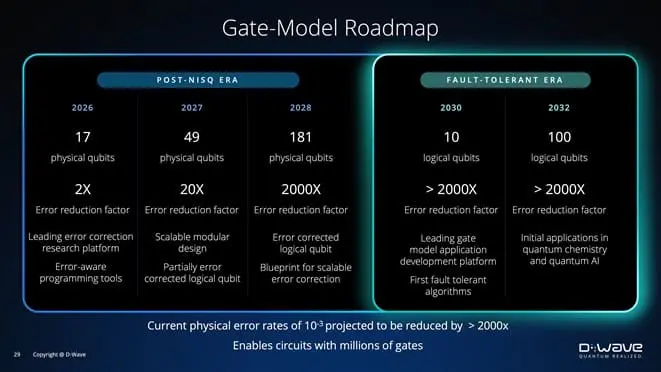
D-Wave Quantum is charting a course toward practical quantum computation, diverging from the industry’s focus on increasing physical qubit counts. The company recently unveiled a gate-model roadmap aiming for 100 logical qubits, error-corrected, usable qubits, capable of executing over 1 million operations. This target signifies a shift toward demonstrating reliable computation, rather than solely pursuing scale. D-Wave’s approach centers on a dual-rail qubit architecture, embedding error detection directly within each qubit to identify issues at the single-qubit level, a feature absent in many competing gate-model designs. This hardware-level error detection is crucial; D-Wave has demonstrated 99.9% two-qubit fidelities, meaning physical errors occur only about once in every 1,000 operations. The roadmap outlines specific milestones, beginning with a 17-physical-qubit system delivering logical error rates twice lower than physical error rates, and culminating in a 100-logical-qubit system supporting initial quantum chemistry and AI applications.
More than 100 organizations across commercial, government and research sectors trust D-Wave to address complex computational challenges using quantum computing.
D-Wave
Milestones for Scalable Error Reduction Factors
This focus represents a departure from strategies centered solely on scaling physical qubit numbers, and instead emphasizes reliable computation for real-world applications. This inherent error detection capability is a key differentiator, as many other gate-model hardware approaches lack the ability to detect qubit errors during computation. D-Wave has demonstrated 99.9% two-qubit fidelities, meaning physical errors occur only about once in every 1,000 operations. Beyond error reduction, D-Wave is targeting a Lambda value of 10, a metric measuring how rapidly errors decrease with added error correction; current industry standards hover around 2. Achieving this leap would allow for significantly faster error reduction, requiring fewer physical qubits to reach fault tolerance.
The industry has spent years talking about fault tolerance. We believe D-Wave has a highly differentiated and credible path to achieving it.
Dr. Alan Baratz, CEO of D-Wave
Lambda Metric and Superconducting System Speed
Beyond increasing qubit numbers, D-Wave is prioritizing a metric called Lambda to gauge progress toward practical, fault-tolerant quantum computation; Lambda measures the rate at which errors diminish as error correction capabilities increase. Currently, the broader quantum computing industry demonstrates Lambda values around 2, meaning each step in error correction halves the error rate, but D-Wave’s roadmap targets a Lambda of 10. This ambitious goal, if achieved, would reduce errors by a factor of ten with each increment of error correction, potentially requiring significantly fewer physical qubits for fault tolerance. The company has also demonstrated 99.9% two-qubit fidelities, meaning physical errors occur only about once in every 1,000 operations. The roadmap outlines specific milestones, including a 181-physical-qubit system designed to deliver a 2,000-fold error reduction factor, serving as a blueprint for scalable, fault-tolerant architectures. Ultimately, D-Wave aims for a 100-logical-qubit system capable of performing over 1 million operations, supporting applications in quantum chemistry and artificial intelligence, and leveraging its existing quantum cloud infrastructure.
Our superconducting dual-rail architecture is a fundamentally different approach to fault-tolerant quantum computing that we expect will position D-Wave not only to compete, but also to redefine how quickly the technology becomes commercial.
Dr. Alan Baratz, CEO of D-Wave



See today’s quantum computing news on Quantum Zeitgeist for the latest breakthroughs in qubits, hardware, algorithms, and industry deals.