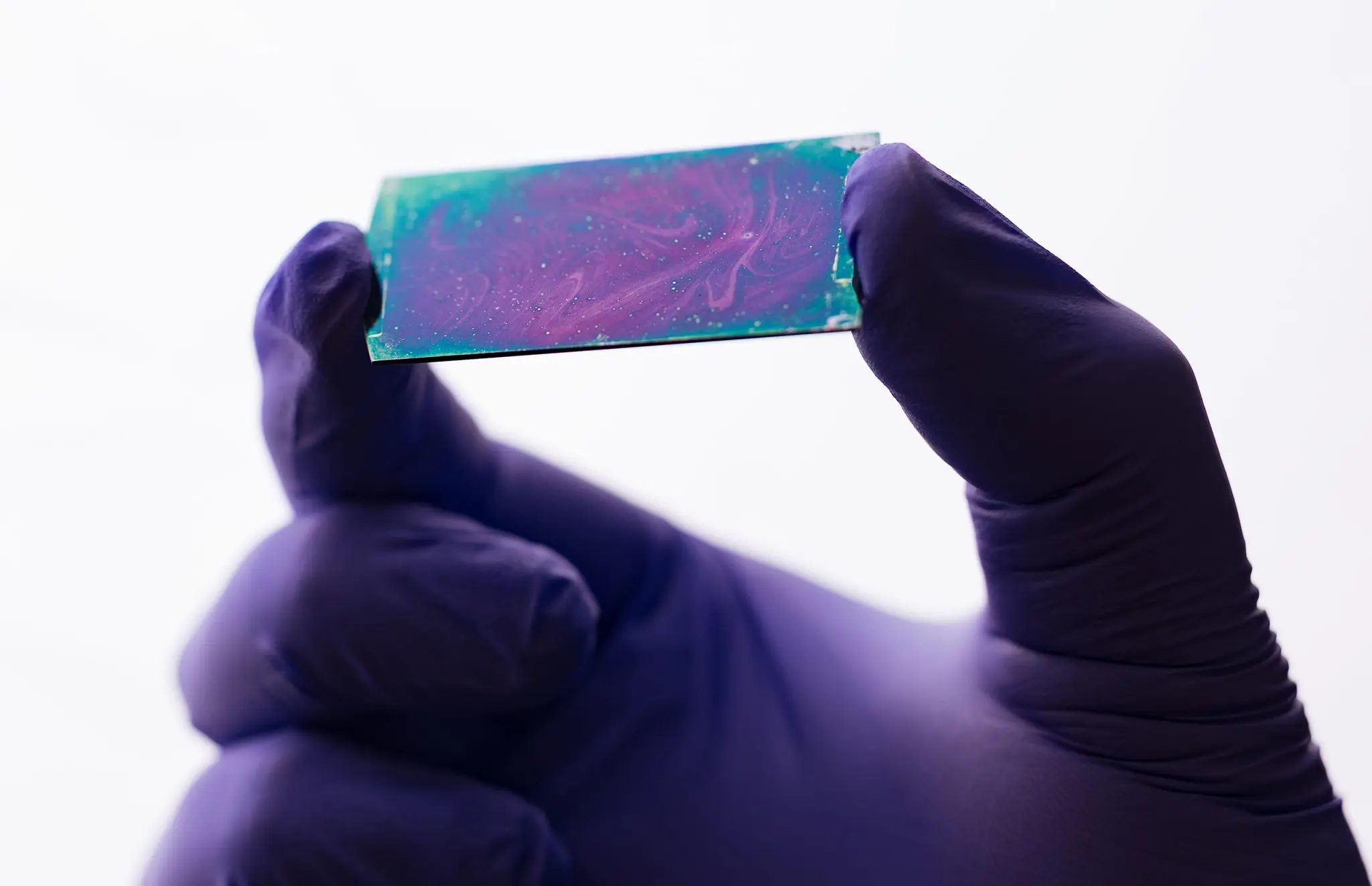
Engineers at the University of Houston, led by Dow Chair and Welch Foundation Professor Alamgir Karim and including former doctoral student Maninderjeet Singh, have developed a novel two-dimensional thin-film dielectric material designed to enhance the speed and reduce the energy consumption of artificial intelligence devices. This breakthrough utilizes low-k materials, covalently bonded sheetlike films composed of lightweight elements like carbon, to replace traditional components in integrated circuit chips. The resulting technology promises to lower power demands and heat production within the rapidly expanding infrastructure of AI data centers, addressing a critical challenge in high-performance computing.
New Thin-Film Material for Faster, Efficient AI
Engineers at the University of Houston have developed a new two-dimensional (2D) thin-film dielectric material designed to improve AI performance and significantly reduce energy consumption. This material acts as an electric insulator, replacing traditional components in integrated circuit chips that generate heat. The breakthrough, detailed in ACS Nano, focuses on “low-k” materials, those that do not store electricity, to combat the exploding energy demands of artificial intelligence and the large cooling systems currently needed to maintain optimal chip performance.
The new material is composed of carbon and other light elements formed into porous, crystalline sheets. Researchers discovered these 2D sheets possess an “ultralow dielectric constant” and “ultrahigh electrical breakdown strength,” crucial for high-voltage operation and maintaining thermal stability. This allows for faster signal speeds and reduced delays in AI data processing, enabling chips to run cooler and more efficiently. The development addresses the substantial energy costs associated with the growing AI data center infrastructure.
This low-k material was created using a method called synthetic interfacial polymerization, a technique pioneered by 2025 Chemistry Nobel Prize winners, where molecules stitch together to form strong, layered crystalline sheets. The research team, led by Alamgir Karim, focused on lightweight covalent organic frameworks to create these base insulators that support high-speed electrical signals with low power consumption and reduced interference, ultimately boosting the performance of AI and conventional electronics.
Development of Low-k Dielectric Materials
University of Houston engineers have developed a new two-dimensional (2D) thin film dielectric material designed to reduce power consumption and increase speed in AI devices. This “low-k” material replaces traditional components in integrated circuit chips, minimizing heat generation. The team focused on materials made from light elements like carbon – lightweight covalent organic frameworks – to accelerate signals and decrease delays, addressing the growing energy demands of artificial intelligence and large data centers.
These low-k materials function as base insulators, supporting electrical signals with low power consumption and minimal interference. Researchers discovered the 2D sheets possess an ultralow dielectric constant and ultrahigh electrical breakdown strength, crucial for high-voltage operation and thermal stability, even at elevated temperatures. This development holds tremendous potential for greatly lowering power consumption within the rapidly expanding AI data center landscape.
The material was created using a method called synthetic interfacial polymerization, a technique discovered by the 2025 Chemistry Nobel Prize winners. This process involves dissolving molecules into immiscible liquids, stitching together molecular building blocks to form strong, crystalline layered sheets. Funding for the research was provided by the American Chemical Society’s Petroleum Research Foundation New Direction program.
UH Research Advancements in Science and Engineering
University of Houston engineers have developed a new two-dimensional (2D) thin film dielectric material designed to significantly reduce power consumption and increase the speed of artificial intelligence (AI) devices. This “low-k” material, created from lightweight elements like carbon, minimizes heat generation within integrated circuit chips, a major problem for energy-intensive AI data centers. Researchers focused on low-k materials to speed signals, reduce delays, and enable chips to run cooler and faster, addressing the growing energy demands of AI.
The breakthrough utilizes a method of synthetic interfacial polymerization, building on Nobel Prize-winning organic framework materials discovered by Omar M. Yaghi and colleagues. This process creates strong, crystalline layered sheets with highly porous structures. Testing revealed the material possesses an ultralow dielectric constant and ultrahigh electrical breakdown strength – crucial for high-voltage operation and thermal stability at elevated temperatures, potentially greatly lowering power consumption in booming AI data centers.
Funded by the American Chemical Society’s Petroleum Research Foundation, the research team, led by Alamgir Karim, successfully created a material with properties ideal for next-generation low-k applications. The team demonstrated the material’s ability to support high-speed electrical signals with low power consumption and minimal interference, contributing to both efficiency and performance in AI and conventional electronics.
Low-k materials are base insulators that support integrated circuit conductors carrying high speed and high frequency electrical signals with low power consumption (i.e. high-efficiency because chips can run cooler and faster!) and also low interference (signal cross talk).
Alamgir Karim
Source: https://www.uh.edu/news-events/stories/2025/december/12022025-karim-tech-thin-film-ai-faster.php


See today’s quantum computing news on Quantum Zeitgeist for the latest breakthroughs in qubits, hardware, algorithms, and industry deals.