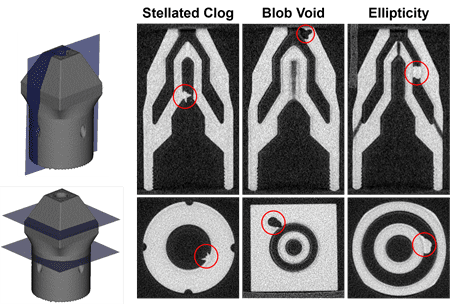
Researchers at the University of Illinois Urbana-Champaign, led by Professor William King, have developed a new method using deep machine learning to detect defects in 3D printed components. The technology uses computer simulations to train the model on a variety of potential defects, enabling it to distinguish between defective and non-defective components. The algorithm was successful in identifying hundreds of defects in real physical parts. The research, which also involved scientists from the University of Maryland, University of Michigan, and Zhejiang University, was published in the Journal of Intelligent Manufacturing.
The Challenge of Detecting Defects in Additively Manufactured Components
Additive manufacturing, commonly known as 3D printing, has revolutionized the production of complex components. However, one of the significant challenges in this field is the detection of defects in the manufactured parts. This is particularly difficult due to the intricate three-dimensional shapes and crucial internal features that are not easily observable. The task of determining whether a component is defect-free is crucial in any manufacturing process, but it becomes even more critical in additive manufacturing due to the complexity of the parts produced.
A Novel Approach: Deep Machine Learning for Defect Detection
Researchers at the University of Illinois Urbana-Champaign have developed a novel technology that employs deep machine learning to simplify the process of identifying defects in additively manufactured components. The researchers used computer simulations to generate tens of thousands of synthetic defects, each varying in size, shape, and location. This allowed the deep learning model to train on a wide variety of potential defects and distinguish between defective and non-defective components. The algorithm was then tested on physical parts, some of which were defective and some of which were not. Remarkably, the algorithm was able to correctly identify hundreds of defects in real physical parts that had not previously been seen by the deep learning model.
The Role of Computer Simulations in Building the Machine Learning Model
The use of computer simulations was instrumental in building the machine learning model. According to William King, Professor of Mechanical Science and Engineering at Illinois and the project leader, this technology addresses one of the toughest challenges in additive manufacturing. “Using computer simulations, we can very quickly build a machine learning model that identifies defects with high accuracy. Deep learning allows us to accurately detect defects that were never previously seen by the computer,” he said.
The Use of X-ray Computed Tomography in Inspecting 3D Components
The research, published in the Journal of Intelligent Manufacturing, used X-ray computed tomography to inspect the interior of 3D components having internal features and defects that are hidden from view. Three-dimensional components can be easily made with additive manufacturing, but inspecting them becomes difficult when important features are hidden from view. X-ray computed tomography provides a solution to this problem by allowing for the inspection of the interior of these components.
The Collaborative Effort Behind the Research
The research was a collaborative effort involving several researchers from different universities. The authors of the study include Miles Bimrose, Sameh Tawfick, and William King from the University of Illinois Urbana-Champaign; Davis McGregor from the University of Maryland; Chenhui Shao from the University of Michigan; and Tianxiang Hu, Jiongxin Wang, and Zuozhu Liu from Zhejiang University. This collaborative effort underscores the importance of interdisciplinary research in addressing complex challenges in the field of additive manufacturing.
External Link: Click Here For More




See today’s quantum computing news on Quantum Zeitgeist for the latest breakthroughs in qubits, hardware, algorithms, and industry deals.