

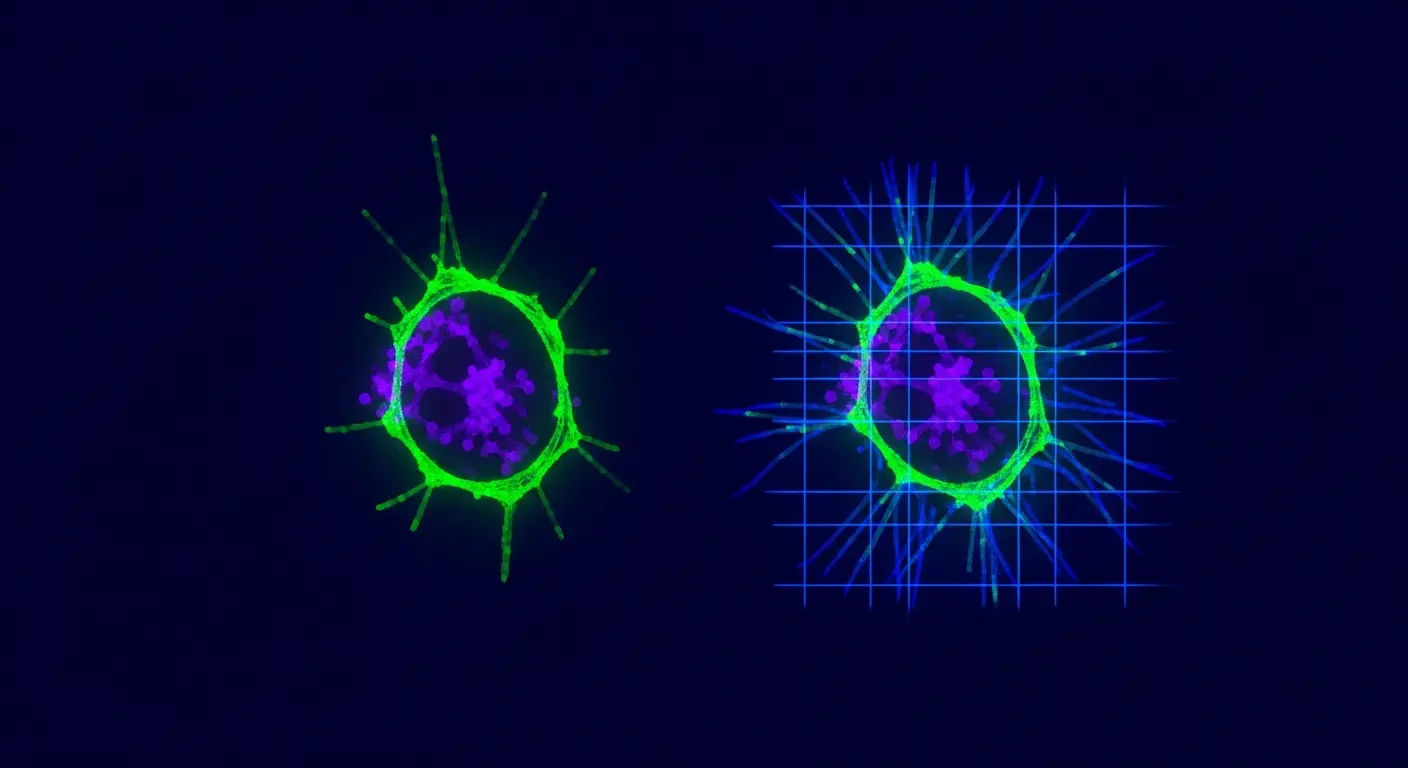
Torsion in materials controls light and amplifies signals at the nanoscale. Carlos Magno O. Pereira and Edilberto O. Silva, at the Federal University of Maranhão, show that introducing torsion into a mesoscopic system with a screw dislocation effectively confines electrons without needing external potential barriers. Their analytical solutions reveal that the combination of torsion, magnetic fields, and topological defects alters the electronic structure, resulting in asymmetric optical spectra and the potential for optical gain through negative absorption. This provides a new pathway for tuning light-matter interactions and could be key for developing nanophotonic devices operating in the mid-infrared and terahertz ranges.
Torsional confinement enhances optical gain via symmetry-broken electron distributions
A 0.3 increase in interlevel spacing has been achieved through geometry-controlled optical gain via negative absorption, compared to systems without torsional confinement. Conventional methods required precisely shaped potential wells to trap electrons, but this enhancement allows bound states to emerge without external potential barriers. The unification of torsion, magnetic fields, and topological defects creates effective in-plane confinement, compressing the radial electronic distribution and breaking symmetry between angular-momentum channels.
This asymmetric optical spectra enable selective amplification of light frequencies in mesoscopic nanophotonic platforms operating within the mid-infrared and terahertz ranges, offering a novel pathway for tuning light-matter interactions. Manipulating the geometry of materials can control how electrons absorb light, achieving a 0.3 increase in interlevel spacing, the energy difference between electron states, compared to unconfined systems. Combining torsion, created by twisting the material, with magnetic fields and topological defects like screw dislocations collectively confines electrons without traditional barriers. Analytical solutions reveal this confinement compresses the electron’s distribution and breaks symmetry between angular momentum channels, leading to asymmetric optical spectra and enabling selective amplification of light at mid-infrared and terahertz frequencies. Intense light can then overcome typical light absorption, creating a negative-absorption regime and potential for optical gain, although sustaining this gain requires overcoming material imperfections and achieving consistently high torsional densities for practical device fabrication.
Torsion and screw dislocations induce geometric confinement of electrons in nanophotonic crystals
Torsion, akin to twisting a material like wringing out a wet cloth but on a microscopic scale, forms the core of a technique for manipulating electrons within nanophotonic structures. This technique combines this twisting force with a magnetic field and a screw dislocation, a type of defect in a crystal structure, similar to a missing brick in a wall, to create effective confinement for electrons without needing traditional external potential barriers. The interaction between these forces alters the electrons’ movement, specifically coupling their longitudinal motion to the geometric background created by the torsion and defect.
Employing torsion, a twisting force, alongside a magnetic field and a screw dislocation, a crystal defect, allowed researchers to investigate electron behaviour within twisted nanophotonic structures. This combination creates electron confinement without traditional barriers, coupling electron motion to the structure’s geometry. The analysis focused on optical responses, including absorption and refractive index changes, within these mesoscopic systems operating in the mid-infrared and terahertz ranges. Variations in resonance energies and peak amplitudes serve as key indicators of torsional confinement and topological effects, offering a pathway to control and amplify light in nanoscale devices.
Harnessing material torsion for negative absorption in nanoscale devices
Fabricating consistently twisted structures presents a significant hurdle, despite the promise of nanoscale light manipulation for advances in mid-infrared and terahertz technologies. This work elegantly sidesteps the need for precise material shaping, instead relying on inherent properties like torsion and defects to control electron behaviour; however, the analytical solutions presented assume ideal helical forms. The paper acknowledges that real-world imperfections, variations in torsional density, or even subtle changes to the screw dislocation could disrupt the delicate balance needed for negative absorption.
Demonstrating the potential for negative absorption, where a material amplifies light rather than absorbing it, opens new avenues for designing more efficient mid-infrared and terahertz devices, even with inevitable imperfections within these twisted nanostructures. These wavelengths are vital for applications like medical imaging and security screening, and therefore, even approximate helical forms offer a pathway towards controlling light at a scale previously unattainable. A method for controlling electrons using geometry has been established, specifically through the combined application of torsion, a twisting force, magnetic fields, and screw dislocations, which are defects within a material’s structure. Unifying these elements demonstrates the creation of confined spaces for electrons without relying on traditional, externally applied potential barriers, allowing for manipulation of their behaviour at the nanoscale. The resulting asymmetry in electron movement enables selective amplification of light frequencies within mesoscopic nanophotonic platforms operating in the mid-infrared and terahertz ranges, opening possibilities for novel device designs.
The research demonstrated that a combination of torsion, magnetic fields, and screw dislocations can confine electrons within a mesoscopic medium without external potential barriers. This geometric control of electrons allows for the selective amplification of light frequencies in the mid-infrared and terahertz ranges. The findings suggest that inherent material properties, such as torsion and defects, can be used to tune electron behaviour and achieve negative absorption. The authors note that this approach may offer a pathway to designing nanoscale devices, even with imperfections in the material’s helical structure.
👉 More information
🗞 Torsion-induced confinement and tunable nonlinear optical gain in a mesoscopic electron system
🧠 ArXiv: https://arxiv.org/abs/2604.12664



See today’s quantum computing news on Quantum Zeitgeist for the latest breakthroughs in qubits, hardware, algorithms, and industry deals.



