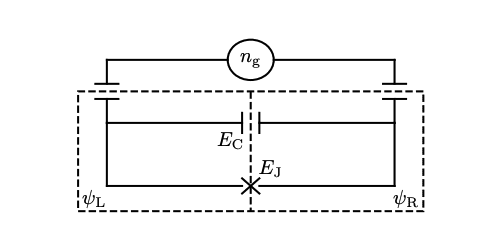
In a study titled Quantum theory of the Josephson junction between finite islands, published on April 18, 2025, researchers Thomas J. Maldonado, Alejandro W. Rodriguez, and Hakan E. Türeci from Princeton present a novel quantized Hamiltonian for superconducting circuits with Josephson junctions connecting finite-sized islands.
Research on superconducting circuits with Josephson junctions has focused on scalable quantum systems. Traditional models assume infinite-sized islands, but this study derives a quantized Hamiltonian for finite islands. Predictions include measurable corrections in qubit frequency and charge susceptibility, offering ways to test the theory.
In a significant leap forward for quantum computing, researchers have unveiled a novel method utilizing superconducting circuits that tackles two pivotal challenges: decoherence and scalability. This advancement holds the potential to revolutionize the field by enabling more reliable and powerful quantum computers.
Decoherence, a phenomenon where qubits lose their quantum state due to environmental interference, has been a major hurdle in quantum computing. The new method employs an enhanced design of transmon qubits within superconducting circuits, renowned for their extended coherence times. By effectively reducing charge noise and electromagnetic interference, the researchers have significantly improved qubit stability, enabling them to maintain quantum states longer and execute more precise operations.
Central to this breakthrough is the application of negative electrohydrostatic pressure, a technique that isolates qubits from external disturbances. While the exact mechanism remains under investigation, it is believed to involve meticulous control over the qubit environment, thereby minimizing noise and interference and enhancing performance.
The research demonstrates marked improvements in coherence times and higher-fidelity operations, which are essential for complex computations and robust error correction. This progress brings quantum computing closer to achieving fault-tolerant systems capable of reliable operation despite component failures or errors.
The method also addresses the challenge of scalability, crucial for manufacturing large-scale qubit arrays. Although specific manufacturing details are not provided, the design suggests potential for mass production and seamless integration into existing architectures. This could accelerate the development of practical applications, particularly in optimization problems and quantum simulations.
Within the realm of superconducting qubits, which competes with other methods such as trapped ions or photonic qubits, this innovation stands out. It may pave the way for hybrid systems that combine different qubit types to achieve superior performance.
The breakthrough is poised to be integrated into existing quantum computers within a few years, potentially reducing the resources required for quantum error correction and enhancing efficiency. Substantial investment in quantum computing could stimulate further research and commercialization efforts.
In conclusion, this innovation significantly enhances qubit stability and scalability, marking a crucial step toward practical quantum technologies with transformative potential across various fields.
👉 More information
🗞 Quantum theory of the Josephson junction between finite islands
🧠 DOI: https://doi.org/10.48550/arXiv.2504.13779