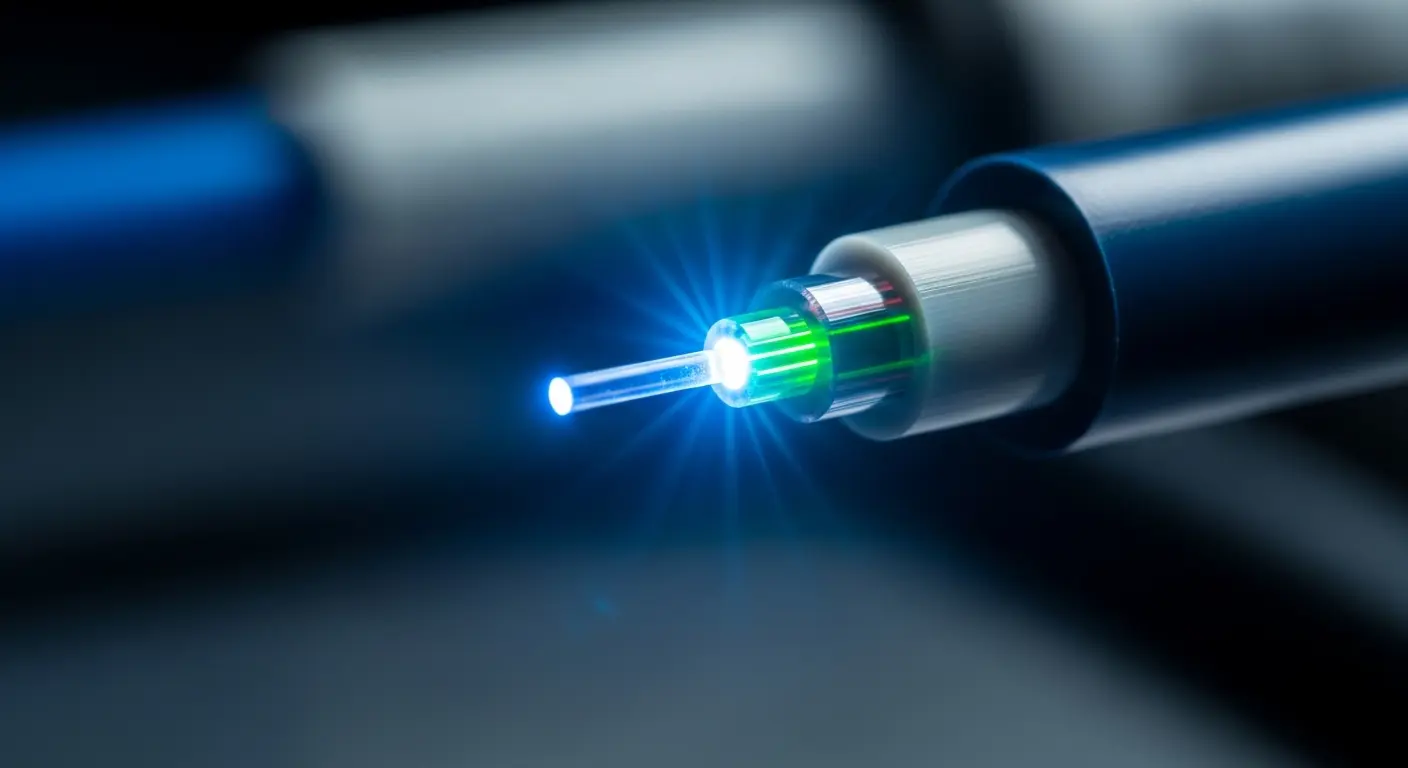
Researchers have, for the first time, created a photon Bose-Einstein condensate, a state where light behaves as matter, using a semiconductor, achieving continuous-wave operation and a high flux of photons. This unusual feat challenges the conventional association of Bose-Einstein condensates with extremely cold matter and opens a pathway toward more practical light-based devices. The team, led by Ross C. Schofield of Imperial College London, identified a regime where coherent, single-mode light emission occurs while simultaneously exhibiting significant photon bunching, a counterintuitive combination. Exploiting this photon bunching, they demonstrated optical range sensing using the condensate, with Schofield noting they are characterizing “the precision of the range measurement and analyzing the dependence on the condensate’s pump power and resulting coherence properties.”
Semiconductor Microcavity Enables Photon Bose-Einstein Condensate
A semiconductor microcavity has yielded a photon Bose-Einstein condensate capable of continuous-wave operation, a feat previously confined to extremely cold matter and presenting a pathway toward practical applications of this quantum state of light. Researchers, led by Ross C. Schofield at Imperial College London and collaborators at the University of Sheffield, have demonstrated this condensate is not merely a physics curiosity; it’s a functioning light source with tangible benefits. Unlike typical Bose-Einstein condensates requiring near-absolute zero temperatures, this system operates at room temperature within a semiconductor structure, significantly broadening its potential for integration into real-world devices. The team identified a surprising regime where the condensate exhibits both coherent, single-mode emission and significant photon bunching, a combination that defies conventional expectations. Coherence generally implies well-separated photons, yet this condensate maintains both properties simultaneously.
This unusual characteristic proved crucial for a demonstration of optical range sensing; the researchers leveraged the photon bunching, rather than attempting to eliminate it, to enhance precision. The resulting system offers a novel approach to distance measurement, potentially improving upon existing technologies like lidar. This work suggests a fundamentally different way to approach optical metrology. “Taking advantage of the photon bunching, along with the continuous-wave operation and high photon flux, we demonstrate optical range sensing using a photon Bose-Einstein condensate,” Schofield stated, highlighting the condensate’s unique capabilities. The research, published in Physics Applied 25, L051002, opens possibilities for compact, efficient, and potentially more accurate sensing technologies.
Range Sensing Demonstrated via Photon Bunching & Coherence
Beyond traditional laser rangefinders, a new approach to distance measurement is emerging, leveraging the unusual properties of light itself. This achievement marks a departure from conventional rangefinding techniques reliant on precisely timed single photons or complex wave patterns. The team’s innovation lies in creating a continuous-wave condensate, a significant hurdle in the field, and exploiting a surprising characteristic: substantial photon bunching occurring alongside coherent, single-mode emission. Schofield, the contact author on the published work in Physics Applied 25, L051002, explained that typically coherence implies well-separated photons, but this condensate exhibits both properties simultaneously, which is key to their method. Rather than attempting to minimize photon bunching, the researchers harnessed it to enhance the precision of their range sensing system. The demonstrated system utilizes the condensate’s unique properties to determine distances, offering a potential pathway toward compact and efficient devices.
While established methods like LiDAR, detailed in a 2015 Nature Photonics article by Schwarz 4, 429, offer high resolution, this new technique presents a fundamentally different approach. The research, published on May 6, 2026, opens possibilities for alternative sensing technologies, and the team has made data available via Zenodo, titling the dataset “Range finding with a photon BEC.”



See today’s quantum computing news on Quantum Zeitgeist for the latest breakthroughs in qubits, hardware, algorithms, and industry deals.