

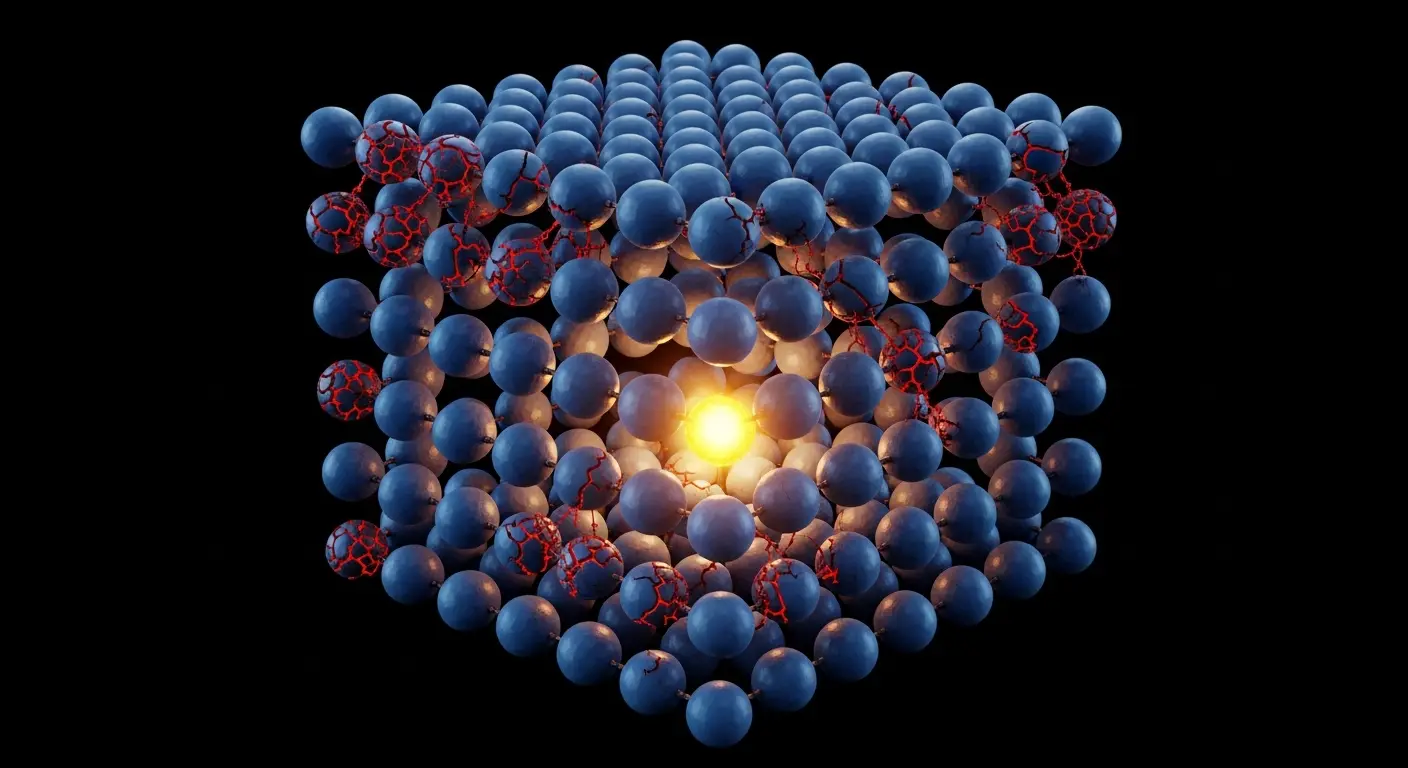
Joshua Courtney and collaborators have developed a new oracle-free quantum algorithm to address the computationally challenging problem of nonadiabatic quantum molecular dynamics. The method applies diabatic Hamiltonian operators directly to the computational basis and is validated through dynamic observables including absorption and recurrence spectra. It offers a circuit depth advantage over existing quantum random-access memory (QROM)-loading architectures and confirms a scalable T-gate advantage when compared to quantum signal processing. This potentially broadens the application of multi-channel dynamics beyond traditional chemistry.
Quantum algorithm achieves scalable advantage for modelling molecular dynamics
A scalable T-gate advantage over quantum signal processing variants confirms the algorithm’s efficiency for simulating complex molecular behaviour. This advantage is particularly significant because T-gates are considered a fundamental building block in many quantum algorithms, and reducing their number directly translates to reduced computational cost and error rates. The ability to achieve a scalable advantage, meaning the benefit increases as the system size grows, represents a key threshold, enabling the modelling of larger, more intricate systems previously beyond the reach of quantum simulation techniques. The algorithm’s ability to use diabatic Hamiltonian operators, simplifying calculations by treating internal energy states as separate pathways, enables this improved performance. Traditional approaches often struggle with the coupling between these states, leading to exponential scaling of computational requirements. By directly applying these operators within a first-quantized split-operator framework, the algorithm circumvents this issue.
Finite basis and discrete variable representations exhibit duality, expanding the applicability of multichannel dynamics beyond chemistry into diverse scientific fields. This structural congruence allows for more flexible quantum circuit design, facilitating adaptation to different physical systems and modelling scenarios. Validation using dynamic observables, including absorption and recurrence spectra, confirms the algorithm’s accuracy in modelling molecular behaviour. Specifically, the absorption spectra accurately reflect the frequencies at which the molecule absorbs photons, while recurrence spectra reveal the periodic return of wave packets to their initial state. Scattering cross-sections and population dynamics also exhibited expected results, further strengthening confidence in the simulation’s fidelity. Successful reproduction of quantum scars, distinctive patterns in energy levels arising from classical instabilities in the corresponding system, demonstrates the algorithm’s ability to capture subtle quantum phenomena and provides a stringent test of its accuracy. These scars are a hallmark of quantum chaos and their accurate modelling requires a high degree of precision in the simulation.
Resource estimation revealed a circuit depth advantage over quantum random-access memory loading architectures on a fault-tolerant scale, indicating potential for efficient implementation. Circuit depth, a measure of the number of sequential operations required, is a critical factor in determining the feasibility of quantum algorithms, as longer circuits are more susceptible to errors. The advantage over QROM-loading, a common technique for encoding classical data into quantum states, suggests that this new algorithm could be more practical for near-term quantum devices. Current results focus on simplified molecular systems and do not yet demonstrate the algorithm’s performance with the 1000 atoms present in realistic, biologically relevant molecules. Further work will focus on scaling the algorithm to tackle these more complex scenarios and exploring its limitations, including the impact of system size and the choice of basis set on computational cost and accuracy.
Modelling molecular dynamics with larger energy gaps benefits from a novel quantum approach
Dr. Alán Aspuru-Guzik of the University of Toronto and Dr. Frank Noé of the Max Planck Institute for Polymer Research have devised a new quantum algorithm to model how molecules change during chemical reactions, sidestepping limitations of previous techniques. Nonadiabatic molecular dynamics, where molecules transition between electronic states during a reaction, is notoriously difficult to simulate accurately due to the complex interplay of quantum and classical effects. This advance promises to unlock more accurate simulations of complex molecular behaviour, important for designing new materials and understanding biological processes, such as enzyme catalysis and photosynthesis. The findings highlight a fundamental tension between the efficiency of this approach and quantum signal processing, though the latter remains competitive when the energy gap between molecular states is small. When the energy difference between electronic states is significant, quantum signal processing requires substantially more computational resources.
The new algorithm establishes an oracle-free approach to simulating nonadiabatic quantum molecular dynamics, a complex process where molecules transition between energy states. Oracle-free algorithms are particularly desirable as they do not rely on the existence of a quantum oracle, a hypothetical device that can solve certain problems instantaneously, which is often a limiting factor in quantum algorithm design. A split-operator framework and a simplified method of describing molecular energy bypass limitations of previous computational methods reliant on initial conditions. This technique allows for the efficient propagation of the quantum state by breaking down the Hamiltonian into simpler terms that can be applied sequentially. This offers a flexible tool for diverse scientific applications, extending the potential of multichannel dynamics beyond chemistry. For example, the algorithm could be adapted to study the dynamics of electrons in solid-state materials or the behaviour of quantum fluids.
The diabatic Hamiltonian operators employed in this algorithm represent a crucial innovation. In the Born-Oppenheimer approximation, molecular dynamics are often treated by assuming separation of electronic and nuclear motion. However, when these motions are strongly coupled, as in nonadiabatic processes, this approximation breaks down. Diabatic operators provide a way to represent the electronic states in a manner that explicitly accounts for these couplings, allowing for a more accurate description of the molecular dynamics. The algorithm’s performance is validated by comparing its predictions to established theoretical results and experimental data for simple molecular systems. The researchers are currently working on extending the algorithm to handle larger and more complex molecules, with the ultimate goal of simulating realistic chemical reactions and biological processes. The initial implementation focused on systems with up to 5 atoms, and future work will aim to scale this to hundreds or even thousands of atoms.
Modelling molecular dynamics with larger energy gaps benefits from a novel quantum approach. Nonadiabatic molecular dynamics, where molecules transition between electronic states during a reaction, is notoriously difficult to simulate accurately due to the complex interplay of quantum and classical effects. This advance promises to unlock more accurate simulations of complex molecular behaviour, important for designing new materials and understanding biological processes, such as enzyme catalysis and photosynthesis. The findings highlight a fundamental tension between the efficiency of this approach and quantum signal processing, though the latter remains competitive when the energy gap between molecular states is small. When the energy difference between electronic states is significant, quantum signal processing requires substantially more computational resources.
The new algorithm establishes an oracle-free approach to simulating nonadiabatic quantum molecular dynamics, a complex process where molecules transition between energy states. Oracle-free algorithms are particularly desirable as they do not rely on the existence of a quantum oracle, a hypothetical device that can solve certain problems instantaneously, which is often a limiting factor in quantum algorithm design. A split-operator framework and a simplified method of describing molecular energy bypass limitations of previous computational methods reliant on initial conditions. This technique allows for the efficient propagation of the quantum state by breaking down the Hamiltonian into simpler terms that can be applied sequentially. This offers a flexible tool for diverse scientific applications, extending the potential of multichannel dynamics beyond chemistry. For example, the algorithm could be adapted to study the dynamics of electrons in solid-state materials or the behaviour of quantum fluids.
The diabatic Hamiltonian operators employed in this algorithm represent a crucial innovation. In the Born-Oppenheimer approximation, molecular dynamics are often treated by assuming separation of electronic and nuclear motion. However, when these motions are strongly coupled, as in nonadiabatic processes, this approximation breaks down. Diabatic operators provide a way to represent the electronic states in a manner that explicitly accounts for these couplings, allowing for a more accurate description of the molecular dynamics. The algorithm’s performance is validated by comparing its predictions to established theoretical results and experimental data for simple molecular systems. The researchers are currently working on extending the algorithm to handle larger and more complex molecules, with the ultimate goal of simulating realistic chemical reactions and biological processes. The initial implementation focused on systems with up to 5 atoms, and future work will aim to scale this to hundreds or even thousands of atoms.
This research successfully demonstrated a new method for simulating nonadiabatic quantum molecular dynamics using diabatic Hamiltonian operators and split-operator propagators. This approach offers advantages over previous methods by avoiding reliance on quantum oracles and simplifying the description of molecular energy, enabling more efficient computation of complex molecular processes. Validated against established theoretical results for systems containing up to five atoms, the algorithm presents a scalable advantage in circuit depth against certain quantum architectures. The authors are currently extending this work to simulate larger molecules and more complex systems.
👉 More information
🗞 An Oracle-Free Quantum Algorithm for Nonadiabatic Quantum Molecular Dynamics
🧠 ArXiv: https://arxiv.org/abs/2604.19319




See today’s quantum computing news on Quantum Zeitgeist for the latest breakthroughs in qubits, hardware, algorithms, and industry deals.



