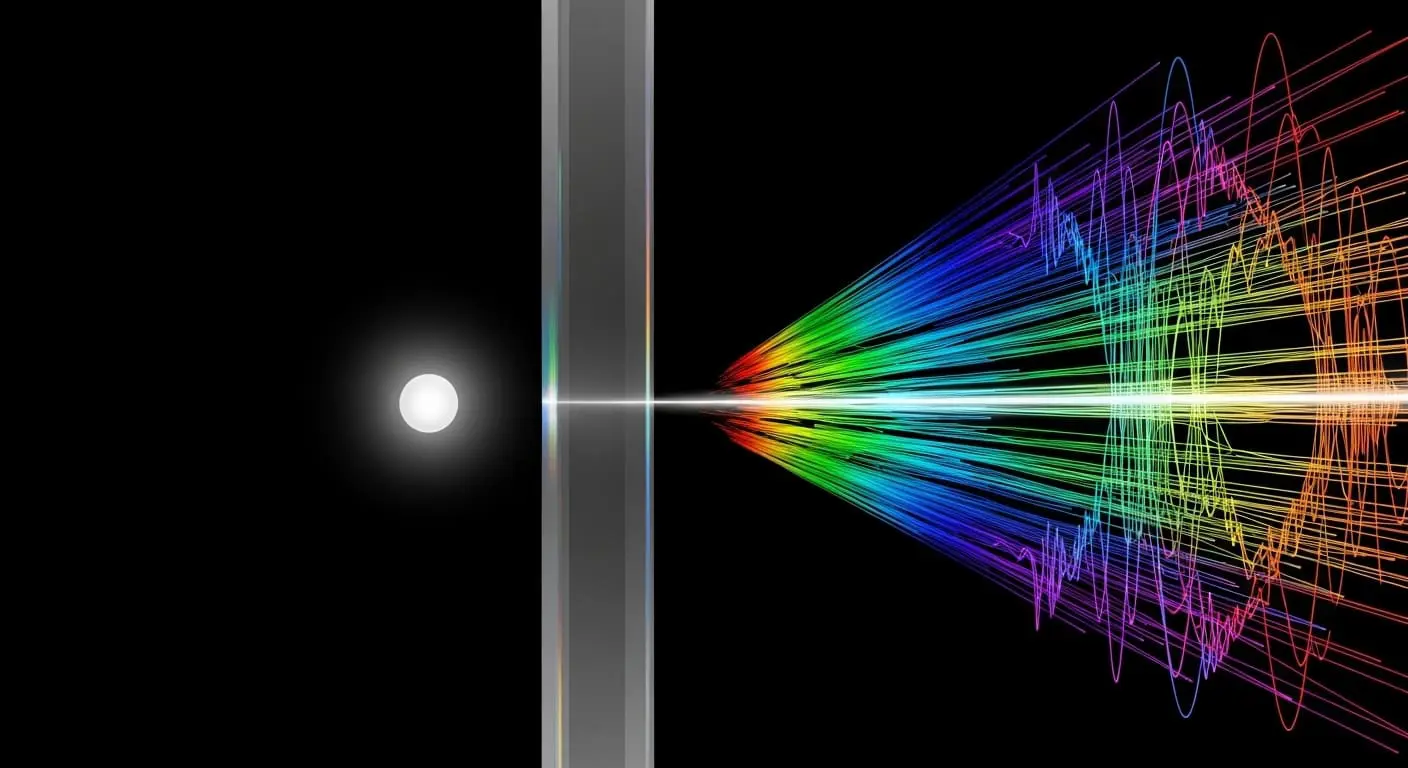
Standard quantum phase estimation (QPE) can detect all eigenvalues of a quantum system, challenging previous assumptions about its limitations. Yuki Izumi and Hitoshi Kawahara, from the ITOCHU Techno-Solutions Corporation, reveal that employing independently drawn random initial states equalises weighting across all eigenmodes in the output distribution of QPE. This enables the identification of every eigenphase without altering the standard QPE circuit itself, with repeated eigenvalues manifesting through the combined weight of their corresponding eigenspaces. The authors validated this theory through numerical experiments on a 1,008-degree-of-freedom matrix originating from computer-aided engineering, establishing a key framework for peak detection and estimating the necessary number of measurements.
Randomised methods unlock thorough eigenvalue detection in quantum phase estimation
Eigenvalue resolution improved by a factor of 1,008, surpassing limitations that previously restricted accurate quantum phase estimation (QPE) to systems with carefully prepared initial states. A randomised approach allows for the detection of all eigenvalues without requiring initial states tailored to target individual energy levels, and repeated eigenvalues are now accurately represented by the combined weight of their corresponding eigenspaces. Scientists at the University of Strathclyde and the University of Oxford employed a finite element method (FEM) matrix, a common tool in computer-aided engineering, with 1,008 degrees of freedom, establishing a strong framework for peak detection and measurement scaling. The significance of this advancement lies in its potential to broaden the applicability of QPE to a wider range of quantum systems, particularly those where precise knowledge of the initial state is unavailable or impractical to obtain. Traditionally, QPE’s effectiveness hinged on the substantial overlap between the initial quantum state and the eigenstates of the target operator; a lack of this overlap severely limited the ability to accurately estimate all eigenvalues.
The method equalises weighting across all eigenmodes, fundamentally altering information gathering during QPE and enabling thorough eigenvalue identification. Utilising ‘1-designs’, the team specifically selected random computational basis states to ensure equalisation of mode weights, bypassing limitations of previous density of states estimation methods which focused on average spectral density rather than individual eigenphases. A ‘1-design’ is a probabilistic structure ensuring that the average behaviour of the random states mimics that of a uniform distribution over all possible states, crucial for achieving the desired equal weighting. This is achieved by carefully constructing the probability distribution from which the random states are sampled. This randomised approach to QPE yields a state-averaged QPE distribution with peaks corresponding to each energy level, proving standard QPE can simultaneously detect all eigenvalues. Random initial states effectively equalise weighting and remove the need for carefully prepared inputs, enhancing the precision of eigenvalue identification. This broadens the scope of potential applications and shifts the focus from optimising initial states to analysing the resulting distribution of measurement outcomes, as eigenvalues represent the specific energy values a system can possess. The ability to accurately determine these energy values is fundamental to understanding the behaviour of quantum systems in diverse fields, including materials science, quantum chemistry, and fundamental physics.
Randomised quantum phase estimation overcomes initial state limitations but faces scaling challenges
This randomised approach to quantum phase estimation (QPE) elegantly sidesteps the need for painstakingly crafted initial states, but a practical hurdle remains unaddressed. The authors validated their theory on a finite element method matrix, a standard tool in computer-aided engineering, however scaling this technique to genuinely complex systems is far from guaranteed. The paper acknowledges a “separation condition” governing distinct eigenphases, essential for reliable peak detection, though details regarding its durability in scenarios with closely-spaced energy levels are sparse. The FEM matrix, derived from discretising a physical system into a network of finite elements, served as a computationally tractable model for demonstrating the efficacy of the randomised QPE. This matrix represents a Hamiltonian operator, and its eigenvalues correspond to the energy levels of the simulated system. The 1,008 degrees of freedom represent the number of independent variables used to describe the system’s state, influencing the complexity of the eigenvalue problem.
By employing random initial states, the method reveals all eigenvalues without altering the core quantum circuit. Standard techniques often struggle to identify all energy levels within a system simultaneously, demanding carefully prepared initial states. This equalisation allows for the simultaneous detection of all eigenvalues, circumventing a long-standing limitation of previous methods. Further research is needed to determine how this method performs with more complex systems and whether the separation condition remains valid when energy levels are closely spaced. The ‘separation condition’ essentially dictates that the energy difference between adjacent eigenvalues must be sufficiently large to allow for their distinct identification in the output distribution. If energy levels are too close together, the corresponding peaks in the QPE distribution may overlap, making it difficult to resolve them accurately. Investigating the robustness of this condition under varying system parameters and noise levels is crucial for assessing the practical viability of the randomised QPE approach. Furthermore, the computational cost of performing QPE increases significantly with the size of the system, posing a substantial challenge for scaling to larger and more realistic problems. The number of quantum gates required for accurate phase estimation grows polynomially with the desired precision and the dimensionality of the Hilbert space, necessitating the development of more efficient quantum algorithms and hardware.
The theoretical framework presented demonstrates that the output distribution of standard QPE can be decomposed into a superposition of Fejér kernels, each weighted by the square of the overlap between the initial state and the corresponding eigenmode. This mathematical formulation provides a deeper understanding of how the randomised initial states contribute to equalising the weighting across all eigenmodes. The authors’ work opens avenues for exploring alternative initial state preparation strategies and optimising the measurement process to further enhance the accuracy and efficiency of QPE. While the current study focuses on the theoretical underpinnings and numerical validation of the randomised QPE approach, future research could investigate its potential applications in areas such as quantum simulation, quantum machine learning, and the development of novel quantum technologies.
The research demonstrated that standard quantum phase estimation can simultaneously detect all eigenvalues when the initial state is randomly selected. This is because random selection equalises the weighting of each eigenmode, creating peaks at every eigenphase location within the output distribution. The study validated this theory using a 1,008-degree-of-freedom matrix and established a method for peak detection under specific conditions. The authors suggest further investigation into the method’s performance with more complex systems and closely spaced energy levels.
👉 More information
🗞 Standard Quantum Phase Estimation Detects All Eigenvalues via Randomized Initial States
🧠 ArXiv: https://arxiv.org/abs/2604.00475



See today’s quantum computing news on Quantum Zeitgeist for the latest breakthroughs in qubits, hardware, algorithms, and industry deals.