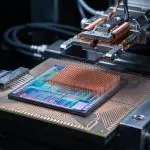
Jiapeng Zhao and colleagues at University of California have created a Universal Quantum Switch, a device offering non-blocking and encoding-agnostic routing of entanglement without inducing substantial decoherence. The device switches entangled states at 1MHz with less than 4% decoherence and projects reconfiguration speeds up to 1GHz. This represents the first demonstration of multi-node dynamic entanglement distribution at these speeds. The developed platform offers a scalable and interoperable building block, potentially accelerating the realisation of a functional quantum internet
Rapid dynamic entanglement switching via integrated lithium niobate photonics
Entanglement measures now demonstrate a greater than five-fold improvement in dynamic distribution speeds, achieving 1MHz switching with less than or equal to 4% decoherence. Previously, quantum networks relied on static links incapable of this on-demand routing. This breakthrough overcomes a key limitation hindering the scalability of quantum networks and the development of a functional quantum internet. The device enables seamless modality conversion between diverse quantum platforms, allowing interoperability between different types of quantum computers and sensors; this addresses a key challenge in building heterogeneous quantum systems
The Universal Quantum Switch prototype demonstrated reconfiguration speeds reaching up to 1GHz, signifying the system can potentially adjust connections hundreds of times per second. Constructed from thin-film lithium niobate, a crystalline material used in optics, the device successfully routed arbitrary entangled states, the fundamental unit of quantum information. Decoherence, the loss of quantum information, was measured at less than or equal to 4%. Tests confirmed the switch operates independently of the number of dimensions used to encode quantum data, suggesting scalability without increased signal degradation. Seamless modality conversion was also achieved, enabling communication between quantum systems utilising different encoding methods like polarisation or time-bin encoding; this interoperability is vital for linking diverse quantum technologies.
Demonstrating 1MHz dynamic entanglement distribution with a lithium niobate prototype
A Universal Quantum Switch, intended to dynamically route quantum information between nodes without losing coherence, has been demonstrated. This prototype, built using thin-film lithium niobate, achieved switching and entanglement distribution at 1MHz with decoherence, the loss of quantum information, of less than or equal to 4%. This represents the first demonstration of multi-node dynamic entanglement distribution at this speed. While projections suggest reconfiguration speeds up to 1GHz, performance at this higher rate has not yet been experimentally verified.
Gigahertz-level switching is essential for many potential quantum networking applications, and this remains a key limitation. The current demonstration focuses solely on a prototype fabricated from thin-film lithium niobate, and compatibility with other quantum platforms remains unproven. Static, point-to-point connections currently restrict quantum networks due to the absence of a dynamic switching capability. Existing mitigation approaches to maintain quantum coherence are reactive, introducing latency and failing to scale for dynamic networks.
This switch aims to address these limitations by enabling on-demand routing and seamless conversion between different quantum encoding methods. Interfacing diverse quantum platforms, each utilising different methods to encode quantum information, presents significant challenges. The proposed switch is designed to enable interoperability between these heterogeneous systems, a key step towards a more flexible quantum internet. Dimension-independent decoherence was detailed, suggesting scalability potential for larger network fabrics.
Dynamic entanglement distribution enabled by a universal quantum switch
Scientists at Cisco Systems Barbara, and collaborating institutions, have unveiled a Universal Quantum Switch, a device designed to overcome limitations in current quantum network designs. Typically, existing quantum networks are restricted to static, point-to-point connections between two fixed locations, hindering scalability and efficient resource use. This new switch allows for dynamic routing of quantum entanglement, a fragile connection between quantum particles, without significant loss of information.
The prototype switch, fabricated using thin-film lithium niobate, demonstrated strong switching with less than or equal to four per cent decoherence, the loss of quantum information, at a speed of 1MHz. Researchers also project the architecture could achieve reconfiguration speeds up to 1GHz, although this higher rate remains to be experimentally verified. This represents the first demonstration of multi-node dynamic entanglement distribution at these speeds. Current optical switching technologies, used in conventional networks, are incompatible with the delicate nature of quantum information.
Photonic qubits, the basic units of quantum information, are susceptible to disturbances that cause decoherence, a problem previous mitigation strategies addressed reactively with limited success. The research highlights the need for interoperable interfaces to convert quantum states between different platforms within a unified network. The architecture’s scalability was projected, demonstrating dimension-independent decoherence, and suggests it could provide a building block for heterogeneous quantum network fabrics, enabling diverse quantum platforms to connect and communicate.
The authors specifically note the importance of achieving this modality conversion without disrupting the underlying quantum information. This new device establishes a key component for building practical quantum networks, moving beyond the limitations of fixed connections. The Universal Quantum Switch dynamically routes quantum information, a fundamental requirement for scalable systems. Entanglement, a key resource in quantum technology, links particles regardless of distance, but is easily disrupted. Achieving this dynamic control with minimal information loss, less than four percent decoherence, demonstrates a significant advance in the field. Fabricated from thin-film lithium niobate, the prototype supports reconfiguration speeds up to 1GHz, potentially adjusting connections hundreds of times per second.
The researchers successfully demonstrated a Universal Quantum Switch, a device capable of dynamically routing quantum information with minimal disruption. This achievement matters because existing quantum networks are limited by static connections, hindering scalability and flexibility. The prototype, built using thin-film lithium niobate, exhibited less than or equal to four per cent decoherence while switching entangled states at 1MHz, and projected reconfiguration speeds up to 1GHz. This work provides a scalable building block for connecting diverse quantum platforms and establishing more complex quantum networks.
👉 More information
🗞 A Universal Quantum Information Preserving Photonic Switch for Scalable Quantum Networks
🧠 ArXiv: https://arxiv.org/abs/2604.21902



See today’s quantum computing news on Quantum Zeitgeist for the latest breakthroughs in qubits, hardware, algorithms, and industry deals.