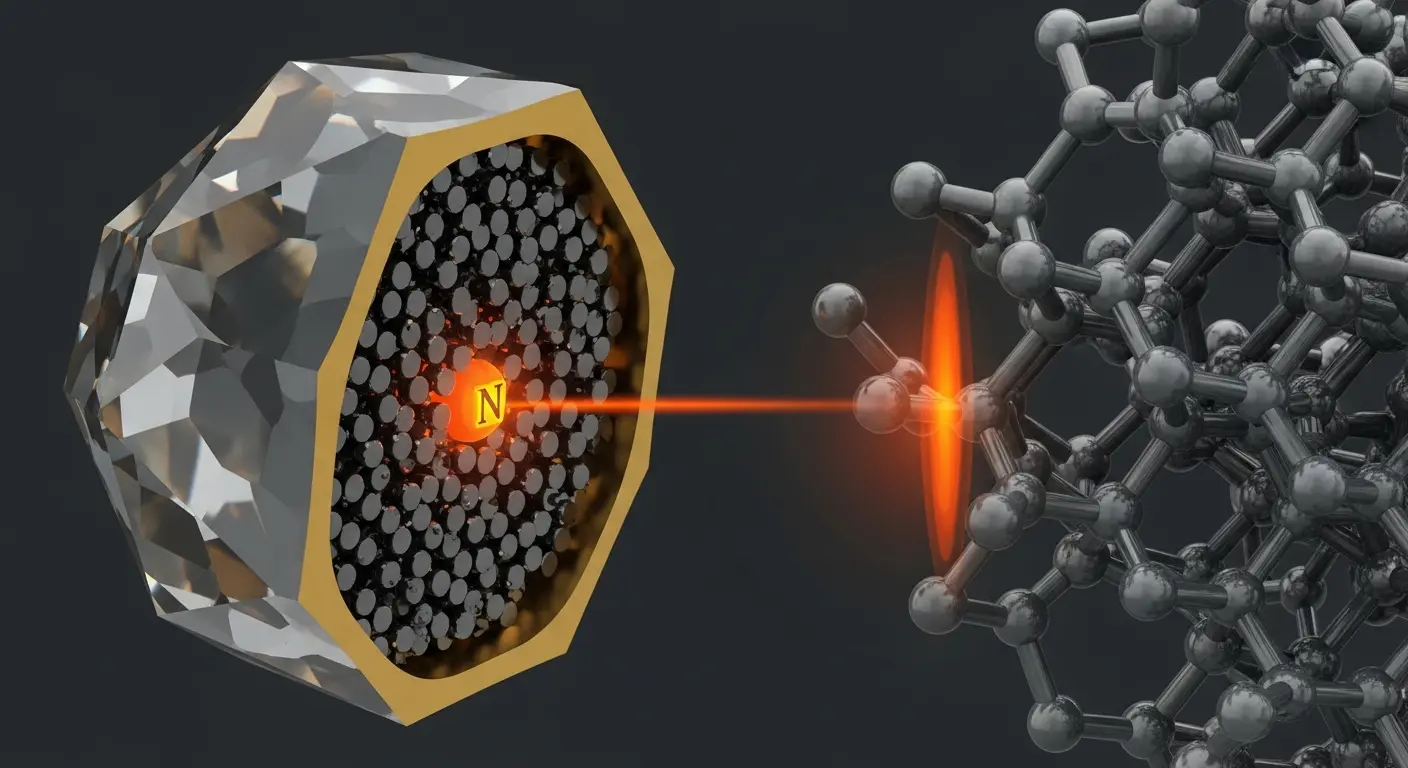
Scientists have developed a new analytically tractable model of a driven quantum harmonic emitter, such as an oscillating charged dipole, and its subsequent emission of radiation via resonance fluorescence. Yuliya Bilinskaya and Sreenath K. Manikandan demonstrate how characterising the quantum mechanical correlations established at early times between the driving force, the resonant emitter, and its fluorescence can enhance sensing capabilities. Joint measurements performed on the quantum emitter and its fluorescence field allow probing of the quantum noise present in the driving field, potentially offering a significant advantage over classical measurement techniques. The model provides a fundamental understanding of quantum sensing, with broad applications spanning quantum optics, acoustics, and gravitational wave detection.
Driving field quantum noise unlocks 80% resolution gain in classicality tests
Statistical null tests designed to determine the classicality of a system now demonstrate a signal resolution improvement exceeding 80% through the implementation of simultaneous measurements. This substantial improvement overcomes limitations inherent in previous approaches by directly probing the quantum noise of the driving field. This advancement represents a vital threshold, enabling differentiation between quantum and coherent driving fields, a distinction previously unattainable using conventional diffusive quantum measurement models. Researchers have constructed an analytically tractable model to characterise these quantum correlations by performing joint measurements on a quantum emitter and its resonance fluorescence, thereby opening avenues for enhanced quantum sensing across a diverse range of fields, from optics and acoustics to the challenging domain of gravitational wave detection.
The technique fundamentally relies on probing the quantum noise inherent in the driving field, revealing subtle features that were previously obscured by classical approximations. It offers a novel approach to understanding fundamental quantum phenomena, moving beyond traditional methods that treat the driving force as purely classical. Characterising quantum correlations between the driving field, the emitter, and the emitted fluorescence, the analytically tractable model reveals the intricate ways in which these elements interact at very short timescales, specifically, the initial dynamics of the emission process. This technique extends beyond the realm of optics, suggesting the potential to detect quantum effects in acoustic experiments using phonons (quantised sound waves) and even in gravitational wave experiments, hypothetically utilising gravitons (the proposed quantum of gravity), thereby employing photons for light, phonons for sound, and potentially gravitons for gravity. Resonance fluorescence, the re-emission of light by an atom after absorbing energy from the driving field, serves as the observable signal, while the driving field itself provides the energy source used to excite the quantum emitter. Further investigation will focus on exploring the applicability of this model to diverse quantum systems and a wider range of experimental setups, including those operating under varying environmental conditions.
The significance of this work lies in its ability to access information about the driving field that was previously inaccessible. Traditional methods often assume a classical driving field, effectively masking any quantum properties it might possess. By jointly measuring the emitter and its fluorescence, the model allows for the reconstruction of the quantum state of the driving field, providing a more complete and accurate description of the system. This is particularly important in scenarios where the driving field itself is a quantum system, such as in quantum information processing or quantum communication. The 80% resolution gain in classicality tests demonstrates the practical impact of this approach, highlighting its potential for improving the precision of quantum measurements. This improvement is achieved by reducing the uncertainty in determining whether the driving field is truly classical or possesses quantum characteristics, which is crucial for validating the assumptions underlying many quantum technologies.
Initial emission dynamics underpin sensitive quantum measurement
Resonance fluorescence, the re-emission of light by an excited atom, offers a promising route to enhanced quantum sensing across diverse fields, including precision spectroscopy, microscopy, and materials science. The model currently focuses on short-time experiments, specifically examining the initial stages of the emission process, neglecting the behaviour of the system over extended timescales. Longer durations introduce complexities related to the decay of the excited state and the accumulation of decoherence effects, which are not captured by the present analysis. Understanding how these quantum correlations evolve with time is therefore crucial for developing a complete picture of the system’s dynamics and for optimising the performance of quantum sensors. This work establishes a clear theoretical framework for interpreting signals from these sensors, detailing how to extract information about subtle quantum effects from the emitted light itself, specifically focusing on the correlations between the driving field, the emitter, and the fluorescence.
Even short bursts of these quantum signatures, detectable within the initial stages of resonance fluorescence, significantly advance the potential for highly sensitive detection technologies. Scientists are now actively refining experimental techniques to measure these effects with increasing precision, which is key for advancing sensor technology and realising the full potential of quantum-enhanced sensing. This detailed model of resonance fluorescence will likely underpin new developments in quantum optics and gravity research, providing a theoretical foundation for designing and interpreting experiments aimed at probing fundamental quantum phenomena. Previously limited by the inability to directly measure the inherent quantum noise of the driving field, this research establishes a robust method for characterising its quantum nature and leveraging it for improved sensing performance. The analytical tractability of the model is particularly valuable, as it allows for a deeper understanding of the underlying physics and facilitates the development of more efficient measurement strategies.
Simultaneous observation of a quantum emitter and its re-emitted light now allows access to information about the driving field’s quantum properties that was previously inaccessible. This approach reveals subtle correlations between the driving force, the emitter itself, and the emitted radiation, offering a more complete and nuanced picture than classical models allow. Characterising these fields opens new possibilities for controlling and manipulating quantum systems, potentially leading to the development of novel quantum devices and technologies. The ability to probe the quantum noise of the driving field is particularly significant, as it provides a means of mitigating the effects of noise and improving the stability of quantum systems. This is a crucial step towards realising practical quantum technologies that are robust and reliable enough for real-world applications.
Scientists demonstrated a method for probing the quantum noise of a driving field by simultaneously measuring a quantum emitter and its fluorescence. This is important because it allows characterisation of the quantum properties of the driving field, information previously difficult to obtain. The research establishes a way to detect quantum signatures in short bursts of emitted light, advancing the potential for sensitive detection technologies. The authors suggest this detailed model will underpin future developments in quantum optics and gravity research.
👉 More information
🗞 Quantum Sensing with Joint Emitter-Fluorescence Measurements
🧠 ArXiv: https://arxiv.org/abs/2604.11377


See today’s quantum computing news on Quantum Zeitgeist for the latest breakthroughs in qubits, hardware, algorithms, and industry deals.