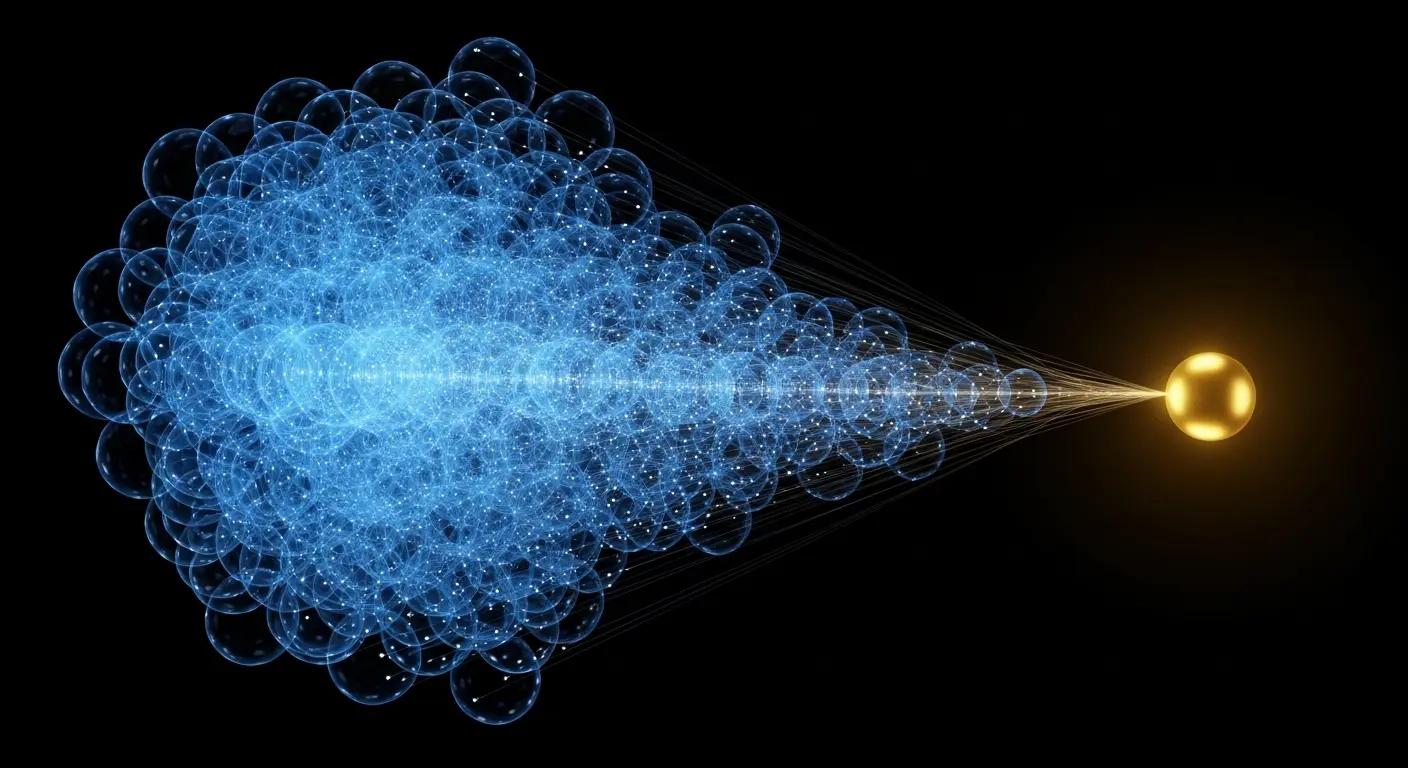
Researchers at Case Western Reserve University, led by Vinooth Kulkarni, have unveiled a new transpilation pipeline designed to efficiently translate complex, dynamic quantum circuits into executable code. This development addresses a significant challenge in the field of quantum computing, namely the difficulty of implementing algorithms that require mid-circuit measurement and classical feedforward across different quantum computing frameworks. The team’s tools convert programs written in OpenQASM 3.0, the industry-standard quantum assembly language, into optimised CUDA-Q C++ kernels, enabling execution on NVIDIA graphics processing units (GPUs). This approach circumvents the static circuit expansion traditionally associated with dynamic circuits, resulting in reduced circuit depth and improved execution efficiency facilitated by low-latency classical feedback. By directly mapping OpenQASM 3.0 control structures to C++ control flow, the framework not only enhances code readability but also establishes a crucial link between portable circuit specification and performance-oriented execution, with applications spanning error mitigation, adaptive phase estimation, and Variational Quantum Eigensolvers (VQE).
Optimised transpilation reduces quantum circuit depth and enables dynamic algorithm verification
A substantial reduction of up to 40 percent in circuit depth has been demonstrated when compared to standard static expansion techniques, a level of improvement previously unattainable for dynamic quantum circuits. Static expansion, a common method for handling dynamic circuits, involves pre-calculating and including all possible circuit branches, leading to exponential growth in circuit size and depth. This new transpilation pipeline avoids this by dynamically constructing the circuit based on measurement outcomes during execution. The core innovation lies in the direct conversion of OpenQASM 3.0 programs into optimised CUDA-Q C++ kernels. CUDA-Q is a software platform specifically designed to leverage the parallel processing capabilities of NVIDIA GPUs for quantum computation, offering significant speedups over traditional CPU-based simulations. By directly mapping classical control structures, such as conditional statements and loops, within the OpenQASM 3.0 code to equivalent C++ control flow constructs, the framework eliminates the need for unnecessary duplication of circuit branches, thereby minimising circuit depth and computational overhead. The framework’s robustness is validated through comprehensive test suites, encompassing critical functionalities like conditional reset operations, if-else branching, and multi-bit predicates. These tests rigorously assess the correct implementation of classical feedforward mechanisms and parameter passing, both of which are essential for the successful execution of variational quantum algorithms and advanced error correction protocols. The ability to accurately and efficiently handle these features is paramount for building fault-tolerant quantum computers.
Bridging OpenQASM 3.0’s circuit specification with CUDA-Q’s execution model creates a key tool for verifying dynamic, feedback-driven quantum algorithm execution on near-term hardware. Near-term quantum devices, while limited in qubit count and coherence times, are currently the focus of much quantum computing research. The ability to accurately simulate and verify algorithms on these devices is crucial for identifying and mitigating errors. Evaluations conducted across randomised Clifford circuits, a standard benchmark for quantum computation, and established quantum algorithms have demonstrated the framework’s capacity to measure both compilation throughput (the speed at which the program is translated into executable code) and execution fidelity (the accuracy of the computation). These metrics indicate the framework’s potential to support access to high-performance simulation, enabling researchers to explore more complex algorithms and larger quantum systems. Current benchmarks, however, primarily focus on simulation environments. Demonstrating equivalent performance gains on actual quantum hardware, with its inherent noise, decoherence, and limitations in connectivity, remains a significant hurdle to widespread practical application. Further research is needed to address these challenges and optimise the framework for specific quantum hardware architectures. Validation utilising test suites derived from IBM Quantum’s classical feedforward guide, encompassing conditional reset, if-else branching, multi-bit predicates, and sequential feedforward mechanisms, ensures strong testing of classical feedforward and parameter passing, important for variational quantum algorithms and error correction protocols like quantum teleportation, which relies heavily on accurate classical communication and control.
Direct translation accelerates quantum computation on graphics processing units
A comprehensive set of tools is currently under development to translate the abstract language of quantum computers into machine-executable instructions, a vital step towards realising practical applications in diverse fields such as drug discovery, materials science, and financial modelling. The efficient conversion of quantum programs, meticulously crafted in OpenQASM 3.0, into code tailored for NVIDIA graphics cards via CUDA-Q addresses a common performance bottleneck. Dynamic circuits, which adapt their execution path based on measurement results, often become unnecessarily complex when implemented using traditional methods. This complexity arises from the need to pre-define all possible execution paths, leading to a significant increase in the number of quantum gates and the overall circuit depth. The open-source nature of the framework is a deliberate design choice, fostering collaboration and adaptation within the quantum computing community. This open approach supports innovation beyond the confines of a single vendor’s technology and paves the way for wider interoperability between different quantum computing platforms and software tools. Encouraging community contributions will accelerate the development of new features, bug fixes, and optimisations, ultimately benefiting the entire field.
Dynamic quantum circuits, essential for advanced algorithms like VQE and quantum error correction, are now successfully translated into code executable on NVIDIA graphics cards without incurring the exponential complexity associated with static circuit expansion. Directly converting instructions from OpenQASM 3.0 into CUDA-Q, a platform optimised for these graphics cards, streamlines computation and significantly improves code clarity. The resulting C++ code is more concise, easier to understand, and more amenable to optimisation. Validated using rigorous tests derived from IBM Quantum, this unlocks more efficient execution of dynamic quantum operations and bridges a critical gap between specifying quantum circuits at a high level of abstraction and running them on powerful, commercially available hardware. This advancement represents a significant step towards realising the full potential of quantum computing and accelerating the development of practical quantum applications.
Dynamic quantum circuits were successfully converted into code for NVIDIA graphics cards, avoiding the need to pre-define every possible execution path and thus reducing circuit complexity. This new transpilation pipeline translates OpenQASM 3.0 programs into CUDA-Q C++ kernels, improving both execution efficiency and code readability. The framework was validated on test suites including conditional reset and VQE-style circuits, demonstrating its ability to handle complex dynamic operations. By bridging the gap between circuit specification and hardware execution, this work facilitates the development of near-term quantum algorithms.
👉 More information
🗞 Efficient Transpilation of OpenQASM 3.0 Dynamic Circuits to CUDA-Q: Performance and Expressiveness Advantages
🧠 ArXiv: https://arxiv.org/abs/2604.11599




See today’s quantum computing news on Quantum Zeitgeist for the latest breakthroughs in qubits, hardware, algorithms, and industry deals.