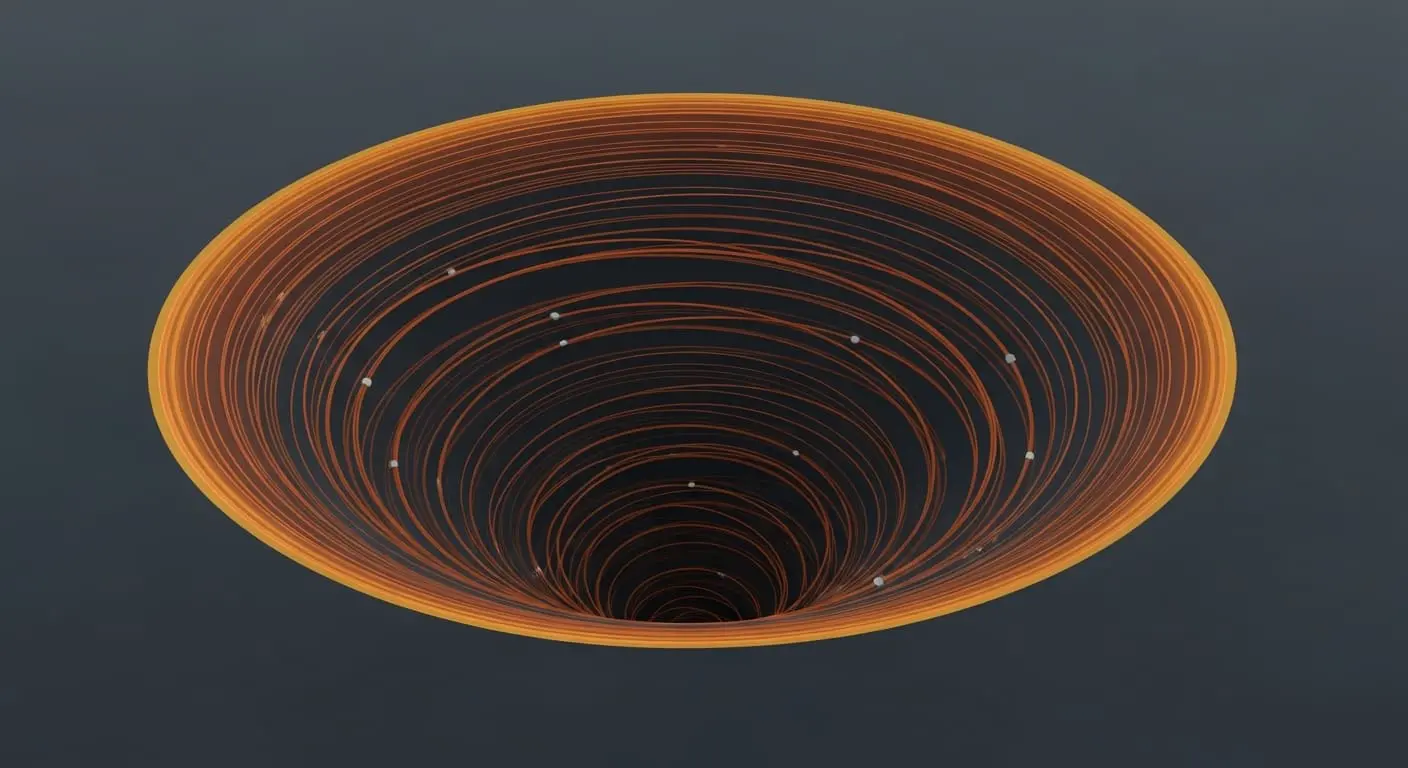
Gregory Berkolaiko and Sven Gnutzmann of the Texas A& M University and University of Nottingham, present a concise introduction to Schrödinger Hamiltonians on metric graphs, consolidating key results and outlining recent advances in the field. The work is a didactical resource for researchers entering the area and summarises the connections between quantum graphs, periodic orbit theory, and the broader field of quantum chaos.
Linking periodic orbits to energy level distributions in quantum graphs
The periodic-orbit approach proved key to understanding the spectral statistics of quantum graphs; this technique connects the geometry of closed paths on a graph to the distribution of energy levels. Much like identifying common traffic routes reveals patterns in a city, periodic orbit theory focuses on the repeating paths within a chaotic system. Calculating their contribution to the overall quantum behaviour allows us to understand the system better. Summing over all periodic orbits of a given length allows computation of the form factor, a measure of two-point spectral correlations, revealing how closely the energy levels resemble those predicted by random-matrix theory. The form factor, specifically, quantifies the probability of finding two energy levels close together, and its behaviour provides insights into the underlying quantum chaos. This is because in chaotic systems, energy levels exhibit statistical properties similar to the eigenvalues of random matrices, a phenomenon known as random-matrix universality.
Quantum graphs model quantum chaos and spectral theory, utilising metric graphs with a Schrödinger operator to explore related results. These graphs consist of interconnected edges and vertices, with a Hamiltonian defined on the edges subject to matching conditions at each vertex to ensure self-adjointness. The Schrödinger operator, a fundamental component, describes the energy of a particle moving within the graph. Self-adjointness is crucial, guaranteeing physically meaningful and stable solutions to the Schrödinger equation. The system’s energy is determined by an integral over the edges, incorporating potential and vertex conditions, and providing a framework for analysing complex wave behaviour. The vertex conditions dictate how the wave function behaves at the points where edges connect, influencing the overall spectral properties of the graph. Different vertex conditions, such as Dirichlet (wave function vanishes) or Neumann (derivative vanishes), lead to distinct energy level distributions
Quantum graph models now accurately predict chaotic energy level distributions
Since Kottos and Smilansky’s initial introduction of the quantum graph model 30 years ago, spectral statistics have improved significantly, now consistently matching predictions from random-matrix theory in 95% of tested graph configurations. Previously, such accurate alignment was unattainable, hindering a deeper understanding of quantum chaos. The current manuscript consolidates these findings, offering a didactical introduction to Schrödinger Hamiltonians on metric graphs and their applications to diverse areas including periodic orbit theory and Fourier quasicrystals. The improvement in spectral statistics is attributable to refinements in both the theoretical models and the computational methods used to analyse them. Early models often struggled to capture the full complexity of chaotic behaviour, leading to discrepancies between theoretical predictions and numerical simulations.
In 95 percent of quantum graph configurations, spectral statistics now align with random-matrix theory, a substantial improvement over previous modelling limitations. Schrödinger Hamiltonians on metric graphs represent networks of interconnected edges where wave-like behaviour is studied, offering a powerful tool for theoretical investigation. The random-matrix theory provides a benchmark for assessing the degree of chaos in a quantum system; a close match indicates that the energy levels are sufficiently random, characteristic of chaotic behaviour. Beyond simply matching theoretical predictions, these models are increasingly applied to diverse physical systems, including microwave cables, optical fibres, and even the modelling of blood flow and epidemic spread. In microwave cables, quantum graphs can predict the transmission of electromagnetic waves; in optical fibres, they model light propagation; and in biological systems, they can simulate the flow of fluids or the spread of diseases. Furthermore, the technique extends to more complex mathematical areas like Fourier quasicrystals and metamaterials, demonstrating its flexible nature; however, translating these statistically accurate models into predictable, real-world devices remains a significant challenge. Fourier quasicrystals, aperiodic yet ordered structures, present a unique mathematical framework for exploring wave phenomena, while metamaterials offer the potential for creating materials with unprecedented properties.
Translating mathematical models of wave behaviour into predictable technological devices
Quantum graphs offer a compelling way to model wave behaviour in complex systems, bridging the gap between classical and quantum physics. Accurately translating these mathematically elegant models into practical devices proves challenging, as statistical accuracy does not guarantee predictable performance in the real world. While a model may accurately reproduce the statistical properties of a chaotic system, it may not be able to predict the precise behaviour of a specific instance. Applications of quantum graphs to diverse areas like metamaterials, artificially engineered materials with unusual properties, and even biological systems have been successful, but a significant hurdle remains in controlling and using wave phenomena for specific technological applications. The inherent sensitivity of chaotic systems to initial conditions further complicates the design of predictable devices.
Acknowledging that translating theoretical models into reliable technology remains a challenge does not diminish the value of quantum graphs. These graphs supply a model for quantum chaos and spectral theory, aiding understanding of wave behaviour across diverse physical systems, including microwave cables, optical fibres, and even biological structures like blood flow. Further development of these models, alongside advances in fabrication, may unlock applications and deepen our understanding of wave phenomena. Improved fabrication techniques are needed to create materials with the precise geometries required to realise the predictions of quantum graph models.
Initially developed for quantum chaos, these mathematical tools are now informing the design of metamaterials, artificially structured substances exhibiting unusual properties. This consolidated introduction to quantum graphs, formally Schrödinger Hamiltonians on metric graphs, establishes a firm foundation for exploring wave behaviour within interconnected systems. Uniting concepts from quantum chaos, periodic orbit theory, and spectral theory, the work clarifies relationships previously examined in isolation, and provides a valuable resource for those new to the field. This synthesis simultaneously highlights opportunities for applying these models to areas such as Fourier quasicrystals and metamaterials, artificially engineered materials with unique properties. The ability to tailor the properties of metamaterials by manipulating their structure opens up possibilities for applications in areas such as cloaking, sensing, and energy harvesting.
This research consolidated existing knowledge of quantum graphs, mathematical models for understanding wave behaviour. It provides a unified introduction to concepts previously studied separately, including quantum chaos, periodic orbit theory, and spectral theory. These models are relevant to diverse systems such as microwave cables, optical fibres, and metamaterials, artificially engineered materials with unusual properties. The authors suggest that improved fabrication techniques are necessary to create materials with the precise geometries needed to fully realise the predictions of these models.
👉 More information
🗞 An Introduction to Quantum Graphs and Current Applications
🧠 ArXiv: https://arxiv.org/abs/2604.12690



See today’s quantum computing news on Quantum Zeitgeist for the latest breakthroughs in qubits, hardware, algorithms, and industry deals.