

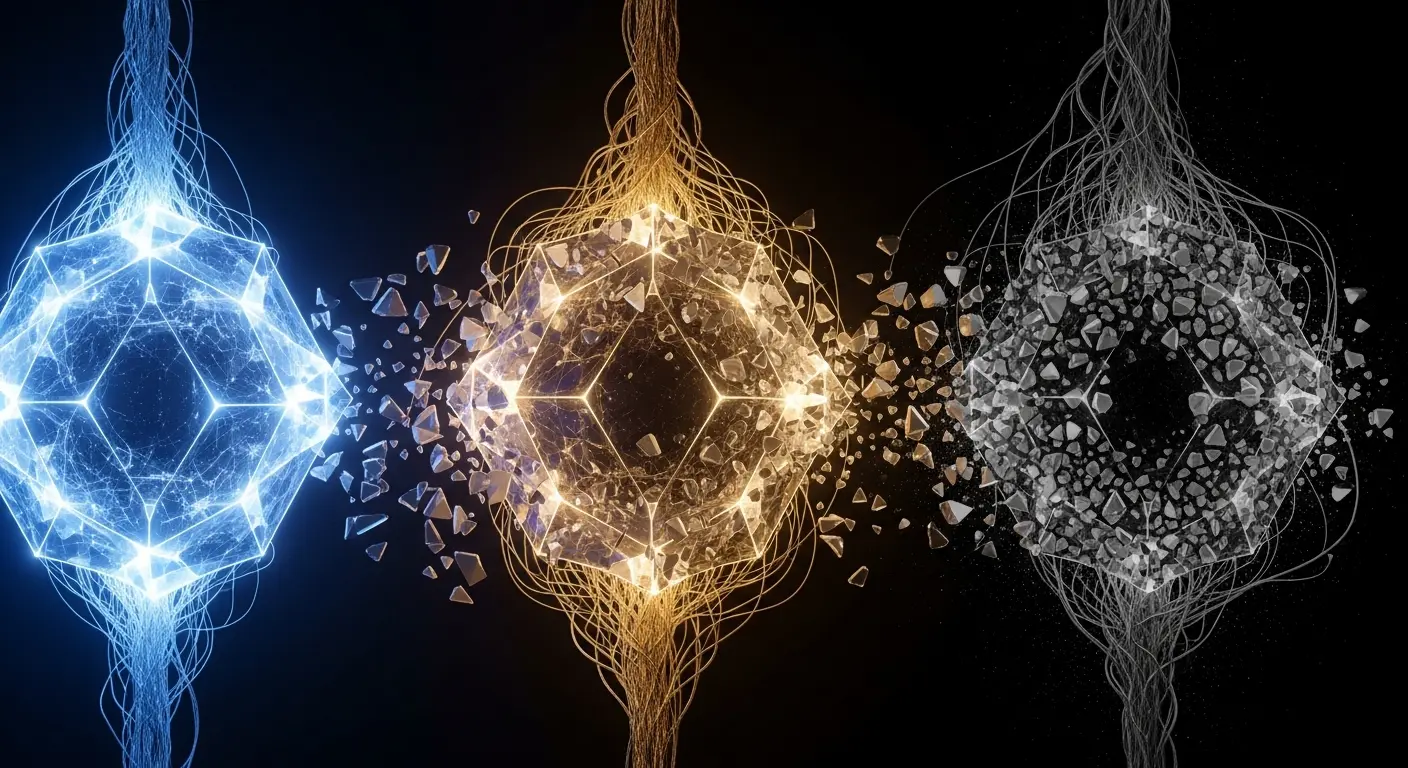
A new investigation reveals how environmental noise impacts the non-Hermitian skin effect (NHSE). Kunkun Wang and colleagues at Anhui University, in a collaboration between Anhui University and Southeast University, found that the NHSE, a form of directional transport, shows surprising key resilience to decoherence. Their experiments using photonic quantum walks reveal that some types of noise can suppress the effect, but others enhance it, leading to sharper transport velocities than observed in purely coherent systems. The findings clarify the interplay between quantum dynamics and environmental interactions, and suggest potential strategies for using decoherence to improve directional transport in practical, noisy environments.
Non-Hermitian skin effect survives and thrives under incoherent dephasing noise
Drift velocities now exceed those of coherent dynamics by a considerable margin, representing a surprising enhancement of directional transport. Maintaining the non-Hermitian skin effect (NHSE), a phenomenon enabling one-way movement of energy, previously required perfectly coherent systems, but this work proves its persistence even in fully incoherent regimes. This durability challenges the expectation that environmental noise always hinders transport, opening possibilities for robust designs in noisy environments. The NHSE arises from non-Hermitian Hamiltonians, which, unlike their Hermitian counterparts, allow for complex eigenvalues and describe systems where energy is not necessarily conserved. This is often realised through engineered dissipation, where energy is deliberately lost from the system, creating asymmetric hopping rates between sites in a lattice. Traditionally, such engineered dissipation was thought to be fragile in the face of naturally occurring environmental noise, leading to a breakdown of the NHSE and a return to diffusive behaviour. However, this research demonstrates a counterintuitive robustness, and even enhancement, under specific noise conditions.
The non-Hermitian skin effect (NHSE), enabling one-way movement of energy, not only survives but is enhanced under dephasing, a type of environmental noise. Drift velocities, measuring the speed of directional transport, exceeded those observed in perfectly coherent systems, with a coin parameter of π/4 resulting in an incoherent drift of 0.87 compared to 0.75 for coherent dynamics. This represents a significant increase in directional transport efficiency. The experimental setup employed a photonic quantum walk, a discrete-time analogue of quantum diffusion, implemented using integrated photonic circuits. Photons, acting as the quantum walkers, propagate through a lattice of waveguides, with each step governed by a beam splitter representing the ‘coin’ operation. The coin parameter of π/4 corresponds to a specific setting of the beam splitter, influencing the probability amplitudes for the photon to move left or right. Amplitude damping exhibits a strong dependence on its timing, suppressing the NHSE when applied before the loss operator, yet allowing it to persist and even amplify when applied afterwards. This enhancement occurred even at high loss strengths, with γ values up to 0.93 still supporting the NHSE, a result markedly different from typical systems where noise degrades performance. The parameter γ represents the rate of amplitude damping, quantifying the probability of a photon being lost during each step of the quantum walk. The observation that the NHSE persists even with γ values approaching 1 indicates a remarkable resilience to strong dissipation. However, these experiments were conducted over only eight steps of a quantum walk, and scaling this to complex systems or longer timescales remains a key challenge. Extending the number of steps is crucial for demonstrating the long-range directional transport capabilities of the NHSE in the presence of noise, and for assessing its potential for practical applications.
Temporal decoherence dictates enhancement of directed energy transfer
Establishing directional transport despite environmental disturbances offers a pathway towards more durable technologies. The ability to maintain directional transport in the presence of decoherence is particularly significant for applications in areas such as quantum information processing and energy harvesting. Conventional quantum systems are highly susceptible to decoherence, which limits the coherence time and hinders the performance of quantum algorithms. The NHSE, by providing a mechanism for robust directional transport, could potentially overcome these limitations and enable the development of more resilient quantum devices. This work highlights a vital limitation, however; the observed enhancements rely heavily on the timing of decoherence, specifically whether amplitude damping precedes or follows the engineered loss within the system. This sensitivity raises a fundamental question: can we truly use decoherence for practical applications if precise control over its temporal relationship with system dynamics is required. The precise timing is critical because the nature of the interaction between the decoherence process and the engineered dissipation dictates whether the NHSE is enhanced or suppressed. When amplitude damping occurs before the loss operator, it effectively randomises the quantum state, destroying the asymmetry required for directional transport. Conversely, when amplitude damping occurs after the loss operator, it acts as a form of ‘protection’, reinforcing the asymmetric hopping rates and enhancing the NHSE.
Acknowledging the importance of precise timing may seem limiting, but this work fundamentally expands understanding of how systems behave when exposed to environmental ‘noise’. Decoherence, the loss of quantum properties due to interaction with surroundings, is often viewed as purely destructive, yet these experiments demonstrate it can enhance directional movement under certain conditions. Experiments utilising photonic quantum walks, where photons mimic particle behaviour, demonstrated the surprising durability of the non-Hermitian skin effect (NHSE) against ‘decoherence’, the disruption of quantum properties by external interactions. This is significant because it suggests potential for building more durable technologies, even within imperfect, real-world environments, by cleverly utilising decoherence itself. Establishing directional transport of energy despite environmental disturbances represents a major advance in understanding non-Hermitian systems, which deviate from conventional physics by allowing energy loss, and challenges the expectation that noise always hinders movement, suggesting potential for robust technologies functioning in imperfect conditions. The research opens avenues for exploring novel strategies for manipulating decoherence to achieve desired functionalities in quantum systems, potentially leading to the development of more robust and efficient devices. Further investigation into the interplay between different types of noise and the NHSE is warranted, as well as exploration of the potential for extending these findings to other physical platforms beyond photonic quantum walks.
The research demonstrated that the non-Hermitian skin effect, a phenomenon enabling directional transport, survives even when quantum systems experience decoherence. This is significant because decoherence typically disrupts quantum behaviour, but in this case, dephasing actually enhanced directional movement. Researchers used photonic quantum walks to show that the timing of amplitude damping, whether before or after energy loss, critically affects the skin effect, with damping applied afterward even reinforcing the directional transport. These findings expand understanding of how systems behave in noisy environments and suggest possibilities for harnessing decoherence itself.
👉 More information
🗞 Decoherence Resilience of the Non-Hermitian Skin Effect
🧠 ArXiv: https://arxiv.org/abs/2604.12739



See today’s quantum computing news on Quantum Zeitgeist for the latest breakthroughs in qubits, hardware, algorithms, and industry deals.



