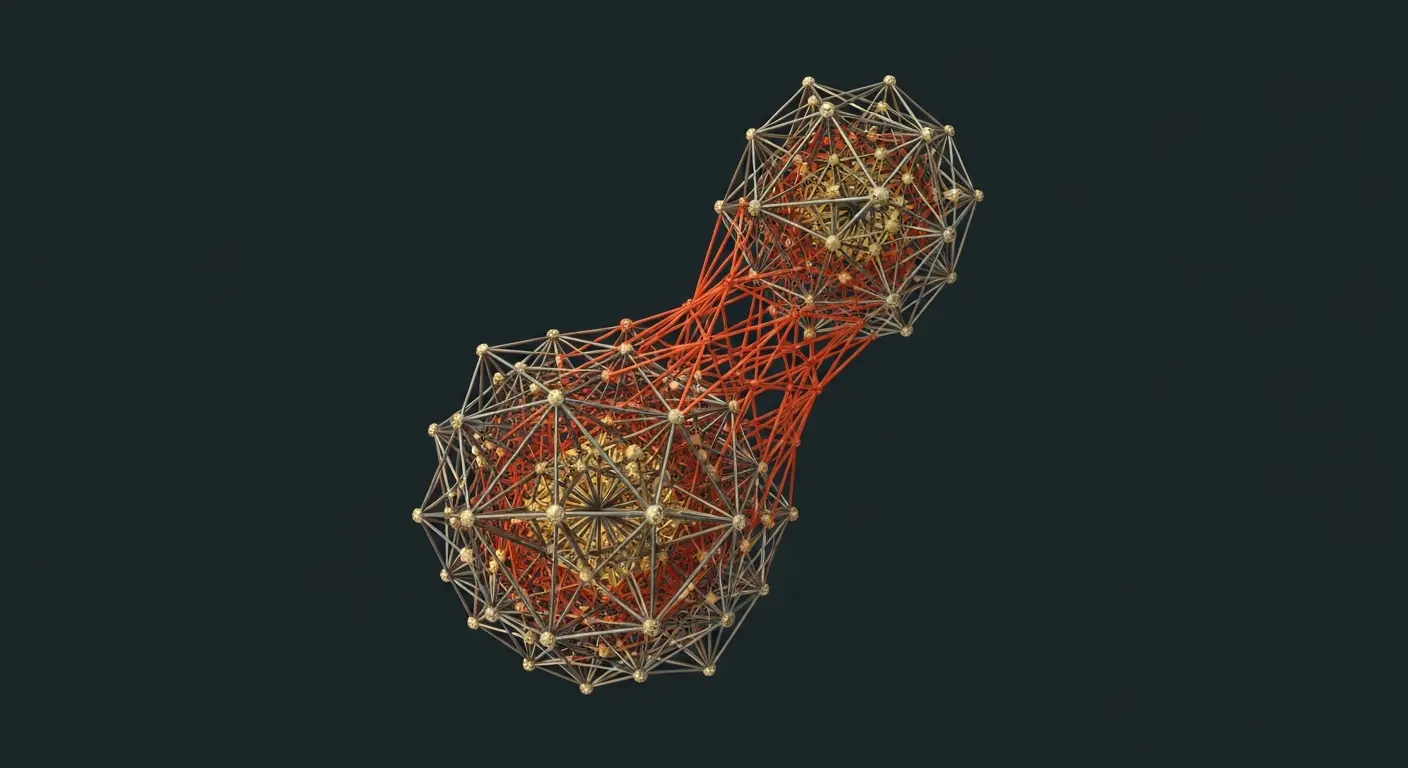
A quantum message-passing framework improves communication over factor graphs utilising finite abelian groups. Avijit Mandal and Henry D. Pfister at Duke University present a method for distinguishing quantum states indexed by these groups, using the structure of group-covariant pure-state channels. The work reveals that these channels can be characterised by their character-indexed eigen lists, enabling the derivation of explicit update rules for key factor types such as check, equality, and homomorphism. This advancement provides a closed quantum message-passing framework applicable to standard code families including polar, LDPC, and turbo codes, extending previous formulations to encompass non-cyclic alphabets and more complex constraints.
Diagonalisation of the Gram matrix using character bases for simplified quantum channel analysis
This advance centres on exploiting the character basis to simplify the description of quantum channels. A character basis functions much like using different colours of light to reveal hidden details of an object; it’s a set of mathematical tools used to analyse the properties of how a quantum channel transforms states. Specifically, for a finite Abelian group G, the character basis consists of a set of complex-valued functions that are eigenfunctions of the group’s translation operators. These characters provide a complete orthonormal basis for the space of functions on the group, allowing any function to be expressed as a linear combination of characters. When viewed through this character basis, the Gram matrix, a measure of relationships between quantum states, becomes remarkably simple, aligning neatly along the ‘character’ directions and allowing for straightforward calculations. The Gram matrix, constructed from the output states of the pure-state channel, effectively captures the correlations between different input states.
Quantum states indexed by finite Abelian groups are now amenable to analysis, with a focus on pure-state channels exhibiting group-covariant behaviour; these channels transform states predictably related to the group’s structure. Group-covariance implies that the channel’s action on a state transforms predictably under group operations, simplifying its mathematical description. This diagonalisation means the channel can be fully understood by examining its character-indexed eigen list, a concise summary of its behaviour. Each element in this eigen list corresponds to an eigenvalue, representing the channel’s gain along a specific character direction. Moving beyond previous binary or cyclic limitations, this approach extends the framework to encompass non-cyclic alphabets and more complex constraints within factor graphs, enabling explicit update rules for messages within these graphs, and broadening applicability to standard codes like polar, LDPC, and turbo codes. The ability to handle non-cyclic alphabets is particularly significant as it allows for the construction of codes with improved performance characteristics and greater flexibility in design.
Character basis diagonalisation enables advanced quantum message-passing protocols
The character basis now diagonalizes Gram matrices, a measure of relationships between quantum states, representing a strong improvement over previous methods limited to analysing only a single direction. Previously, precise calculations of quantum channel behaviour and the application of quantum message-passing to simple coding schemes were hindered by the inability to achieve this diagonalisation. This meant that determining the optimal decoding strategy for a given channel was computationally expensive and often required approximations. This unlocks a closed quantum message-passing framework applicable to more complex constraints and non-cyclic alphabets, broadening the scope of quantum communication protocols; for instance, the approach generalizes results for binary convolutional codes on qubit pure-state channels. A ‘closed’ framework implies that all necessary update rules can be derived explicitly, allowing for efficient and deterministic decoding. The generalisation to binary convolutional codes demonstrates the framework’s versatility and potential for practical implementation. The ability to perform message passing efficiently is crucial for achieving high throughput and low latency in communication systems.
The significance of this diagonalisation lies in its ability to decouple the different character components of the quantum state. This decoupling simplifies the message-passing equations, allowing for efficient computation of the belief propagation algorithm, a key component of many decoding schemes. By expressing the channel in the character basis, the researchers have effectively transformed a complex multidimensional problem into a set of independent one-dimensional problems, each of which can be solved efficiently. This approach not only reduces computational complexity but also provides valuable insights into the channel’s behaviour and its impact on the transmitted information. Furthermore, the framework allows for the design of codes that are tailored to the specific characteristics of the quantum channel, maximising performance and minimising error rates.
Quantum error correction advances with tree-structured factor graph limitations
While this framework elegantly extends quantum message-passing to more complex alphabets, its current form relies on a vital restriction; it’s presently demonstrated only for factor graphs possessing a tree structure. This limitation hinders direct application to the cyclic graphs frequently encountered in practical coding schemes, presenting a challenge for real-world implementation. Tree-structured graphs, while mathematically convenient, do not accurately represent the dependencies present in many real-world coding schemes, such as those based on cyclic redundancy checks. Adapting the framework to handle these more intricate, looped configurations is a key area for future work. The presence of cycles introduces feedback loops into the message-passing algorithm, making it more difficult to analyse and potentially leading to instability.
Despite this restriction to tree-structured graphs, a foundational quantum message-passing framework applicable to widely used coding families like polar, LDPC, and turbo codes, employed in data transmission and storage, is now established. These codes are widely used in various applications, including mobile communications, satellite communications, and data storage systems. Extending this to cyclic graphs, though challenging, represents a clear path towards practical applications and improved error correction. The researchers are currently exploring various techniques for extending the framework to cyclic graphs, including the use of approximate message-passing algorithms and the development of new graph representations. This offers a novel approach to using quantum mechanics for classical communication tasks, potentially boosting efficiency and security. The potential for increased efficiency stems from the ability to exploit quantum phenomena, such as superposition and entanglement, to encode and transmit information more effectively. The enhanced security arises from the inherent properties of quantum mechanics, which make it difficult to eavesdrop on quantum communication channels without being detected.
A framework for quantum communication utilising finite abelian groups is now available. Characterising quantum channels allows for precise calculation of message updates within factor graphs, simplifying complex systems into interconnected local constraints and enabling a closed quantum message-passing system for tree-structured graphs. The development of this framework represents a significant step towards realising the full potential of quantum communication and its application to practical coding problems. The resulting framework offers a unified structure for diverse schemes, building on established coding families.
The researchers developed a quantum message-passing framework applicable to tree-structured factor graphs utilising finite abelian groups. This characterisation of quantum channels allows for the calculation of message updates, simplifying complex systems and enabling a closed quantum system for coding problems. The framework applies to standard code families including polar, LDPC, and turbo codes, currently used in data transmission and storage. The authors are now exploring techniques to extend this framework to more complex, cyclic graphs.
👉 More information
🗞 Quantum Message Passing for Factor Graphs over Finite Abelian Groups
🧠 ArXiv: https://arxiv.org/abs/2604.12186


See today’s quantum computing news on Quantum Zeitgeist for the latest breakthroughs in qubits, hardware, algorithms, and industry deals.