

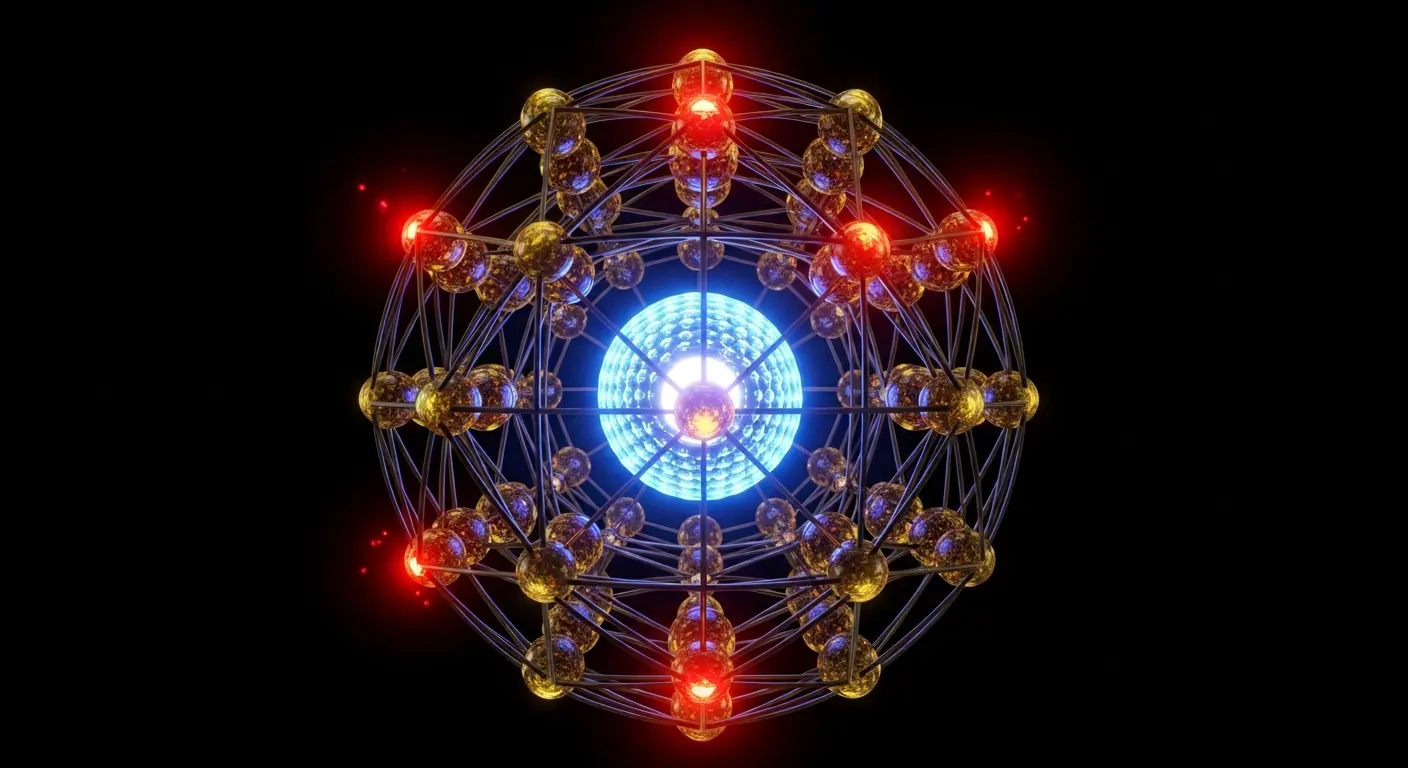
A new set of tools generates deterministic bosonic grid states, key for hardware-efficient quantum error correction. Yanis Le Fur and colleagues at Institute of Fundamental Physics IFF-CSIC, in collaboration with Department de F´ısica, Departamento de F´ısica T´eorica de la Materia Condensada and Condensed Matter Physics Centre (IFIMAC), demonstrate these protocols using programmable nonlinear bosonic circuits comprised of squeezing, displacement, and Kerr operations. The protocols reveal a distinct class of states, termed phased-comb states, offering near-optimal performance under boson loss and a viable pathway towards scalable bosonic quantum error-correcting codes exceeding standard GKP encodings.
Phased-comb states enable scalable bosonic quantum error correction with record low error rates
Error rates for generating scalable bosonic quantum error-correcting states have dropped to ≲0.98, a sharp improvement over previous methods limited to photon numbers below ten. This advancement is particularly significant as quantum information is inherently fragile, susceptible to decoherence and errors arising from environmental interactions. Quantum error correction (QEC) is therefore crucial for building fault-tolerant quantum computers. Bosonic QEC, which encodes quantum information into continuous-variable systems like harmonic oscillators, offers a promising route to hardware-efficient QEC due to its potential for high encoding rates and resilience to certain types of errors. This new approach utilises programmable nonlinear bosonic circuits, sidestepping the limitations of probabilistic protocols, which often require numerous attempts to successfully generate a state, or complex auxiliary qubit systems that add significant overhead. Scientists at the Institute of Fundamental Physics CSIC and collaborating institutions have identified a novel class of states, termed phased-comb states, which are unitarily related to standard grid states but possess an intrinsic phase structure offering near-optimal performance under boson loss, a pervasive challenge in photonic quantum computing where photons can be lost during processing or transmission.
A scalable code is defined by these phased-comb states, establishing a viable route beyond conventional GKP encodings and paving the way for more robust quantum information protection. The Gottesman-Kitaev-Preskill (GKP) states are a well-known example of bosonic grid states, characterised by a periodic distribution of probability amplitudes in phase space. However, generating high-fidelity GKP states has proven difficult. The phased-comb states, while mathematically related to GKP states, exhibit a different phase structure that proves advantageous in certain scenarios. Channel fidelities rival those of established GKP encodings, as analysis reveals they maintain near-optimal performance under boson loss, a key challenge in photonic quantum computing. The team successfully designed and simulated a universal gate set utilising only the resources available within their programmable nonlinear bosonic circuits, demonstrating the implementability of logical operations essential for complex quantum computations. Squeezing, displacement, and Kerr operations were employed by the circuits. Squeezing reduces quantum noise in one quadrature of the electromagnetic field at the expense of increased noise in the other. Displacement shifts the state in phase space, and Kerr interactions introduce a nonlinear phase shift dependent on the intensity of the light. These operations, carefully orchestrated, allow for the creation and manipulation of the desired quantum states, representing a significant step towards practical scalability.
Symmetry limitations challenge established approaches to scalable quantum error correction
Developing deterministic methods for generating protective quantum states is a significant step, yet the work highlights a curious trade-off. While these phased-comb states offer comparable error correction to established Gottesman-Kitaev-Preskill, or GKP, states, attempts to improve GKP symmetry within the circuits lead to diminishing returns. Perfect symmetry in GKP states is theoretically desirable as it enhances their error-correcting capabilities. However, the researchers found that as they increased the complexity of the circuits to achieve higher symmetry, the quality of the generated states plateaued. This suggests a fundamental limit to how perfectly these systems can restore symmetry, potentially due to imperfections in the physical implementation of the circuits or inherent limitations in the underlying physics. This raises whether pursuing perfect GKP-like states is the most fruitful path, or if alternative strategies, such as optimising for performance under realistic noise conditions, might be more effective.
Despite acknowledging that perfecting traditional grid states may yield limited gains, demonstrating a viable route to scalable bosonic quantum error correction remains vital. Programmable nonlinear bosonic circuits now serve as a practical means of generating these protective states, moving beyond reliance on probabilistic methods or complex auxiliary systems. The ability to deterministically generate these states is crucial for building a reliable quantum computer, as probabilistic methods introduce uncertainty and require significant overhead to achieve acceptable error rates. Though subtly different, phased-comb states offer comparable performance to established techniques under realistic conditions like boson loss, broadening the set of tools for building strong quantum computers. The resilience of these states to boson loss is particularly important for photonic quantum computing, where photon loss is a major source of error.
Deterministic generation of bosonic grid states, a key step towards scalable quantum error correction, has been achieved using programmable nonlinear bosonic circuits. Light and matter were manipulated through squeezing, displacement, and Kerr operations, bypassing the limitations of previous methods. This work identifies phased-comb states, a novel class of quantum states unitarily related to standard GKP states but exhibiting an intrinsic phase structure; these states offer comparable performance despite a saturation of symmetry restoration with increasing circuit complexity. Further research will focus on optimising the performance of these states in the presence of realistic noise and exploring their potential for encoding more complex quantum information. The development of efficient decoding algorithms will also be crucial for realising the full potential of this approach to quantum error correction.
The research successfully generated bosonic grid states deterministically, utilising programmable nonlinear bosonic circuits with squeezing, displacement and Kerr operations. This is important because it provides a practical method for creating states needed for protecting quantum information, moving beyond less reliable probabilistic techniques. These circuits produced phased-comb states, which are similar in performance to established grid states, even when experiencing boson loss. The authors intend to optimise these states further and develop efficient decoding algorithms to fully realise their potential for quantum error correction.
👉 More information
🗞 Deterministic generation of grid states with programmable nonlinear bosonic circuits
🧠 ArXiv: https://arxiv.org/abs/2604.21824

See today’s quantum computing news on Quantum Zeitgeist for the latest breakthroughs in qubits, hardware, algorithms, and industry deals.



