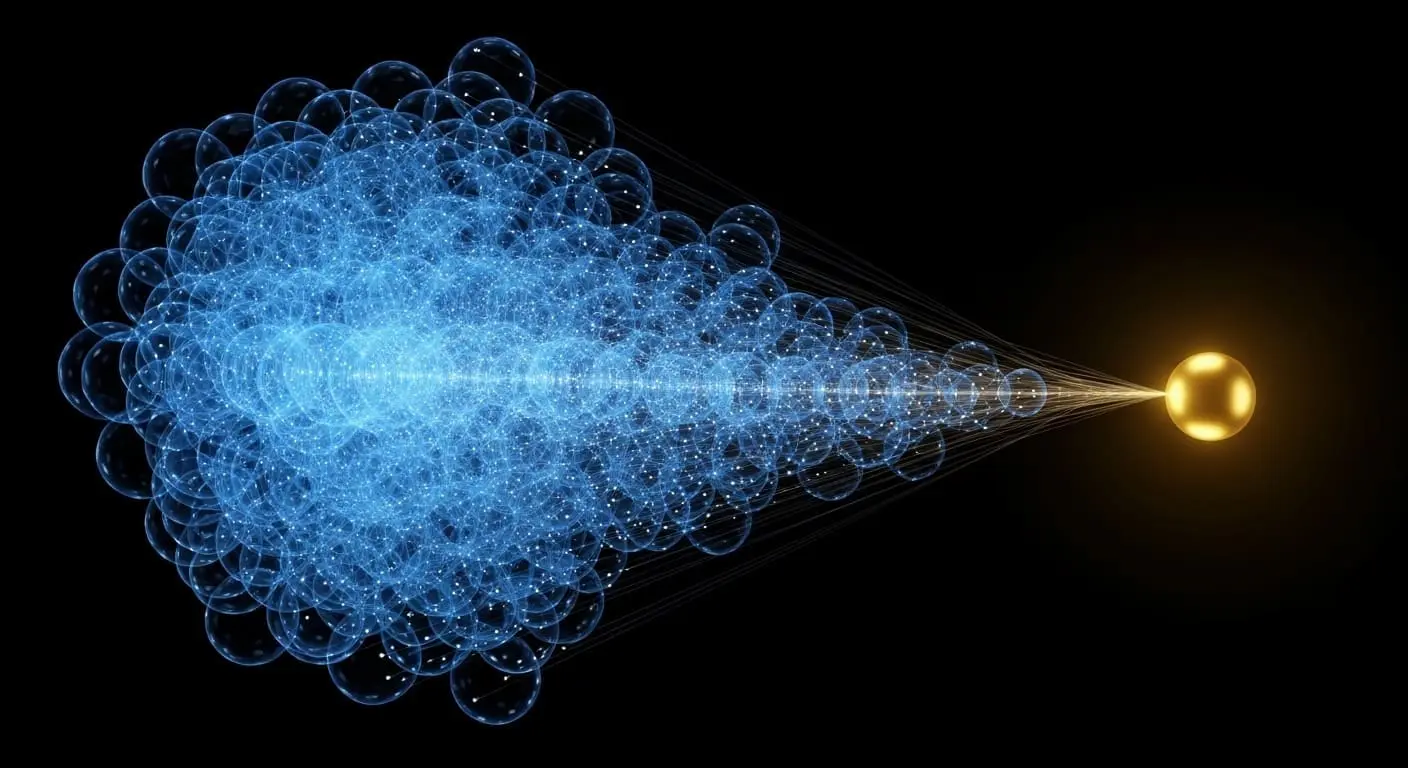
Scientists at the Institute for Theoretical Physics, led by Elias Rothlin, have demonstrated a compelling connection between gauge theories and quantum error-correcting codes (QECCs) within the framework of lattice quantum electrodynamics (QED). The research constructs explicit recovery operations, utilising quantum reference frames (QRFs), to address errors arising from both idealised and realistically imperfect conditions. Lattice QED, through this work, functions as a QECC capable of correcting errors in up to two charge sectors. This represents a significant advance beyond conventional stabilizer codes which are typically limited to single-sector correction. This finding clarifies how gauge symmetry, a cornerstone of the theory, fundamentally provides a crucial structure for encoding quantum information and enabling robust error correction, a relationship that has been subject to ongoing debate.
Gauge symmetry encodes and protects quantum information within lattice QED
Lattice quantum electrodynamics (QED) now operates as a quantum error-correcting code (QECC), effectively correcting errors in up to two charge sectors, a substantial improvement over earlier stabilizer codes limited to single-sector correction. This advancement confirms that gauge symmetry, a fundamental aspect of the theory, actively encodes information supporting error correction, a role previously debated. At the University of California, Berkeley, researchers constructed quantum reference frames (QRFs), standardised coordinate systems for interpreting quantum data, utilising “spanning trees of the lattice” to resolve ambiguities arising from gauge-violating errors. The spanning tree construction provides a means of defining a preferred basis for the gauge fields, effectively ‘fixing’ the gauge and allowing for unambiguous identification of errors. This is crucial because gauge symmetry implies that physically equivalent configurations are related by transformations, and without a reference frame, distinguishing true errors from gauge transformations becomes impossible.
These QRFs pinpoint information encoding and enable the construction of explicit recovery operations for both ideal and non-ideal quantum reference frames. The system incorporates a gauge-field QRF derived from the lattice structure and a fermionic field QRF originating from the matter fields, thereby expanding encoding possibilities. The gauge field QRF is constructed from the links of the lattice, representing the gauge bosons, while the fermionic QRF is built from the fermion fields residing on the lattice sites. Combining these two QRFs allows for encoding of information in both the gauge and matter sectors. Group-theoretical methods were employed to rigorously address error sets, confirming a direct connection between gauge theories and quantum information protection, and detailing the technical aspects of the recovery process. Specifically, the researchers leveraged the group structure of the gauge symmetry to characterise the possible error operators and design recovery operations that effectively undo their effects without disrupting the encoded quantum information. The recovery operations involve applying specific combinations of Pauli operators to the lattice sites, carefully chosen to correct the identified errors while preserving the gauge symmetry.
Protecting quantum information using mathematical symmetries and lattice structures
Although the current work demonstrates an inherent error-correction structure within lattice quantum electrodynamics, it remains confined to Abelian gauge groups, such as that of QED. Extending these findings to the more complex area of non-Abelian gauge theories, which underpin the strong and weak nuclear forces, presents a significant challenge. Non-Abelian gauge theories possess a more intricate symmetry structure, with self-interactions between the gauge bosons, making the construction of appropriate quantum reference frames and recovery operations considerably more difficult. It is unclear whether the techniques used to construct quantum reference frames within this specific framework will translate to systems governing the strong and weak nuclear forces, requiring potentially novel approaches to encoding and error correction.
Protecting quantum information using mathematical symmetries and lattice structures is a key step. Lattice quantum electrodynamics as a quantum error-correcting code reveals a deeper role for gauge symmetry than previously understood. The mathematical framework underpinning this theory inherently encodes information, actively resisting the effects of noise and errors, moving beyond simply describing physical phenomena to providing a mechanism for strong data preservation. This is particularly relevant in the context of quantum computation, where maintaining the coherence of quantum information is a major hurdle. The ability of gauge symmetry to protect information suggests that it could be harnessed as a resource for building more robust and fault-tolerant quantum computers. In particular, this demonstrates that abstract mathematical symmetries can actively protect information, a principle with broad implications for the field. This discovery opens avenues for exploring similar protective mechanisms in other physical systems and theoretical frameworks. The implications extend beyond quantum computation, potentially offering insights into the foundations of quantum gravity and the nature of spacetime itself, where symmetries play a crucial role. Further research will focus on generalising these findings to non-Abelian gauge theories and exploring the potential for utilising gauge symmetry as a fundamental resource for quantum information processing and storage, potentially leading to the development of entirely new paradigms for quantum technologies.
Lattice quantum electrodynamics has been demonstrated as a quantum error-correcting code, revealing that gauge symmetry actively encodes and protects information. This finding suggests that the mathematical framework of gauge theories does more than describe physical phenomena, but also provides a means of preserving data against errors. By constructing quantum reference frames based on lattice structures, researchers showed how physical information is encoded within the system and how errors can be corrected. The authors intend to extend these findings to more complex, non-Abelian gauge theories, potentially broadening the understanding of information protection in physics.
👉 More information
🗞 Error Correction in Lattice Quantum Electrodynamics with Quantum Reference Frames
🧠 ArXiv: https://arxiv.org/abs/2604.06149


See today’s quantum computing news on Quantum Zeitgeist for the latest breakthroughs in qubits, hardware, algorithms, and industry deals.