Hiroshi Okamoto and colleagues at Akita Prefectural University in collaboration wtih Quantum and Nanotechnologies Research Centre, have developed a method for quantum information transfer between an electron microscope and a quantum computer, enabling imaging of beam-sensitive specimens. Their quantum algorithm successfully distinguishes the correct image from a set of candidates, even when the number of candidates exceeds the inherent limitations of conventional imaging techniques. The method offers a key advancement in visualising delicate samples with reduced radiation damage, opening avenues for materials science and biological applications.
Overcoming Hilbert space limitations with qudit-based quantum computational imaging
A quantum computational imaging technique now identifies the correct image from ‘n’ candidate images, where ‘n’ is larger than the effective dimension of the imaging electron’s Hilbert space; this represents a sharp leap beyond conventional methods limited by that same dimensional constraint. The Hilbert space, in this context, defines the total number of distinguishable states the electron beam can occupy during imaging. Traditional electron microscopy is constrained by the Nyquist-Shannon sampling theorem, requiring a sufficient number of samples to accurately reconstruct an image. This necessitates a high-dimensional Hilbert space, which becomes increasingly difficult to manage with increasing image complexity and resolution. The new technique circumvents this limitation by leveraging the principles of quantum superposition and entanglement, allowing the effective dimensionality of the Hilbert space to be exceeded. Previously, obtaining clear images necessitated a trade-off between resolution and sample integrity, but this breakthrough enables imaging of beam-sensitive specimens, such as those found in biological research, with substantially reduced radiation damage. The system utilises ‘qudits’, quantum units capable of representing multiple values simultaneously, enabling complex data storage and processing within a quantum computational electron microscope. Unlike classical bits which are limited to 0 or 1, qudits can exist in a superposition of ‘d’ states, where ‘d’ is the dimension of the qudit. This increased capacity allows for more efficient encoding and manipulation of image data.
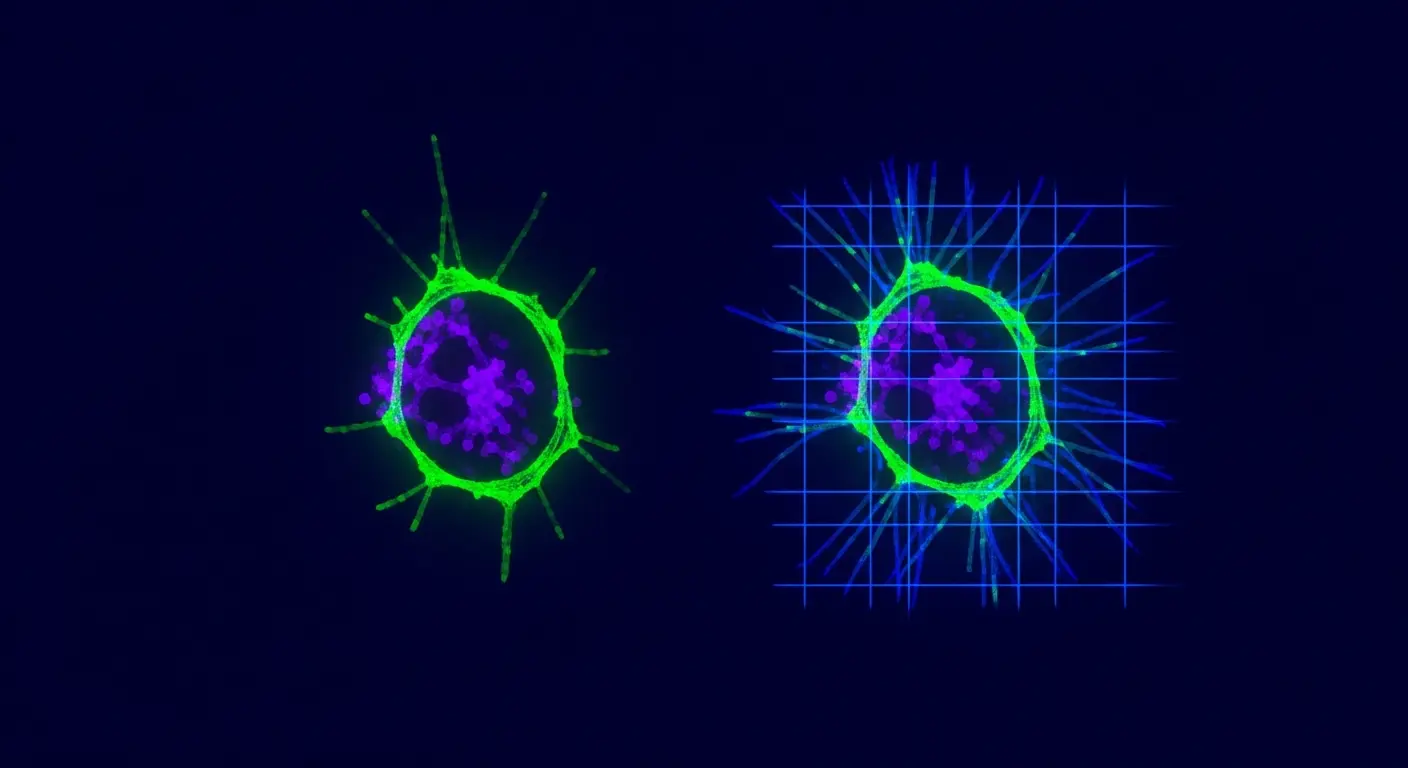
A quantum computational electron microscope, or QCEM, combining a universal quantum computer and an electron microscope, is detailed in this research. Deliberately positioned near the electron beam are two qudits, enabling complete transfer of quantum information when the specimen acts as a phase object, altering the phase of the electron wave. The electron beam, behaving as a wave, interacts with the specimen, and any changes to its phase contain information about the specimen’s structure. These phase shifts are subtle and easily disrupted by inelastic scattering events, which contribute to radiation damage. By encoding the image information into the quantum state of the qudits, the system minimises the need for high-intensity electron beams, thereby reducing damage. These quantum units function as quantum beam deflectors, enabling raster-scanning of the electron beam across d × d points on the specimen, where ‘d’ represents the number of states within each qudit. The use of qudits allows for a more compact representation of the scanning area compared to classical scanning methods. This setup allows for the creation of superpositions of electron beam positions, generating arbitrary two-dimensional structures with just two deflectors, potentially simplifying instrumentation compared to classical approaches and reducing the cost and complexity of future microscopes. Classical raster scanning requires precise mechanical control of the electron beam, whereas the quantum approach utilises quantum interference to achieve the same effect, potentially leading to a more stable and efficient system.
Quantum imaging currently limited to phase object analysis
Quantum computation is now used to identify images, a feat promising to revolutionise low-dose electron microscopy and preserve beam-sensitive samples. However, the initial demonstration relies heavily on analysing ‘phase objects’, materials that alter the wave-like properties of electrons; broadening the technique’s application to non-phase samples presents a significant hurdle. Phase objects, such as thin biological samples or certain nanomaterials, primarily affect the phase of the electron wave without significant amplitude scattering. This makes them ideal candidates for this quantum imaging technique, as the phase information can be readily encoded into the qudit states. Non-phase objects, on the other hand, cause both phase and amplitude changes, complicating the quantum information transfer process. Addressing this limitation will require new quantum algorithms or sample preparation methods, a challenge that could dictate the technique’s ultimate impact. Potential solutions include developing algorithms that can disentangle phase and amplitude information, or employing techniques like ptychography to reconstruct the image from a series of diffraction patterns.
Vital for both biological and materials science, reducing radiation damage allows the study of delicate samples without destroying them. Biological samples, in particular, are highly susceptible to radiation damage, limiting the resolution and duration of observation. This new technique offers the potential to image these samples at near-native resolution, providing unprecedented insights into their structure and function. Establishing a quantum link between an electron microscope and a quantum computer opens entirely new avenues for image analysis and enhancement, potentially allowing reconstruction of images from incomplete or noisy data. Quantum algorithms can be employed to filter out noise and enhance image contrast, leading to clearer and more informative images. The new technique demonstrates a functional link between electron microscopy and quantum computation, identifying the correct image from a field of ‘n’ possibilities. This is achieved through a quantum search algorithm that efficiently compares the measured quantum state with the quantum states corresponding to each candidate image. While currently demonstrated with specimens altering electron wave properties, this work establishes a framework for future expansion to a wider range of materials; further work will focus on adapting the technique to accommodate samples with varying scattering characteristics and compositions. This includes exploring different qudit encoding schemes and developing quantum algorithms that are robust to scattering effects. The long-term goal is to create a versatile quantum computational electron microscope capable of imaging a wide range of materials with minimal radiation damage and maximum resolution.
The research demonstrated a functional link between electron microscopy and quantum computation, successfully identifying the correct image from a selection of ‘n’ possibilities using a quantum algorithm. This matters because it offers a potential pathway to reduce radiation damage during low-dose electron microscopy of beam-sensitive specimens, vital for biological and materials science. The technique utilises two qudits to transfer quantum information between the microscope and a quantum computer when imaging phase objects. Authors suggest future work will focus on adapting the technique to accommodate samples with varying scattering characteristics and compositions.
👉 More information
🗞 Low-dose Image Recognition with Quantum Computational Electron Microscopy
🧠 ArXiv: https://arxiv.org/abs/2604.11303
See today’s quantum computing news on Quantum Zeitgeist for the latest breakthroughs in qubits, hardware, algorithms, and industry deals.