

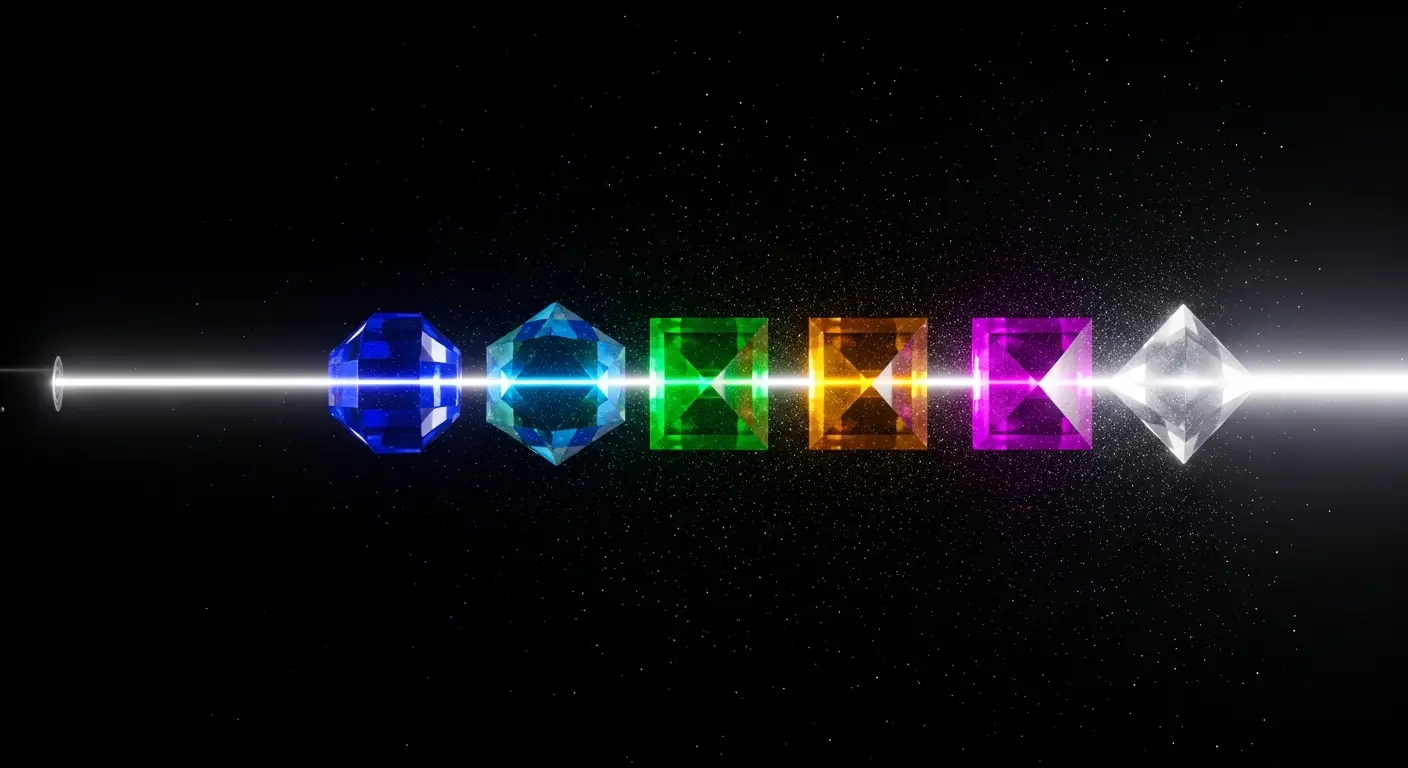
Jurek Frey and colleagues at Peter Grünberg Institute-Quantum Computing Analytics in collaboration with Saarland University, Ulm University demonstrate a pathway for creating key quantum connections between quantum bits, or qubits. They use germanium-vacancy (GeV) centres in diamond, which possess long-lived nuclear spins suitable for quantum computing and communication. Their research optimises the control of two-qubit gates, essential operations for distributing entanglement over long distances, and achieves high-fidelity gates exceeding 99.9% even when accounting for realistic noise. The research offers a scalable strategy for building group-IV quantum nodes and represents a sharp step forward in the field of distributed quantum technologies.
Hyperfine coupling mitigation enables near-perfect germanium-vacancy quantum gates
Gate fidelities now surpass 99.9 percent for germanium-vacancy (GeV) centres in diamond, a substantial improvement over previous limitations. The GeV centre, a point defect in the diamond lattice where a germanium atom replaces a carbon atom, exhibits a unique electronic structure that allows for the creation of stable, spin-active qubits. These qubits are formed by utilising both the electron spin and the nuclear spin of the germanium atom, offering a degree of robustness against environmental noise. However, strong hyperfine coupling, the interaction between the electron and nuclear spin, previously hindered achieving such precision. This coupling, while beneficial for initial spin manipulation, introduces complexities in precisely controlling the quantum states and can lead to decoherence, the loss of quantum information. Dr. Tim Schröder, Dr. Igor Usov, and Professor Guido Burkard successfully implemented strong SWAP gates at 99.91% and CNOT gates at 99.94% using quantum optimal control, a technique that sculpts electromagnetic fields to precisely manipulate qubits. Quantum optimal control involves sophisticated numerical algorithms that determine the optimal pulse shapes and timings to achieve desired quantum operations while minimising errors. This is achieved by iteratively refining the control pulses based on the calculated response of the qubit system.
Optimising the non-local component of the SWAP gate decreased its error by almost one order of magnitude, providing a scalable strategy for group-IV quantum nodes. The SWAP gate, crucial for entanglement distribution, exchanges the quantum states between two qubits. The ‘non-local’ component refers to the part of the interaction that relies on the spatial separation of the qubits and is particularly susceptible to noise. By carefully engineering the control pulses to minimise this non-local interaction, the researchers significantly reduced the error rate. This optimisation is particularly important for scalability, as it suggests that the same techniques can be applied to create larger networks of interconnected qubits without a proportional increase in error. These results are applicable to all group-IV colour centres, including silicon and germanium vacancies, as these defects share an electron spin-1/2 system. Group-IV elements, possessing four valence electrons, create defects with similar electronic structures when incorporated into the diamond lattice, making the findings broadly relevant to the development of diamond-based quantum technologies. The electron spin-1/2 system provides a well-defined two-level quantum system, ideal for encoding and processing quantum information. Utilising the strong coupling between the electron and carbon-13 nuclear spin exceeds environmental decoherence, enabling two-qubit gates with fidelities exceeding 99.9 percent. Carbon-13, a naturally occurring isotope of carbon, possesses a nuclear spin that can be harnessed to enhance qubit coherence and facilitate quantum operations.
The GeV centre’s strongly-coupled carbon-13 nuclear spin operates at a rate exceeding environmental decoherence, a major source of errors in quantum systems. Environmental decoherence arises from interactions between the qubit and its surroundings, such as lattice vibrations (phonons) and electromagnetic fluctuations. The strong coupling to the carbon-13 nuclear spin effectively shields the electron spin from these environmental perturbations, extending the coherence time and enabling more complex quantum computations. Refining the non-local component of the SWAP gate alone reduced its error by nearly one order of magnitude, highlighting a pathway to improved scalability. This demonstrates the power of targeted optimisation strategies in overcoming specific limitations in quantum hardware. Current fidelity figures, however, represent performance within a controlled laboratory setting and do not yet account for the complexities of interconnecting multiple nodes or maintaining coherence over extended periods, representing a key hurdle to building a practical quantum computer. Scaling up to many qubits introduces challenges related to cross-talk, control signal distribution, and maintaining uniform qubit properties. Furthermore, preserving coherence over longer timescales is essential for performing complex quantum algorithms.
Numerical modelling predicts near-perfect quantum gate performance in diamond defects
Reliable quantum connections are vital for building a future quantum internet, yet maintaining the delicate state of qubits remains a formidable challenge. A quantum internet, leveraging the principles of quantum mechanics, promises secure communication and distributed quantum computing capabilities. However, the fragility of quantum states necessitates the development of robust qubits and high-fidelity quantum connections. While fidelity thresholds are consistently pushed upwards, this investigation highlights a crucial gap between theoretical optimisation and practical implementation. The theoretical calculations demonstrate the potential for achieving near-perfect gate performance, but translating these results into a physical device requires overcoming various engineering and materials science challenges. Carefully tailored control pulses achieved impressive gate performance, though a demonstrated physical realisation is still required to assess the impact of unmodelled noise sources. The numerical simulations provide a valuable roadmap for experimental efforts, but the actual performance may be limited by factors not accounted for in the model, such as imperfections in the diamond crystal or fluctuations in the control signals.
Even acknowledging reliance on numerical modelling rather than a working device, the findings are significant for advancing quantum technology. The use of numerical modelling allows researchers to explore a wide range of control parameters and optimise gate performance before investing in costly and time-consuming experimental fabrication and characterisation. High-fidelity two-qubit gates exceeding 99.9% were demonstrated within germanium-vacancy centres in diamond, establishing a pathway to scalable quantum technologies. This level of fidelity is crucial for implementing complex quantum algorithms and achieving fault-tolerant quantum computation. These defects function as qubits, utilising the interaction between electron and nuclear spin, and open possibilities for strong quantum information processing. The combination of electron and nuclear spin degrees of freedom provides a versatile platform for encoding and manipulating quantum information. This advance provides a framework adaptable to other group-IV materials, suggesting a flexible route towards building interconnected quantum nodes for distributed computing and communication networks. The ability to utilise different group-IV materials offers advantages in terms of cost, availability, and compatibility with existing fabrication techniques, paving the way for the widespread adoption of diamond-based quantum technologies.
The research successfully demonstrated high-fidelity two-qubit gates, exceeding 99.9%, within germanium-vacancy centres in diamond. This achievement matters because such precise control of quantum bits is essential for building more complex and reliable quantum computers. Researchers used numerical modelling to optimise gate performance, providing a strategy for developing scalable quantum nodes. The framework developed is also adaptable to other group-IV materials, offering a versatile approach to quantum information processing and potentially distributed quantum networks.
👉 More information
🗞 Optimal Two-Qubit Gates for Group-IV Color-Centers in Diamond
🧠 ArXiv: https://arxiv.org/abs/2604.11340


See today’s quantum computing news on Quantum Zeitgeist for the latest breakthroughs in qubits, hardware, algorithms, and industry deals.



