Public Quantum Computing Companies are corporations actively involved in the research, development, and commercialization of quantum computing technologies. Their stocks are publicly traded on various stock exchanges.
Quantum computing is a significant leap from traditional computing. It harnesses the principles of quantum mechanics. This enables the processing of information in ways that classical computers can’t. This article is not financial advice.
Companies range from startups pioneering novel quantum hardware or algorithms. Established tech giants are expanding their portfolios into the quantum realm. Their work includes developing quantum processors. They are also creating quantum-resistant cryptographic methods. Additionally, they are exploring quantum computing applications in various fields like finance, healthcare, and cybersecurity.
As publicly listed entities, they offer investors the opportunity to engage financially in the quantum computing sector. This field is poised to revolutionize computing. It can solve complex problems beyond the reach of classical computers.


- Rigetti Computing (NASDAQ: RGTI)
- Quantum Computing Inc (NASDAQ: QUBT)
- D-Wave Systems (NYSE: QBTS)
- IonQ (NYSE: IONQ)
- Zapata AI (NASDAQ:ZPTA)
- Honeywell Quantum (NASDAQ: HON)
- Alibaba Group (NYSE: BABA)
- Fujitsu (TYO: 6702)
- Google (NASDAQ: GOOG)
- Intel (NASDAQ: INTC)
- NEC (TYO: 6701)
- Raytheon (NYSE: RTX)
- Toshiba (TYO: 6502)
- NVIDIA (NASDAQ: NVDA)
- IBM (NYSE: IBM)
- Microsoft (NASDAQ: MSFT)
- Amazon (NASDAQ: AMZN)
Rigetti Computing (NASDAQ: RGTI)
Rigetti Computing, a noteworthy name in quantum computing, has been making significant strides. The company gained attention by developing a modular superconducting qubit architecture in August 2023, enhancing quantum computing capabilities.
A fundamental leadership change occurred in November 2022. Founder Chad Rigetti stepped down as CEO. His new focus is on product development. Rigetti is also recognized for collaborating with the US Military Agency DARPA ONISQ Program. The company is also known for its initiative to build the first commercial quantum computer in the UK.
Rigetti unveiled the Novera Quantum Processing Unit (QPU), a 9-qubit processor designed for hands-on quantum research and development. The Novera QPU is Rigetti’s first commercially available processor, providing researchers with unprecedented access to quantum technology.
Quantum Computing Inc (NASDAQ: QUBT)
Quantum Computing Inc. is deeply involved in various quantum initiatives and collaborations. These efforts illustrate the practical applications of quantum computing in the financial sector. One such partnership is with Rabobank. The company’s capabilities in optimizing complex systems were highlighted when VIPC designated Quantum Computing Inc. as a partner for risk-based flight trajectories.
Their service expansion includes launching a subscription service for Dirac 1 Entropy Quantum Computing. They have also demonstrated their technological prowess. They solved a complex problem for BMW in just six minutes.
D-Wave Systems (NYSE: QBTS)
D-Wave Systems stands out as a pioneer in quantum computing. A business combination with DPCM Capital and the launch of the QBTS stock ticker in 2022 marked the company’s growth. D-Wave has shown its commitment to advancing quantum applications. This is evident in its strategic partnership with Mastercard. It is also evident in its development of advanced Fluxonium Qubits.
In April 2024, D-Wave unveiled a fast-anneal feature, enhancing the performance of their quantum annealing systems. This advancement is expected to attract both commercial and academic researchers. They aim to develop advanced applications and conduct bench marking studies.
Additionally, in January 2025, D-Wave announced the Leap Quantum LaunchPad program. This initiative offers qualified participants a three-month free trial, providing access to D-Wave’s annealing quantum computing technology and support resources. The program is designed to accelerate the development and deployment of quantum and hybrid applications. It enables organizations to quickly realize the benefits of quantum computing.
IonQ (NYSE: IONQ)
IonQ has announced significant deals, such as a $25.5M Quantum Deal with the United States Air Force Research Lab. The company introduced Quantum Computing Systems named Forte and Tempo, promising commercial advantages and performance.
IonQ’s global expansion includes partnerships across Europe and collaborations to advance quantum computing in generative AI applications. Their growth is also reflected in their financial achievements, including record bookings and the establishment of their first Quantum Data Center in Europe.
Zapata AI (NASDAQ:ZPTA)
Zapata AI was founded in 2017 as a Harvard spinout. It initially specialized in quantum software. Later, it pivoted to focus on artificial intelligence (AI). In April 2024, the company went public via a special purpose acquisition company (SPAC) merger with Andretti Acquisition Corp.
Zapata AI went public after a merger with Andretti Acquisition Corp. The company has collaborated with IonQ on generative AI applications. They also worked with Insilico Medicine for drug discovery using quantum-enhanced AI.
By October 2024, Zapata AI ceased operations due to financial challenges, including an inability to meet financial obligations.

Honeywell Quantum (NASDAQ: HON)
Honeywell Quantum has emerged as a significant player in quantum computing. Their merger with Cambridge Quantum Computing created Quantinuum. This marked an important event in the industry. It became one of the largest pure quantum companies with several hundred employees.
Honeywell has integrated quantum-enhanced encryption in smart meters and introduced the H1 System, a leading development in quantum physics. Their latest Quantum System Model achieved a remarkable Quantum Volume. The collaboration with Cambridge Quantum has played a central role in their journey towards mainstream quantum computing.
In April 2024, Quantinuum’s H-Series quantum computers reached a quantum volume of 1,048,576, further advancing the field. Additionally, the company achieved a two-qubit gate fidelity of 99.9%, marking a significant milestone in quantum computing performance.
In December 2024, Honeywell announced the closing of a $300 million equity investment round for Quantinuum. This valued the company at a pre-money valuation of $5 billion. This investment aims to accelerate the development and commercialization of quantum technologies.

Alibaba Group (NYSE: BABA)
Alibaba has recognized the potential of quantum computing, establishing the Alibaba Cloud Quantum Laboratory (ACQL) to explore quantum computing’s frontiers. The ACQL focuses on quantum algorithms, Quantum Machine Learning (QML), and hardware infrastructure. It aims to bridge the gap between theory and practice in quantum algorithms.
Their collaboration with the Chinese Academy of Sciences has led to the launch of a quantum computing cloud platform. This collaboration emphasizes their vision to make quantum computing more accessible globally. Although recent reports suggest the company has shuttered its Quantum Offering.
In November 2023, Alibaba’s DAMO Academy, the company’s in-house research initiative, closed its quantum computing laboratory. This was part of a broader restructuring effort. The lab, which employed approximately 30 staff members, was donated to Zhejiang University, along with its experimental equipment.
This strategic shift shows DAMO Academy’s decision. They decided to focus on artificial intelligence (AI) research. This moves them away from their earlier emphasis on quantum computing.
Baidu (NASDAQ: BIDU)
Baidu’s venture into quantum computing is marked by its strategic approach and global aspirations. In August 2022, Baidu unveiled its first superconducting quantum computer, Qianshi, featuring 10 superconducting qubits.
The company has unveiled a cloud quantum computing service. It has taken significant steps like open-sourcing its quantum machine learning toolkit. These actions indicate its commitment to quantum advancements beyond China.
In January 2024, Baidu decided to halt its quantum computing division. The company donated its entire research facility to the government-run Beijing Academy of Quantum Information Sciences (BAQIS). This action signals a strategic shift away from quantum computing research.
Fujitsu (TYO: 6702)
Fujitsu introduced the Digital Annealer in 2017, a quantum-inspired computing platform designed to solve combinatorial optimization problems. Although it was not a quantum computer in the strictest sense, it used principles from quantum mechanics (particularly quantum annealing) to solve problems much faster than traditional computers.
The Digital Annealer was positioned as a bridge between classical and quantum computing and aimed at industries like logistics, manufacturing, and finance.
In 2021, Fujitsu began working on its own superconducting quantum processor, seeking to develop a fully-fledged quantum computer. The company aimed to build a scalable, high-fidelity quantum processor that could address a wide range of applications, including AI and machine learning, financial modeling, and materials science.
Fujitsu launched a cloud-based quantum computing service, offering both quantum-classical hybrid computing and access to their Digital Annealer systems. The platform was designed to allow businesses and researchers to experiment with quantum algorithms and optimization solutions without needing to own or maintain quantum hardware.
Fujitsu’s involvement in quantum-related ventures is evident in its partnerships and innovations. The company collaborated with CESGA to launch a Quantum Knowledge Center in Spain. Its Digital Annealer has unlocked new potential in the investment sphere. Fujitsu’s dedication to advancing quantum technology is clear in these initiatives.
Google (NASDAQ: GOOG)
Google unveiled Bristlecone, its quantum processor that consisted of 72 qubits in 2017. The processor was designed as a testbed for future scaling and error correction techniques. It was a significant milestone in Google’s quantum hardware development, laying the foundation for future quantum supremacy experiments.
In October 2019, Google made a historic breakthrough by demonstrating quantum supremacy. Google used their 53-qubit Sycamore processor to solve a computational problem in 200 seconds. This problem would have taken the world’s most powerful classical supercomputer approximately 10,000 years to complete. This event marked a significant advancement in quantum computing. It proved that quantum computers could solve problems that classical computers cannot.
Google has made significant strides in quantum computing alongside its achievements in AI. The company has also been working on Quantum-Resistant Cryptography in its Chrome browser and has committed $50M towards a Quantum Computing Partnership with universities.
Google Cirq is an open-source quantum computing framework developed by Google for creating, simulating, and running quantum circuits on quantum hardware (programming a quantum computer). It is designed specifically for quantum processors such as Google’s Sycamore chip, but it can also interface with other quantum hardware and simulators.
The Willow chip is a quantum processor developed by Google to advance its quantum computing efforts in late 2024. It is specifically designed to focus on improving quantum error correction (QEC). This approach addresses one of the most significant challenges in quantum computing.
Quantum systems are highly susceptible to errors due to decoherence and noise. This innovation makes Willow a more reliable chip. It enables quantum computers to handle errors more efficiently. It also allows for the execution of more stable and accurate quantum algorithms.
Willow is built on superconducting qubits. It aims to increase the number of qubits compared to previous processors like Sycamore. Sycamore was central to Google’s quantum supremacy achievement in 2019. This increase in qubit count will enable the processing of more complex quantum circuits. Processing these circuits is essential for tackling practical problems in chemistry, material science, and optimization.
Intel (NASDAQ: INTC)
Intel began its involvement in quantum computing in the early 2000s. They focused on both quantum theory and quantum hardware research. The company initially explored quantum computing to overcome the limitations of classical silicon-based transistors. They were particularly interested in areas such as computational speed and energy efficiency.
Intel unveiled its first quantum processor based on silicon, the Tangle Lake chip. The Tangle Lake processor was a 49-qubit superconducting quantum processor. Intel focused on building a scalable quantum architecture. They leveraged existing silicon-based technologies. They believed this approach would be more compatible with classical semiconductor manufacturing processes.
Intel introduced the Horse Ridge II cryogenic control chip. This part is crucial for improving the operation of quantum processors. It reduces complexity. Horse Ridge II aimed to improve the scalability of quantum computers significantly. It did this by integrating cryogenic electronics directly into the quantum processor.
The company unveiled the Tunnel Falls Chip with 12 qubits, showcasing their progress in spin-based quantum dot quantum systems.
Quantum dots are semiconductor devices that can trap individual electrons. Intel’s research aims to harness their properties for quantum information processing. The Tunnel Falls chips represent a significant advancement for Intel. They help in building a large-scale, reliable quantum computing platform. Intel uses conventional semiconductor technologies to overcome key quantum computing challenges.
Intel’s Tunnel Falls chips are part of the company’s broader strategy. They aim to integrate quantum processors with control electronics on the same chip. This integration simplifies the architecture of quantum systems, making them easier to scale.
The chips are designed for testing. They aim to combine quantum processing with cryogenic control electronics effectively. These control electronics need to manage quantum operations at extremely low temperatures.
Intel plans to use its advanced silicon manufacturing capabilities. They aim to develop quantum processors that can be scaled from a handful of qubits to thousands. This scaling is a necessary step toward building practical, fault-tolerant quantum computers.
The Tunnel Falls chips focus on scalability. They are also part of Intel’s research into improving quantum error correction. Furthermore, they work on enhancing qubit coherence times.

Additionally, Intel’s focus extends to software development. It released its Intel Quantum Software Development Kit (SDK). This demonstrates its commitment to building a robust quantum programming environment. Intel is leading in next-generation technological advancements.
NEC (TYO: 6701)
NEC began its exploration into quantum computing in the early 2000s. The company initially focused on the theoretical aspects of quantum algorithms. It also invested in experimental quantum communication. These efforts were part of its broader research into advanced computing technologies.
NEC partnered with NTT (Nippon Telegraph and Telephone Corporation). They aim to explore the use of quantum key distribution (QKD). They will also focus on other quantum communication technologies. This collaboration also included joint efforts in developing quantum cryptography systems for secure data transmission.
NEC developed an 8-qubit Quantum Annealing Machine, which explored the potential of quantum annealing for solving optimization problems. Quantum annealing is a quantum computing method. It is designed to find the optimal solution to complex problems by exploiting quantum mechanics. This involves using the concept of quantum tunneling to navigate large solution spaces more efficiently than classical approaches.
Raytheon (NYSE: RTX)
Raytheon Technologies is increasingly involved in quantum computing, particularly through its Raytheon BBN Technologies division. Raytheon’s focus on quantum computing primarily revolves around applying quantum technologies to enhance its work in defense, aerospace, and cybersecurity. The company recognizes the potential of quantum computing to revolutionize various sectors, particularly in solving complex problems related to optimization, machine learning, and simulation.
Raytheon is also exploring the use of quantum algorithms for applications such as aircraft design, radar systems, and sensor technologies. The company is engaging with academic institutions and industry leaders. They aim to stay at the forefront of quantum developments. They also seek to integrate these cutting-edge technologies into their existing product lines and solutions.
Toshiba (TYO: 6502)
The company has not yet developed a large-scale quantum computer. Nonetheless, it has made advancements in quantum key distribution (QKD). This is a critical application of quantum mechanics for secure communication.
Toshiba’s expertise in semiconductors and optics is crucial in their quantum research. These fields particularly help in advancing quantum-safe cryptography solutions. These solutions can withstand the threats posed by future quantum computers.
Toshiba’s achievements include developing Quantum Key Distribution to protect data against future quantum computing threats. Toshiba collaborates with companies like BT to construct quantum-secured networks. They have also integrated their Ising machine into Azure Quantum. These are testaments to Toshiba’s active role in the quantum industry.
NVIDIA (NASDAQ: NVDA)
NVIDIA’s DGX systems, introduced in 2016, were pivotal in advancing the broader field of quantum computing. They provided high-performance computing (HPC) infrastructure. These systems are crucial for simulating quantum algorithms. They are used for modeling quantum systems. They also run machine learning tasks that complement quantum computing research. The DGX systems leveraged NVIDIA’s GPUs to accelerate simulations and parallel computing workloads for quantum research.
CUDA-Q is a software development framework introduced by NVIDIA to enable the development of quantum computing applications using GPU-based acceleration. It is part of NVIDIA’s efforts to bridge the gap between classical and quantum computing. They combine the power of CUDA (NVIDIA’s parallel computing platform) with quantum programming models. CUDA-Q allows developers to implement quantum algorithms on GPUs, thereby speeding up the simulation of quantum circuits and quantum algorithms.
NVIDIA, the GPU Giant, released cuQuantum. This software development kit (SDK) accelerates the simulation of quantum circuits on classical GPUs. This innovation enabled researchers to simulate quantum algorithms on NVIDIA GPUs with high efficiency. It dramatically reduced the time required to run quantum simulations.
cuQuantum is a well used tool for researchers in quantum computing. It is particularly valuable in the field of quantum chemistry and materials science. Simulations of quantum phenomena in these fields are computationally intensive.
IBM (NYSE: IBM)
IBM, often called Big Blue, has been a key player in quantum computing for decades. It contributes significantly to the development of quantum hardware. It also supports the growth of quantum software ecosystems.
The company has focused on creating a broad quantum ecosystem. It emphasizes quantum hardware development. It also focuses on quantum programming languages and cloud-based quantum computing services. IBM’s involvement in quantum computing includes many milestones. These innovations have established the company as a leader in the field.
IBM Q Experience: IBM launched the IBM Q Experience. It was the world’s first cloud-based quantum computing platform. This platform allowed anyone with an internet connection to access a quantum computer for the first time. This platform used a 5-qubit quantum processor. It provided a quantum computing interface, Qiskit. This allowed users to create and test quantum algorithms remotely.
IBM Quantum Hummingbird: IBM released its Quantum Hummingbird processor, a 16-qubit quantum processor. This was part of their roadmaps to build quantum computers capable of solving real-world problems. IBM also began using this processor for benchmarking, algorithm testing, and scaling up to more advanced quantum systems.
IBM’s milestones in quantum computing reflect its position as a pioneer in the field. From their first 5-qubit quantum processor to their development of cloud-based quantum platforms and ambitious plans for scaling up to multi 1,000+ qubit systems.
By 2026, IBM aims to enhance quantum circuits with up to 7,500 gates. They will achieve this through improvements in circuit quality. An ambitious roadmap will guide these advancements. This advancement will automate quantum circuits and increase their depth. It will facilitate more complex computations. It will also broaden the scope of quantum applications.
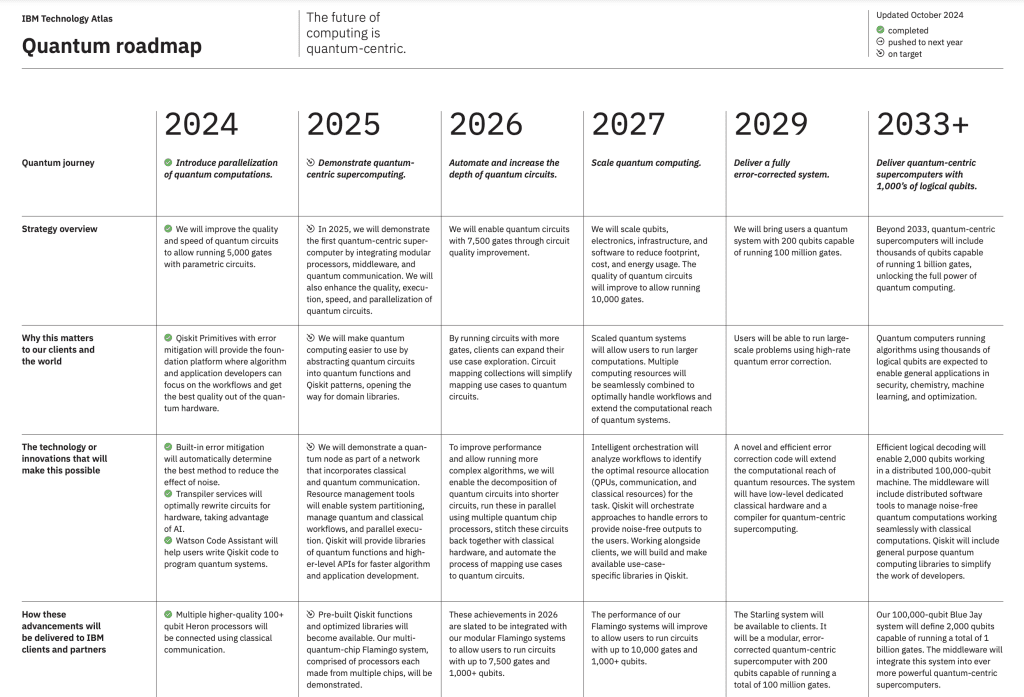
IBM’s significant contributions to quantum computing include collaborations with institutions. They work with organizations like CERN and DESY. They also house the first university-based IBM Quantum System One at Rensselaer Polytechnic.
Microsoft (NASDAQ: MSFT)
Microsoft’s advancements in quantum computing are centered around its Azure Quantum platform. The company has been exploring hybrid quantum algorithms and collaborating with various entities to revolutionize innovation using Azure Quantum. These efforts highlight Microsoft’s dedication to harnessing quantum computing’s potential. It is also behind the Q# language.
In 2021, Microsoft achieved a significant milestone. They demonstrated the creation and control of Majorana quasiparticles. These quasiparticles are essential for topological qubits. This advancement brings the company closer to realizing a topological quantum computer. This computer is capable of outperforming classical systems in specific computational tasks. It appears that Microsoft has abandoned this methodology.
Microsoft and Atom Computing have formed a strategic partnership to advance quantum computing technologies. They are focusing on developing reliable and scalable quantum systems.
In November 2024, the collaboration achieved a significant milestone by creating and entangling 24 logical qubits using neutral atom qubits. This advancement demonstrated the ability to detect and correct errors, marking a major step toward fault-tolerant quantum computing.
Amazon (NASDAQ: AMZN)
Amazon Web Services (AWS) has been actively collaborating with quantum technology providers and researchers. Initiatives include expanding the availability of Aquila Quantum Computer on Amazon Braket. Another initiative is integrating the Wolfram Language with Amazon Braket. These actions demonstrate Amazon’s commitment to the quantum technology field.
Amazon Braket is a fully managed quantum computing service. It is offered by Amazon Web Services (AWS). Researchers, scientists, and developers can build, test, and run quantum algorithms on a variety of quantum hardware platforms using it. It allows on-demand access to quantum processing units (QPUs) from multiple providers. This includes superconducting qubits from Rigetti and IonQ. The service also offers neutral atom-based processors from QuEra Computing.
Legal Disclaimer
Quantum Zeitgeist does not provide personal investment or financial advice, or act as personal financial, legal, or institutional investment advisors, or individually advocate the purchase or sale of any security or investment or the use of any particular financial strategy. All investment strategies include the risk of loss for some or even all of your capital.
Before pursuing any financial strategies discussed or relying on information within this website, you should always consult with a licensed financial advisor. Any analysis we provide is for informational purposes only and does not take into consideration your circumstances or other factors that may be important in making decisions. It should not be considered an individualized recommendation or personalized investment advice. Any investment vehicles, stocks, or securities mentioned may not be suitable for all investors.