Recently, a newly published study has outlined several methods that colleges and universities can use when updating their curricula to help train new quantum workers that will enter the industry’s workforce. Rochester Institute of Technology Associate Professor Ben Zwickl, one of three researchers, suggested these methods after interviewing more than 20 managers working in quantum technology companies across the US.
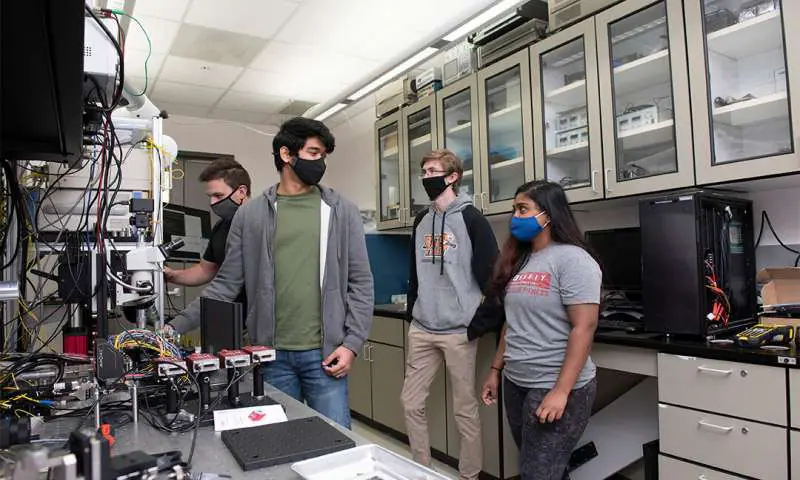
The authors from the University of Colorado Boulder and RIT wanted to understand entry-level positions these companies offered, as well as the education pathways directly leading into said jobs. These companies do seek employees with traditional STEM degrees, but also want candidates to have basic quantum information science (QIS) and technology knowledge when applying.
‘For a lot of those roles, there’s this idea of being ‘quantum aware’ that’s highly desirable. The companies told us that many positions don’t need to have deep expertise, but students could really benefit from a one- or two-semester introductory sequence that teaches the foundational concepts, some of the hardware implementations, how the algorithms work, what a qubit is, and things like that. Then a graduate can bring in all the strength of a traditional STEM degree but can speak the language that the company is talking about.’
Professor Ben Zwickl, a member of RIT’s Future Photon Initiative and Centre for Advancing STEM Teaching, Learning and Evaluation
Colleges should be offering introductory, multidisciplinary courses with few prerequisites that allow software engineering, computer science, physics, and other STEM majors to learn the core concepts of QIS and quantum technology. By providing this education to these students across disciplines, they will be able to adapt and disrupt a wide range of fields, due to quantum technology’s potential.
‘It’s a growing industry that will produce new sensors, imaging, communication, computing technologies, and more. A lot of the technologies are in a research and development phase, but as they start to move toward commercialization and mass production, you will have end-users who are trying to figure out how to apply the technology. They will need technical people on their end that are fluent enough with the ideas that they can make use of it.’
Professor Ben Zwickl
The professor’s participation in this study was partly supported by RIT receiving funds from NSF’s Quantum Leap Challenge Institutes program. As a co-PI and lead for the proposal’s education and workforce development, he wants to apply many of the study’s lessons to RIT’s curriculum. Two new introductory RIT courses in quantum information and science are being developed, as well as an interdisciplinary minor of the above subjects.