Experiments with cesium atoms are revealing the subtle influence of a newly considered “neutrino force,” a phenomenon where neutrinos team up to transmit influences between particles and potentially reshaping our understanding of fundamental forces. The effect, not predicted by the established Standard Model, arises because neutrinos and other particles can act as force carriers despite traditionally being considered matter. Physicists discovered that incorporating this force into their calculations resolved a long-standing discrepancy between theory and experimental results, as detailed in a paper submitted in February to arXiv.org. “Once the forces were considered, the tension disappeared completely,” says theoretical physicist Victor Flambaum of University of New South Wales in Sydney, a coauthor of the paper, suggesting this previously neglected force may be larger than anyone had guessed.
Neutrino Force Resolves Cesium Atom Experiment Discrepancy
A subtle force mediated by neutrinos appears to have resolved a longstanding discrepancy between theoretical predictions and experimental results in cesium atom measurements, challenging conventional understandings of particle interactions. Physicists discovered that incorporating the effects of this “neutrino force” into their calculations eliminated a previously observed tension, suggesting the force isn’t merely theoretical but demonstrably influences real-world experiments. This finding is particularly notable because the Standard Model of particle physics doesn’t typically account for force transmission via neutrinos or electrons, traditionally considered matter particles rather than force carriers. While the concept of a neutrino force dates back to the 1960s, it was largely dismissed as insignificant until recently. The team’s calculations revealed that the neutrino force, alongside similar forces carried by pairs of quarks and electrons, accounted for the observed shift in parity violation experiments.
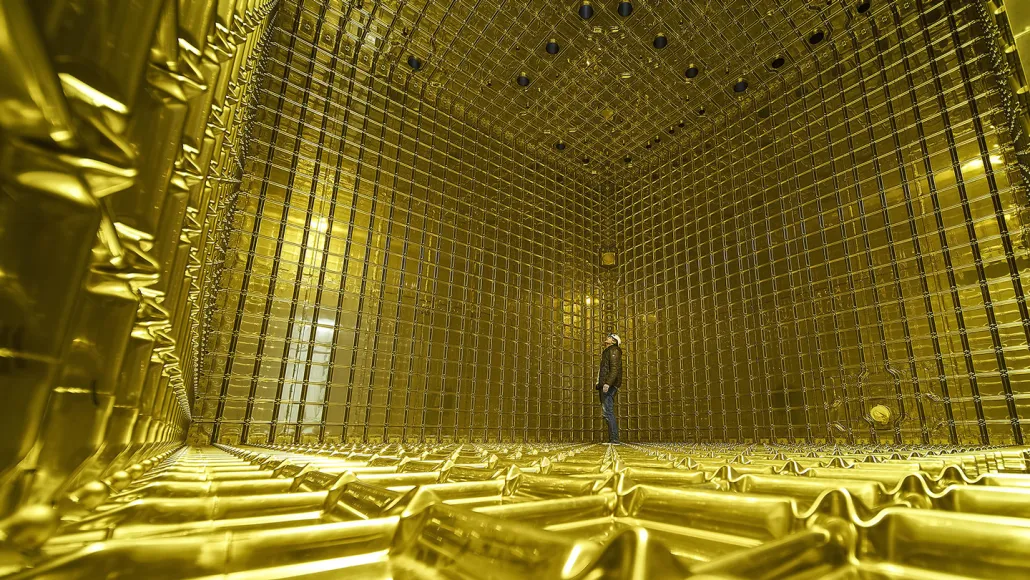
The discrepancy arose in highly precise measurements of parity violation in cesium atoms, a phenomenon where mirror images of systems behave differently. These experiments are crucial because physicists are constantly seeking deviations from the Standard Model, hoping to uncover clues about unresolved mysteries like dark matter. Understanding these subtle effects requires increasingly sophisticated experiments; ProtoDUNE, a prototype for the larger DUNE neutrino detector, is relevant for detecting these elusive particles and the forces they might mediate, demonstrating the importance of large-scale facilities for probing these interactions.
Fermion Pairing Explains Force Transmission Beyond Bosons
The established understanding of force transmission in particle physics relies heavily on bosons, particles like photons responsible for mediating interactions. However, recent theoretical work suggests a more nuanced picture, one where fermions, the building blocks of matter, including neutrinos and electrons, can also contribute to force transmission through a pairing mechanism. This concept, initially proposed in the 1960s, posited that two fermions could combine to effectively act as a boson, opening the possibility of forces mediated by these typically non-force-carrying particles. For decades, the idea remained largely theoretical, considered too insignificant to impact experimental results, but new calculations indicate otherwise. Researchers have now demonstrated that these “neutrino forces,” alongside similar effects from paired quarks and electrons, may be influencing highly precise experiments, specifically those measuring parity violation in cesium atoms.
While detecting the force directly remains a challenge due to its inherent weakness, theoretical physicist Yuval Grossman of Cornell University notes, “At the end of the day, this force is so, so small that so far we were never able to see it.” The impact on existing measurements provides compelling evidence for its existence and importance. Physicist Dmitry Budker of Johannes Gutenberg University Mainz in Germany adds, “It’s very good that theorists are getting better and better, and this is important.”
It’s as if a clock built to tick clockwise behaved differently than one built to tick counterclockwise.
ProtoDUNE Detectors & Parity Violation Measurements
The search for physics beyond the Standard Model is increasingly focused on subtle effects, and researchers at CERN are leveraging the ProtoDUNE detector to refine these investigations. ProtoDUNE, a prototype for the future Deep Underground Neutrino Experiment (DUNE), isn’t simply designed to observe neutrinos; its precision is proving vital in understanding forces previously considered negligible. Recent theoretical work suggests that a “neutrino force,” mediated by pairs of neutrinos, could be influencing experiments measuring parity violation in atoms, and the capabilities of ProtoDUNE are central to validating these claims. This isn’t merely a theoretical exercise; discrepancies between experimental results and Standard Model predictions in cesium atom parity violation experiments prompted a re-evaluation of known forces. Physicists, including those working with the ProtoDUNE collaboration, are now accounting for forces transmitted by pairs of particles, neutrinos, electrons, and even quarks, that were previously dismissed as inconsequential.
The team’s analysis, submitted in February to arXiv.org, demonstrates that incorporating these forces resolves the observed mismatch, suggesting a more complete understanding of fundamental interactions. The implications extend beyond cesium, and many would agree that this is interesting. While neutrinos are notoriously difficult to detect due to their weak interactions, the sensitivity of detectors like ProtoDUNE is crucial for probing these subtle effects.
“At the end of the day, this force is so, so small that so far we were never able to see it,”


See today’s quantum computing news on Quantum Zeitgeist for the latest breakthroughs in qubits, hardware, algorithms, and industry deals.