

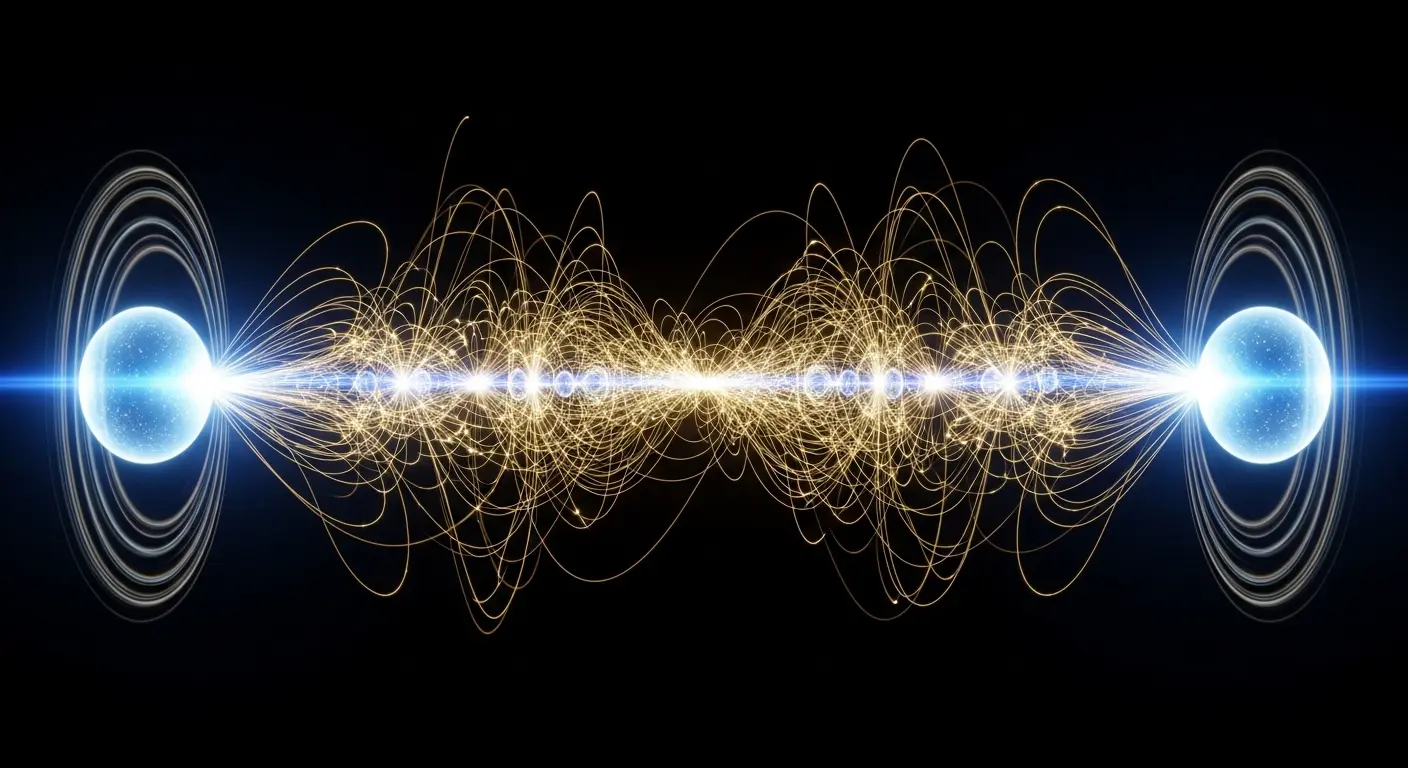
Scientists at Aalto University have conducted a detailed investigation into the behaviour of entanglement within superconducting circuits when subjected to multiple microwave signals, offering significant insights for the advancement of quantum computation. Mikael Vartiainen and colleagues demonstrate that increasing the number of parametric pump tones, while seemingly counterintuitive, does not enhance initial entanglement but redistributes it across numerous modes, establishing connections to new frequencies and impacting the design of complex quantum architectures. The findings directly address the pervasive issue of dissipation, a critical limitation hindering the scalability of entangled states in microwave quantum computing, and rigorously confirm theoretical predictions through careful experimental analysis of two-mode squeezing within a Josephson parametric amplifier.
Enhanced microwave entanglement via optimised multi-tone parametric amplification
Two-mode squeezing, a fundamental quantum resource essential for continuous-variable quantum computing, has now been achieved at a level of -12 dB in Josephson parametric amplifier (JPA) circuits. This represents a substantial improvement over previously reported results, notably surpassing the -9.5 dB achieved in travelling wave parametric amplifiers. This advancement opens new and promising avenues for generating robust entangled states within the microwave domain, a realm historically plagued by dissipation which severely limits the scalability of quantum systems. The Aalto University team has demonstrated that increasing the number of parametric pump tones, rather than simply amplifying entanglement, fundamentally alters its distribution. Specifically, it diminishes initial two-mode correlations, effectively redistributing entanglement across a larger and more complex network of modes and introducing previously unconnected idler frequencies. These idler frequencies are inherent byproducts of the parametric amplification process and their presence significantly impacts the design of pump-engineered cluster-state architectures, a specific and promising approach to continuous-variable quantum computation. Experiments utilising up to fifteen parametric pump tones have successfully expanded the network of entangled connections within the quantum circuit, allowing for a more granular control over entanglement distribution. Detailed analysis of both symmetric and asymmetric pumping configurations revealed crucial differences in their effects. Symmetric pumping configurations generate numerous beam splitter correlations between modes, effectively creating a web of entanglement. Conversely, asymmetric pumping, despite utilising fewer such correlations, leads to a greater loss of information and a less efficient distribution of entanglement, highlighting the importance of precise control over pump signal characteristics.
Optimising entanglement distribution requires subtle microwave signal control
The creation of increasingly intricate and robust entanglement is paramount for the realisation of powerful, large-scale quantum computers. However, maintaining this delicate quantum state, susceptible to environmental noise and imperfections, proves exceptionally difficult. The challenge of effectively distributing entanglement across numerous interconnected components within a quantum circuit is now being actively addressed by researchers, a problem significantly exacerbated by unavoidable signal loss and decoherence. The research reveals that simply adding more microwave signals to attempt to ‘boost’ entanglement does not necessarily improve overall performance; instead, it fundamentally alters the distribution of entanglement, potentially weakening the connections between individual components and hindering the creation of a truly scalable quantum system. This is because each added pump tone introduces new degrees of freedom and pathways for entanglement, diluting the strength of existing correlations.
Pump configurations can be meticulously optimised to tailor both the frequencies and power levels of the applied microwave signals, strategically concentrating entanglement where it’s most effective within the quantum circuit. Josephson parametric amplifier experiments demonstrated that increasing the number of parametric pump tones introduces entanglement with additional, previously unconnected frequencies, profoundly impacting the scalability of ‘cluster-state’ architectures. These architectures rely on a specific topology of entangled qubits, and the introduction of unwanted connections can disrupt this structure. Sophisticated modelling indicates that increasing the number of coupled modes inherently redistributes entanglement, reducing the strength of correlations between any specific pair of modes. This reduction in pairwise entanglement is a key factor when designing scalable quantum architectures, as strong, reliable connections are essential for performing complex quantum operations. Further investigation revealed that this approach significantly affects the flow of entanglement throughout the circuit, demanding careful consideration of how initial connections between microwave photons are altered as they propagate across the circuit. The JPA, acting as a non-linear element, mediates these interactions, and its characteristics dictate the efficiency of entanglement transfer. Understanding these dynamics is crucial for developing strategies to preserve and enhance entanglement in larger, more complex quantum processors. The -12 dB squeezing achieved represents a significant step towards overcoming the limitations imposed by dissipation, allowing for the propagation of entangled states over longer distances and enabling the construction of more robust and scalable quantum circuits.
The research demonstrated that adding multiple parametric pump tones to a quantum circuit diminishes initial entanglement by distributing it across more modes. This is important because scalable cluster-state quantum computing relies on strong connections between a specific set of qubits, and additional connections weaken these crucial correlations. Experiments using a Josephson parametric amplifier showed that increasing pump tones introduces entanglement with new frequencies, impacting the circuit’s scalability. The team’s modelling and -12 dB squeezing achievement provide insight into managing entanglement distribution within these complex systems.
👉 More information
🗞 Bipartite entanglement under frequency comb pumping in parametric Josephson circuits
🧠 ArXiv: https://arxiv.org/abs/2604.21692



See today’s quantum computing news on Quantum Zeitgeist for the latest breakthroughs in qubits, hardware, algorithms, and industry deals.



