

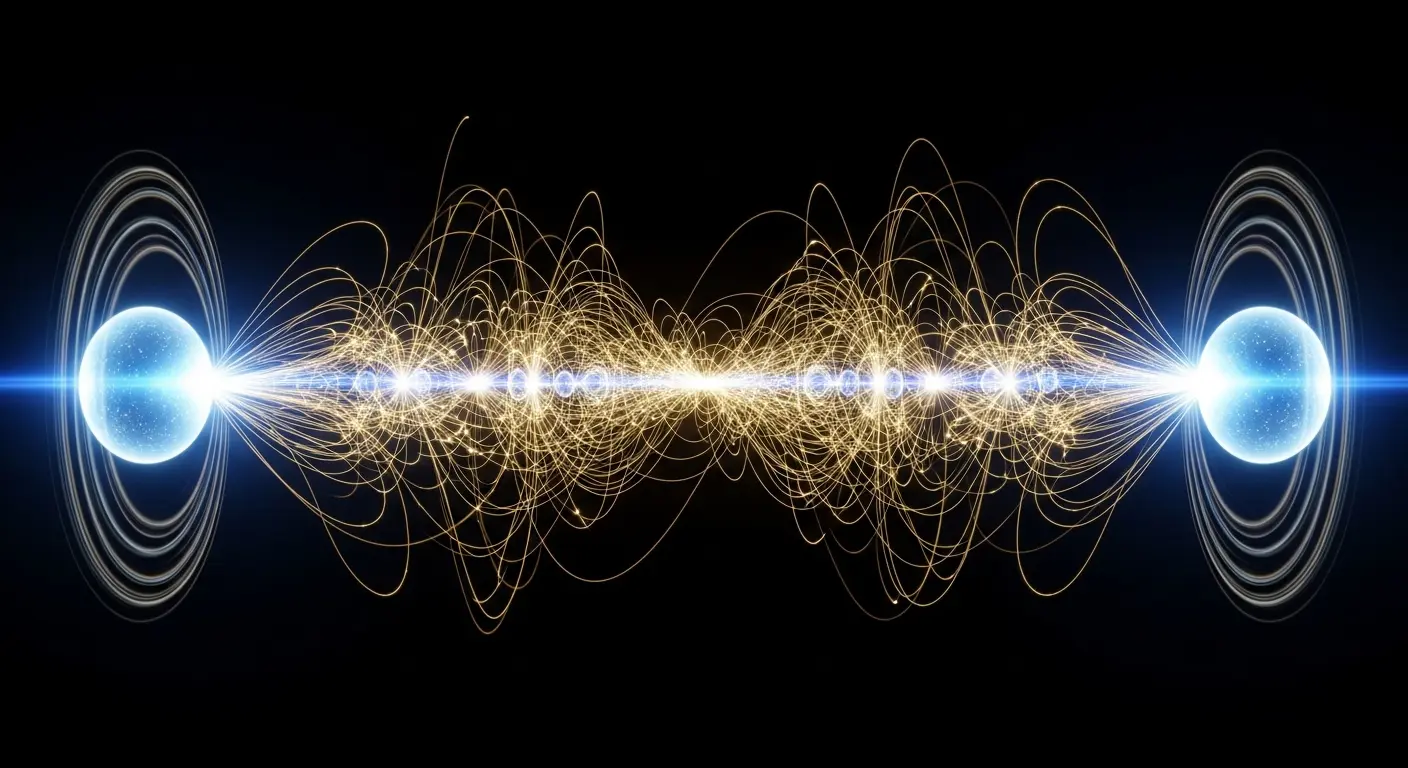
A new analysis from the University of Trieste, led by Anirudh Gundhi and colleagues, reveals that previously reported gravitational entanglement may not be as strong as initially believed. The work challenges a recent claim, published in Nature [Nature, 646, 813 (2025)] by Aziz and Howl, that quantum particles entangle through classical gravitational interactions, showing the observed entanglement results from a mathematical simplification in the original analysis. By retaining previously discarded terms in the calculations, the team proves an initially separate quantum state remains unentangled, suggesting classical gravity alone cannot generate this quantum phenomenon. This finding is key because it clarifies the fundamental relationship between gravity and entanglement, impacting our understanding of quantum gravity and the emergence of quantum behaviour in classical systems. The implications extend to ongoing research attempting to bridge the gap between general relativity and quantum mechanics, potentially refocusing efforts on more complete theoretical frameworks.
Reconstructed calculations eliminate induced entanglement from classical gravity
Entanglement measures now reveal a previously overestimated effect, decreasing to effectively zero when all relevant quantum amplitudes are accounted for. This dramatic shift indicates that initial reports of entanglement arising from classical gravitational interaction stemmed from a mathematical approximation; the calculations were carefully reconstructed, revealing the importance of discarded terms for an accurate assessment. The analysis confirms that an initially factorized quantum state remains factorized over time, challenging the notion that gravity alone can induce quantum entanglement in this scenario. This finding clarifies the fundamental relationship between gravity and quantum mechanics, and stresses the importance of complete calculations in quantum gravity research. The original calculations, based on a simplified model of gravitational interaction, assumed a static and classical gravitational potential, neglecting potential quantum fluctuations that could contribute to entanglement. The current work demonstrates that even within this classical framework, a complete treatment of the quantum dynamics eliminates the spurious entanglement.
Detailed analysis of the transition amplitudes revealed that discarded terms, crucial for accuracy, led to an overestimation of entanglement. In particular, off-diagonal terms, representing transitions between different quantum states, were incorrectly neglected in prior work. These terms, while often small, contribute significantly to the overall quantum dynamics and cannot be ignored without introducing inaccuracies. Calculations demonstrate that the dominant exchange coefficient, βRL, while larger than βLL, βRR, and βLR, still maintains a factorized structure, meaning the initial quantum state remains independent over time. This factorized structure is a direct consequence of including the previously discarded terms, effectively decoupling the particles despite their gravitational interaction. Furthermore, the analysis confirms this effect holds even for identical particles, arising solely from wave function symmetrization, not virtual particle exchange. These findings reinforce that classical gravity, within this non-relativistic framework, cannot generate entanglement; however, the current results do not address scenarios involving relativistic effects or particle creation, where entanglement via gravity is theoretically possible. The non-relativistic framework employed simplifies the calculations but limits the scope of the conclusions to systems where velocities are much less than the speed of light.
Identifying the mathematical origin of spurious gravitational entanglement claims
While mathematically sound, the dismissal of gravitational entanglement under these conditions doesn’t resolve the broader question of quantum gravity; it simply clarifies the limitations of a specific calculation. The analysis focused on an initially factorized quantum state, but what happens if the initial state is already subtly correlated, or if the particles aren’t prepared in such a clean configuration. Investigating these scenarios requires more complex calculations and may reveal different behaviours. Nevertheless, this detailed analysis matters because it pinpoints exactly where earlier claims of gravitational entanglement went awry, revealing a subtle but critical error in mathematical treatment. The original approach, while seemingly reasonable, failed to fully account for the quantum mechanical evolution of the system under the influence of gravity, leading to an incorrect prediction of entanglement. The team employed a time-dependent perturbation theory approach, carefully tracking the evolution of the wave function and identifying the terms responsible for the spurious entanglement.
The initial calculations disregarded certain transitional possibilities, effectively forcing entanglement where none existed within this specific model. Understanding this limitation is key; it doesn’t invalidate the search for quantum gravity, but rather refines the approach and highlights the need for rigorous accounting of all contributing factors when modelling particle interactions. Classical gravitational interaction, within a specific non-relativistic model, does not generate quantum entanglement from initially independent particles, as this analysis confirms. The implications for experimental tests of quantum gravity are significant, suggesting that simpler setups relying on classical gravity may not be sufficient to observe entanglement. More sophisticated experiments, potentially involving strong gravitational fields or quantum sources of gravity, may be necessary to probe the subtle interplay between gravity and quantum mechanics.
Previous claims relied on incomplete calculations of quantum amplitudes, subtle mathematical components describing the probability of a quantum system changing states. By carefully reconstructing the original calculations and including previously discarded terms, a quantum state remaining separate over time is guaranteed, effectively nullifying the reported entanglement. This refinement is vital because it clarifies the conditions under which gravity fails to induce entanglement, guiding future investigations into the complex relationship between gravity and quantum mechanics. The discarded terms represent higher-order corrections to the gravitational interaction, which, while small, are essential for maintaining the integrity of the quantum mechanical description. The team’s work serves as a cautionary tale, emphasizing the importance of mathematical rigor and completeness in the pursuit of a unified theory of physics. Further research will focus on extending this analysis to more complex scenarios, including relativistic effects and the potential for entanglement generated by quantum fluctuations in the gravitational field.
The research demonstrated that previously reported quantum entanglement arising from classical gravitational interaction was a result of incomplete calculations. This matters because it clarifies that, within this specific non-relativistic model, gravity does not generate entanglement from initially independent particles. The findings suggest that experimental tests of quantum gravity relying on simpler setups may not be sufficient to observe entanglement. Researchers intend to extend this analysis to more complex scenarios, including relativistic effects and quantum fluctuations in the gravitational field.
👉 More information
🗞 Can classical theories of gravity produce entanglement?
🧠 ArXiv: https://arxiv.org/abs/2604.19696


See today’s quantum computing news on Quantum Zeitgeist for the latest breakthroughs in qubits, hardware, algorithms, and industry deals.



