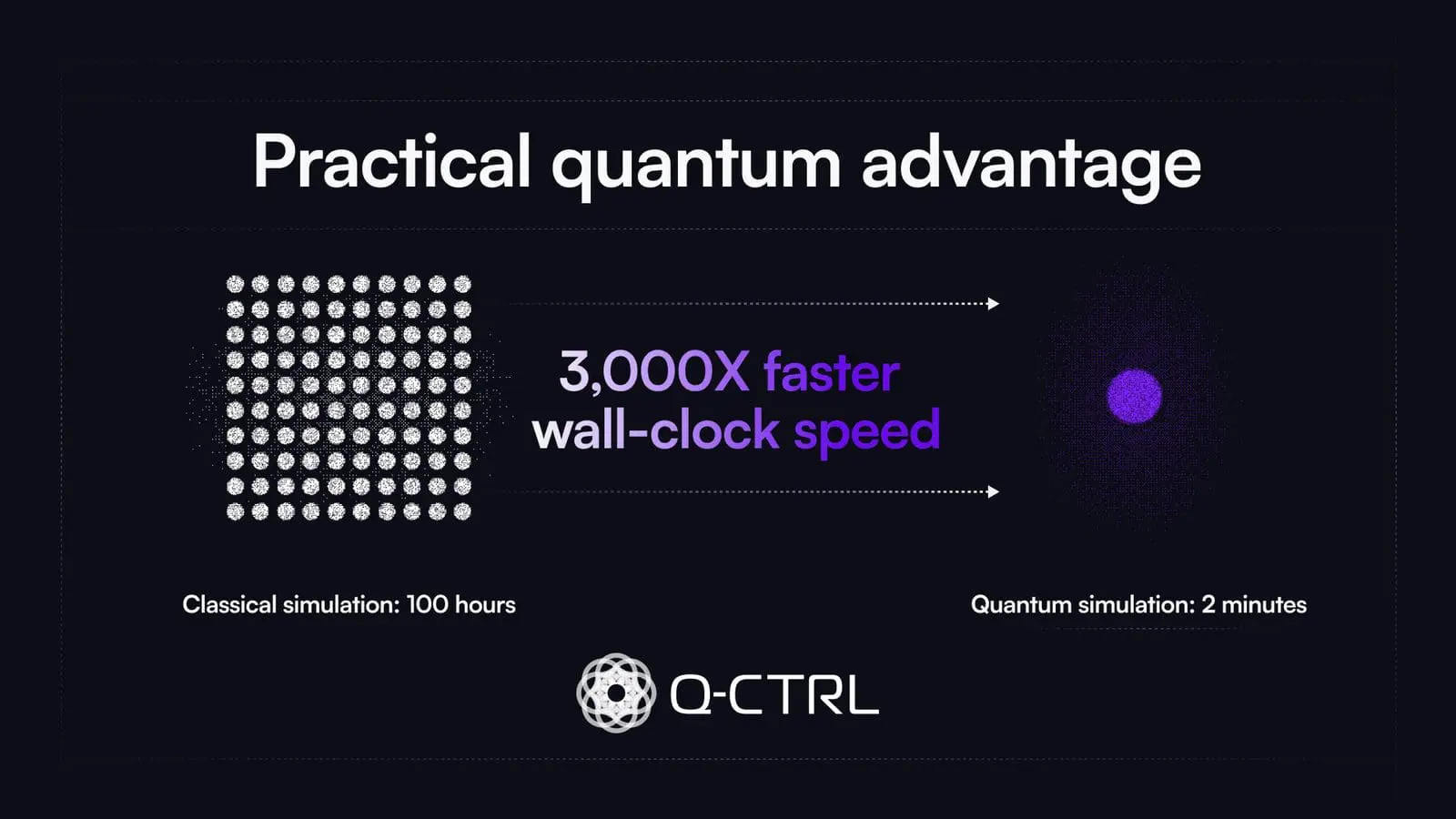
Q-CTRL has demonstrated a solution 3,000 times faster for a materials science problem using the IBM Quantum Platform, completing a complex calculation in two minutes compared to over 100 hours with industry-standard classical software. This achievement marks what the company calls the first instance of practical quantum advantage on a commercially relevant task, utilizing 120 qubits, a scale of simulation exceeding the capabilities of exact classical computation. Approximately one-third of all global supercomputer time is currently devoted to chemistry and materials simulation, underscoring the potential impact of this speedup for critical energy applications. “Scientists and engineers dedicate thousands of hours to performing materials simulations,” said Biercuk, CEO and Founder of Q-CTRL, “These results mark the beginning of an era of return on investment from today’s widely available quantum computers on problems that early adopters truly care about.”
3,000x Speedup: Q-CTRL Demonstrates Practical Quantum Advantage
A performance leap achieved by Q-CTRL demonstrates a tangible benefit from quantum computing, exceeding the capabilities of even the most powerful classical supercomputers for a specific, commercially relevant task. Q-CTRL focused on simulating the behavior of electrons in materials, a crucial process for developing new technologies in energy transmission, storage, and generation.
The quantum algorithm’s success hinged on Q-CTRL’s performance-management software, which mitigates the inherent noise and errors that plague quantum computers and limit their practical application. This is the nature of Practical Quantum Advantage. The team rigorously compared the quantum results with those from a classical software package, TDVP from the Flatiron Institute, and found that increasing the classical simulation’s resolution to match the quantum accuracy resulted in a more than 3,000-fold increase in computation time. Andre Konig, CEO of Global Quantum Intelligence, highlighted the importance of software in realizing near-term quantum capabilities, noting that Q-CTRL’s emphasis on runtime error suppression proved speed is a critical advantage. The infrastructure software used in this demonstration will soon be available to other researchers on the IBM Quantum Platform as a new Qiskit Function, allowing wider adoption and further innovation in quantum materials research.
The pursuit of practical quantum computing recently achieved a significant milestone as researchers demonstrated a substantial performance advantage on a commercially relevant problem. This achievement isn’t merely theoretical; it represents a 3,000 times speedup on a problem with clear industrial applications, marking what the company terms “Practical Quantum Advantage.” The calculation, performed using 120 qubits, tackled the complex behavior of electrons within materials, a crucial area for advancements in energy technologies.
Developing room-temperature superconductors and carbon-neutral materials represents some of the most significant computational challenges today. Q-CTRL and IBM have now demonstrated that a quantum processor, reinforced by advanced error suppression, can surpass leading tensor-network heuristics on a non-trivial Fermi-Hubbard model. This achievement represents a major signal to industry that quantum simulation is both ready and an essential component of the R&D roadmap for future materials discovery.
Jean-Francois Bobier, Partner and Vice President at the Boston Consulting Group
TDVP Classical Baseline & Performance Comparison
Q-CTRL’s demonstration of a 3,000 times speedup in materials science simulation relies on a direct comparison with established classical methods. The team benchmarked its quantum algorithm against the Time-Dependent Variational Principle (TDVP), a widely used software package from the Flatiron Institute responsible for over 1,250 publications in quantum materials research since its release. This wasn’t a comparison against theoretical possibilities, but against a current, actively maintained industry standard, a crucial distinction when claiming “practical quantum advantage.” The quantum calculation, leveraging 120 qubits and over 9,000 two-qubit operations on the IBM Quantum Platform, completed the task in two minutes, a stark contrast to the over 100 hours required by TDVP running on conventional hardware. The scale of this simulation, considering size, evolution time, and resolution, represents a significant leap beyond what is achievable with exact classical calculation, pushing the boundaries of quantum computing capability.
Q-CTRL acknowledges the potential for future classical algorithm improvements or GPU acceleration of TDVP, but asserts its advantage is based on current capabilities. “We’ve moved past the question of whether quantum computers have utility and onto the question of how to use them well,” said Jay Gambetta, Director of IBM Research and IBM Fellow.
Q-CTRL’s demonstrations showcase the crucial role of software in unlocking near-term quantum capabilities. A standout aspect of Q-CTRL’s recent effort is their emphasis on runtime error suppression, highlighting speed as a critical advantage for quantum computers, and proving that quantum hardware can currently outpace state-of-the-art classical architectures in total wall-clock time for certain applications of high strategic value.
Andre Konig, CEO of Global Quantum Intelligence
The pursuit of viable quantum computing has long been hampered by the inherent instability of qubits; however, recent demonstrations suggest software solutions are emerging to address these limitations and unlock practical applications. Q-CTRL’s software directly addresses these issues, expanding the capabilities of existing quantum hardware.
We’ve moved past the question of whether quantum computers have utility and onto the question of how to use them well. IBM has built the largest quantum computing ecosystem in the world, and we’re putting increasingly capable systems in the hands of the people doing the work. Results from partners like Q-CTRL are showing how these systems contribute to scientific workflows.
Jay Gambetta, Director of IBM Research and IBM Fellow




See today’s quantum computing news on Quantum Zeitgeist for the latest breakthroughs in qubits, hardware, algorithms, and industry deals.