Scientists A. I. Tóth and colleagues at University of Edinburgh have discovered that defects within liquid crystals behave similarly to Majorana quasiparticles, particles theorised to underpin key quantum information processing. Their research reveals that braiding these defect profiles, repeatedly looping them around each other, mimics the complex behaviour of non-Abelian anyons, potentially enabling the creation of more sophisticated quantum gates. Liquid crystalline systems represent a promising and potentially scalable platform for exploring topological computation.
Defect exchange dynamics quantified via lattice Boltzmann simulation and bivector analysis
A hybrid lattice Boltzmann approach meticulously simulated the behaviour of liquid crystals containing defects. The computational technique allowed precise tracking of the director field, the average orientation of the liquid crystal molecules, and its distortions around these defects. Liquid crystals, existing in a state between conventional liquids and solid crystals, exhibit long-range orientational order, making their defects particularly amenable to this type of study. Observation of how these distortions evolved during repeated defect exchanges was enabled, a process akin to weaving strands of hair as defects were looped around each other. This detailed tracking is crucial for understanding the topological properties emerging from these defects.
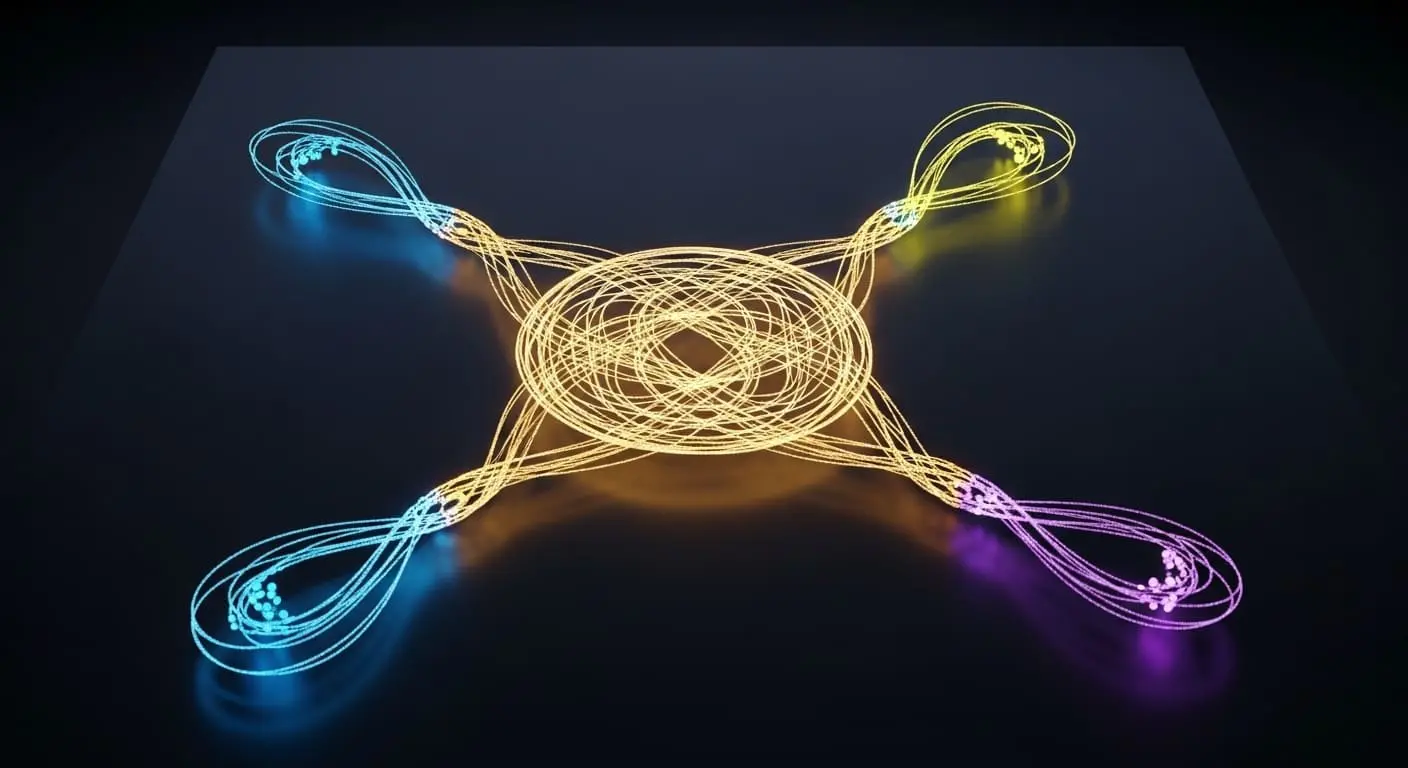
The team defined a ‘defect bivector’ to quantify these distortions, a mathematical construct analogous to using arrows to represent both the direction and strength of a force. This construct provides a means to characterise the orientation and intensity of each defect within the liquid crystal. Simulations used a “Majorana square” consisting of four defect profiles initially positioned at the vertices of a square domain of size d, contained within a larger square of size L with periodic boundaries. Periodic boundaries minimise edge effects, allowing for a more accurate representation of bulk behaviour. The simulations employed a uniaxial approximation with an order parameter q equal to 1/2 when χ equals 3. This parameterisation defines the degree of alignment of the liquid crystal molecules and influences the stability and interaction of the defects. The defect bivector, Ω, was defined using the disclination tensor, Dij, and singular value decomposition to characterise defect orientation and intensity; elastic interactions aligned all four bivectors, and they summed to zero. The disclination tensor mathematically describes the degree to which the director field is distorted around a defect, while singular value decomposition allows for the extraction of key properties like orientation and strength. The condition that the bivectors sum to zero reflects the conservation of topological charge within the system.
Full Bloch hemisphere coverage enables strong braiding of Majorana-like defects in nematic liquid
Defect bivector rotations now span the entirety of the Bloch hemisphere, a substantial improvement over previous liquid crystal demonstrations limited to discrete point groups. The Bloch hemisphere provides a geometrical representation of the possible states of a quantum system, and achieving full coverage is essential for universal quantum computation. This broadened range, enabled by elastic interactions and dynamical effects, overcomes a critical barrier to complex gate creation. Prior systems lacked the tunability needed for subtle control of topological qubits, but this new approach offers greater control. Specifically, exchanging defects with differing winding numbers causes the system’s defect bivector to rotate on a Bloch-like hemisphere, a phenomenon analogous to the braiding observed in non-Abelian anyons. Winding number refers to how many times a closed loop encircles a defect, influencing its topological properties.
This rotation occurs due to the degeneracy of states connected by the liquid crystal’s nematic elasticity, offering tunability compared to Majorana quasiparticles. Nematic elasticity, the material’s resistance to deformation, plays a crucial role in determining the behaviour of the defects and the extent of the Bloch hemisphere coverage. Simulations tracked these distortions, revealing behaviour akin to classical anyons even with variations in elasticity; the configuration typically returns to its initial position after two or four exchanges. However, accounting for the impact of entangled photons or three-dimensional nematic loops remains a challenge before realising practical topological computation. Entangled photons could introduce additional degrees of freedom and complexity, while three-dimensional loops would represent a more realistic and potentially more robust topological qubit. The observed behaviour, while promising, is still a simplification of the complex interactions required for fault-tolerant quantum computation.
Liquid crystal defects simulate anyon braiding for potential topological computation
Researchers at the University of Pennsylvania and the University of Chicago are exploring whether liquid crystals can mimic the behaviour of exotic quantum particles, potentially offering a new route to building topological computers. Liquid crystals offer a readily accessible platform for modelling complex quantum phenomena, a key advantage over attempting to manipulate actual subatomic particles. The difficulty of creating and controlling Majorana quasiparticles directly motivates the search for analogous systems that are easier to fabricate and manipulate. While these simulations demonstrate complex braiding of defects, repeatedly twisting patterns within the liquid crystal, a fundamental question remains unanswered: building a useful computer requires many more interacting components than the four defects currently simulated.
These simulations reveal that liquid crystal defects can behave like ‘anyons’, exotic particles important for topological computing, where information is encoded in the way particles are braided rather than their state. Topological protection, the inherent robustness of information encoded in the braiding pattern, is a key advantage of this approach. Demonstrating that liquid crystal defects can emulate key properties of non-Abelian anyons moves beyond simple mathematical comparisons to reveal shared physical characteristics. Braiding, or looping and twisting, these defects generates complex behaviour describable using mathematical tools representing defect orientation and strength, on a hemisphere similar to a Bloch sphere. This broadened range of behaviour, influenced by the material’s elasticity and dynamics, enhances the potential for creating more intricate computational ‘gates’ than previously possible with similar systems. The ability to control and manipulate these defects with precision is crucial for realising the full potential of liquid crystals as a platform for topological computation, and future research will focus on scaling up the system and improving its robustness.
The research demonstrated that defects within liquid crystals can emulate the behaviour of non-Abelian anyons, exotic particles with potential applications in topological computing. This is significant because it provides a more accessible method for modelling these complex quantum phenomena than working directly with subatomic particles. Researchers successfully braided four nematic defect profiles, observing behaviour analogous to the braiding of anyons and generating complex ‘gates’ through material elasticity and dynamics. The study suggests liquid crystalline spinors are promising components for topological computers, and future work aims to scale up the system and improve its stability.
👉 More information
🗞 Braiding and exchange statistics of liquid crystalline Majorana quasiparticles
🧠 ArXiv: https://arxiv.org/abs/2604.00492


See today’s quantum computing news on Quantum Zeitgeist for the latest breakthroughs in qubits, hardware, algorithms, and industry deals.