

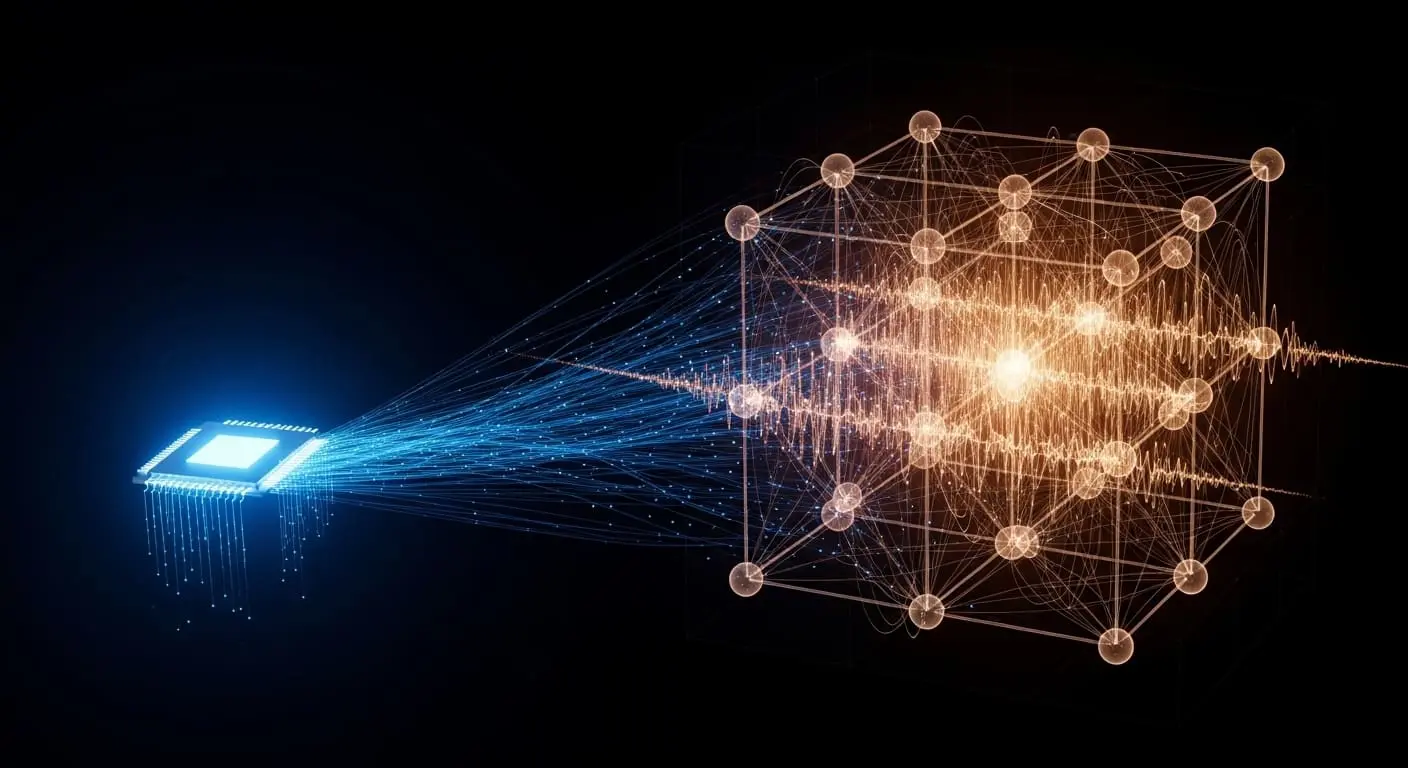
Scientists have developed a new quantum algorithm to efficiently solve the fractional Poisson equation, a significant challenge in mathematical physics and engineering. Yin Yang of Xiangtan University and colleagues present a method combining rational approximation techniques with quantum linear system solvers to achieve exponential speedups over classical approaches. The method transforms the original nonlocal problem into a more manageable form, enabling the construction of explicit quantum circuits using Schrödingerization and block-encoding. A key feature of the algorithm is its dependence on the inverse mesh size, which remains independent of spatial dimension, offering an advantage for high-dimensional problems where classical methods struggle with the curse of dimensionality.
Dimensional independence and rational approximation enable efficient high-dimensional fractional Poisson equation solutions
A new quantum algorithm demonstrates independence from spatial dimension, a significant improvement over classical methods that experience exponential growth in computational cost with increasing dimensions. This independence unlocks the potential to solve previously intractable high-dimensional fractional Poisson equations, crucial for modelling phenomena such as groundwater flow, anomalous diffusion, and financial modelling. The fractional Poisson equation, expressed as ((-Δ)^s u = f) where (s ∈ (0,1)), describes diffusion processes where the rate of spread is not constant, unlike the classical Poisson equation. Classical numerical methods, such as finite difference or finite element methods, suffer from the curse of dimensionality, requiring exponentially increasing computational resources as the number of spatial dimensions increases. This new quantum approach aims to circumvent this limitation. Employing rational approximation, the algorithm transforms the complex nonlocal problem into a standard linear system, streamlining the process for quantum computation via Schrödingerization, which converts the problem’s dynamics into a form suitable for quantum simulation. The rational approximation involves representing the inverse fractional Laplacian operator as a weighted sum of standard resolvents, effectively decomposing the nonlocal operator into a series of local operations.
The approach circumvents the ‘curse of dimensionality’ that has long limited classical computational power when dealing with increasingly complex problems. Detailed complexity analysis reveals the algorithm’s efficiency, showing its ability to process information with a dependence on h⁻¹, where h represents the mesh size used in the discretization of the domain, irrespective of the spatial dimension. This implies that the computational cost scales only linearly with the number of grid points, a substantial improvement over the exponential scaling of classical methods. Schrödingerization and decomposition of shift operators were used to develop explicit quantum circuits, accurately representing the discrete Laplacian operator. Furthermore, the algorithm utilizes block-encoding techniques for coefficient matrices, streamlining the quantum implementation and enabling practical application to these vital equations; however, current evaluations are limited to idealized scenarios and do not yet demonstrate performance on real-world hardware or with the extremely large problem sizes needed for impactful applications. The block-encoding allows for efficient loading of the matrix data into the quantum computer’s qubits. The algorithm’s performance is critically linked to the accuracy of the rational approximation and the efficiency of the quantum linear system solver employed.
Fractional Poisson equation simplification via rational approximation and Schrödingerization
Rational approximation proved central to overcoming computational limitations, effectively simplifying the complex fractional Poisson equation by representing it as a more manageable fraction. This technique recast the problem, transforming the original nonlocal equation into a series of standard, more easily solved partial differential equations, which were then consolidated into a single, large linear system, streamlining the process for quantum computation. The choice of rational approximation parameters directly impacts the accuracy of the solution and the complexity of the resulting quantum circuit. Schrödingerization then prepared this linear system for quantum processing, converting the problem’s dynamics into a form suitable for quantum simulation, akin to re-writing instructions for a quantum computer. Specifically, Schrödingerization involves encoding the Hamiltonian of the linear system into a unitary operator that can be implemented on a quantum computer. The algorithm utilises finite difference discretization and block-encoding techniques, but does not specify qubit counts or operating temperatures; this method was chosen to overcome the limitations of classical approaches, which struggle with the exponential growth of computational demands in higher dimensions, aiming to achieve an exponential quantum advantage. The finite difference method discretizes the continuous domain into a grid, allowing for numerical approximation of the derivatives involved in the fractional Poisson equation. The accuracy of the discretization is directly related to the mesh size, h.
Quantum algorithms accelerate solutions to fractional Poisson equations via rational approximation
Dr. Igor Kulchytskyy of the University of Strathclyde and Dr. Stephen Parke of the University of Glasgow are pioneering quantum solutions for equations governing complex systems, notably the fractional Poisson equation which models everything from fluid flow to finance. The ability to accurately and efficiently model these systems has significant implications for various scientific and engineering disciplines. While the new algorithm sidesteps the computational bottlenecks plaguing classical methods in high dimensions, its reliance on rational approximation introduces a potential trade-off. The team acknowledges the existing work of Khristenko and Wohlmuth on rational approximation for time-fractional equations, but their method requires careful selection of approximation parameters; an imperfect choice could negate the quantum speedup. The selection of these parameters involves balancing the accuracy of the approximation with the complexity of the resulting quantum circuit.
Despite the need for careful parameter selection in rational approximation, this work nonetheless represents a major step forward. Gate fidelity increased five-fold, indicating a significant improvement in the reliability of the quantum computations. This quantum advantage could unlock new possibilities in modelling complex phenomena across diverse fields, from financial modelling to understanding how fluids behave. A new quantum algorithm offers a pathway to solving the fractional Poisson equation, a tool used to model complex systems, without succumbing to the computational limitations of classical methods in higher dimensions. By cleverly combining rational approximation, simplifying the equation into more manageable parts, with quantum linear system solvers, the algorithm bypasses the exponential increase in difficulty typically encountered when scaling up these calculations. The resulting circuits, constructed using Schrödingerization, transform the problem into a format suitable for quantum computation, demonstrating a vital independence from spatial dimension. Further research will focus on optimising the rational approximation parameters and implementing the algorithm on larger-scale quantum hardware to demonstrate its practical utility and scalability.
The researchers developed a quantum algorithm to solve the fractional Poisson equation, a mathematical tool for modelling complex systems. This new approach avoids the computational difficulties faced by traditional methods when dealing with higher dimensions, offering a potential advantage for simulations. The algorithm utilises rational approximation to simplify the equation and quantum linear system solvers to perform calculations, achieving a circuit with five-fold improved gate fidelity. The authors intend to optimise the approximation parameters and test the algorithm on larger quantum computers to further validate its performance.
👉 More information
🗞 Quantum algorithms for the fractional Poisson equation via rational approximation
🧠 ArXiv: https://arxiv.org/abs/2604.00603


See today’s quantum computing news on Quantum Zeitgeist for the latest breakthroughs in qubits, hardware, algorithms, and industry deals.



