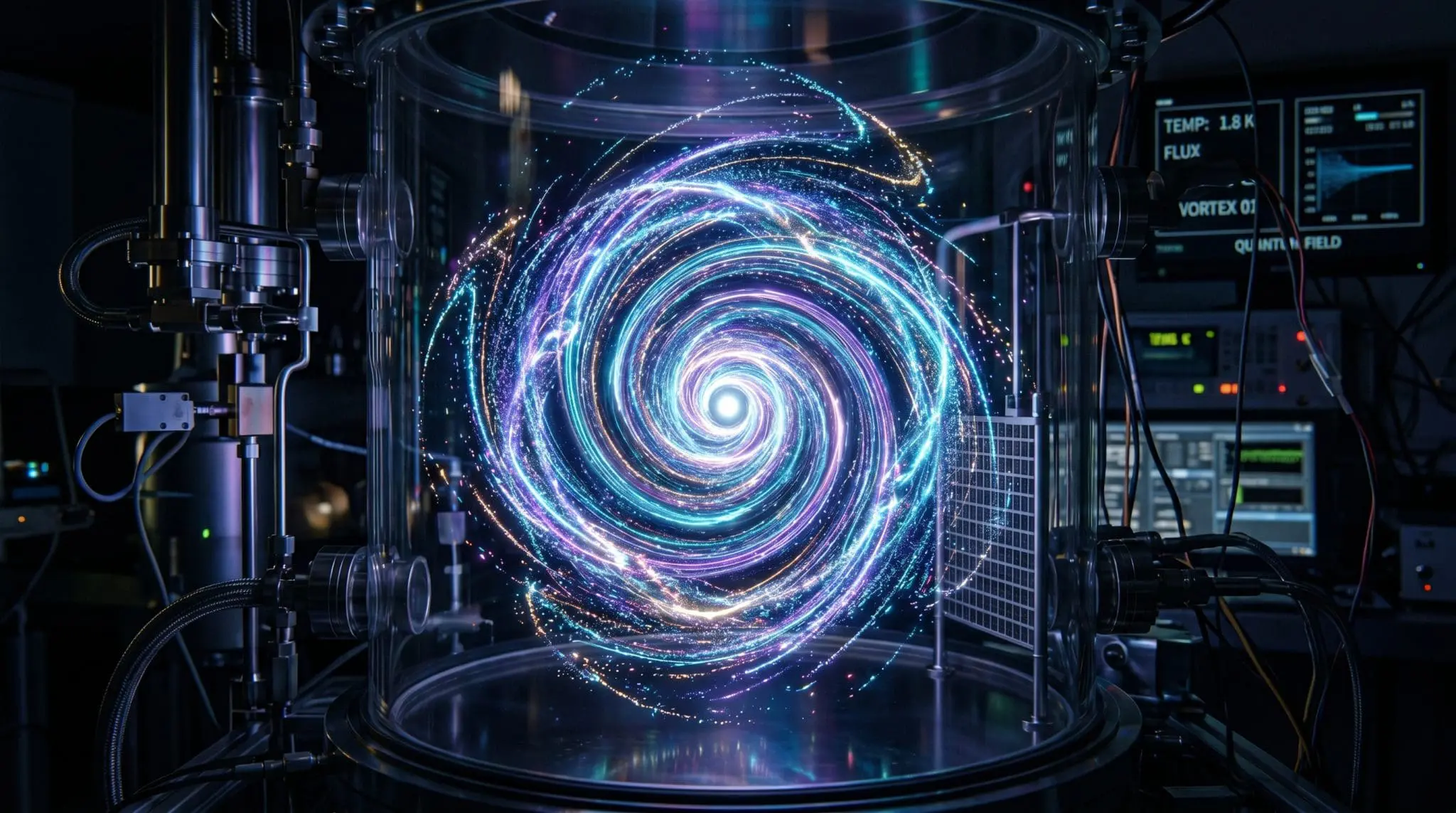
Researchers at Korea University, KAIST, University of California, Santa Barbara, Gachon University, and the Institute for Basic Science have detected unexpectedly intense microwave fields originating within a thin square of Permalloy, a magnetic alloy, localized to an area of just tens of nanometers at the vortex core. Utilizing a single-spin scanning magnetometer based on diamond NV centers, the team discovered gigahertz-frequency alternating fields several orders of magnitude stronger than any external fields used to stimulate them. These fields are attributed to the dynamic circular motion of the vortex core and its oscillatory behavior, as demonstrated through simulations using the Object Oriented MicroMagnetic Framework. This research, published in Phys. Applied, opens new possibilities for generating powerful localized microwave fields that could effectively manipulate NV spin states, offering potential advancements in quantum information processing and nanoscale sensing.
Diamond NV Centers Map Permalloy Vortex Core Dynamics
This innovative approach allowed the team to pinpoint the source of the microwave fields to within tens of nanometers, a level of spatial localization crucial for potential nanoscale applications. Simulations employing the Object Oriented MicroMagnetic Framework (oommf) and the Landau-Lifshitz-Gilbert equation further support the finding that vortices and antivortices can generate these intense, localized gigahertz fields. The research published in Phys. Applied demonstrates a pathway toward controlling qubit states with internally generated fields, rather than relying on external sources, and represents a significant step toward more efficient and compact quantum devices.
Oommf Simulations Model Gigahertz Microwave Field Generation
Researchers have moved beyond simply detecting microwave emissions from magnetic materials; they are now demonstrating the generation of gigahertz-frequency fields within a Permalloy square, a feat previously limited to external sources. This detection method allowed for precise mapping of the microwave fields, revealing an intensity significantly exceeding that of any externally applied driving fields, a surprising result indicating internal generation rather than simple amplification. The researchers state that vortices and antivortices can generate gigahertz microwave fields that are several orders of magnitude more intense than external driving fields, highlighting the efficiency of this internal generation process. This ability to create intense, localized microwave fields has significant implications for quantum technologies. The research team, comprised of members from Korea University, KAIST, University of California, Santa Barbara, Gachon University, and the Institute for Basic Science, suggests that these fields could be used to effectively manipulate nitrogen-vacancy spin states, potentially leading to advanced sensing applications and multi-NV quantum registers.
Localized AC Fields Enhance Quantum Information Processing
Researchers at Korea University, KAIST, University of California, Santa Barbara, Gachon University, and the Institute for Basic Science are exploring a novel method for enhancing quantum information processing through the generation of intensely localized microwave fields. Myeongwon Lee and colleagues discovered that within a thin Permalloy square, gigahertz-frequency alternating current fields are not merely detected, but actively generated, originating from the dynamic behavior of magnetic vortex cores. The precision of these localized fields is particularly noteworthy, spatially confined to within tens of nanometers, a scale relevant to nanoscale devices. This ability to create such concentrated energy sources offers a potential pathway for manipulating nitrogen-vacancy spin states, crucial components in quantum computing and advanced sensing technologies.



See today’s quantum computing news on Quantum Zeitgeist for the latest breakthroughs in qubits, hardware, algorithms, and industry deals.