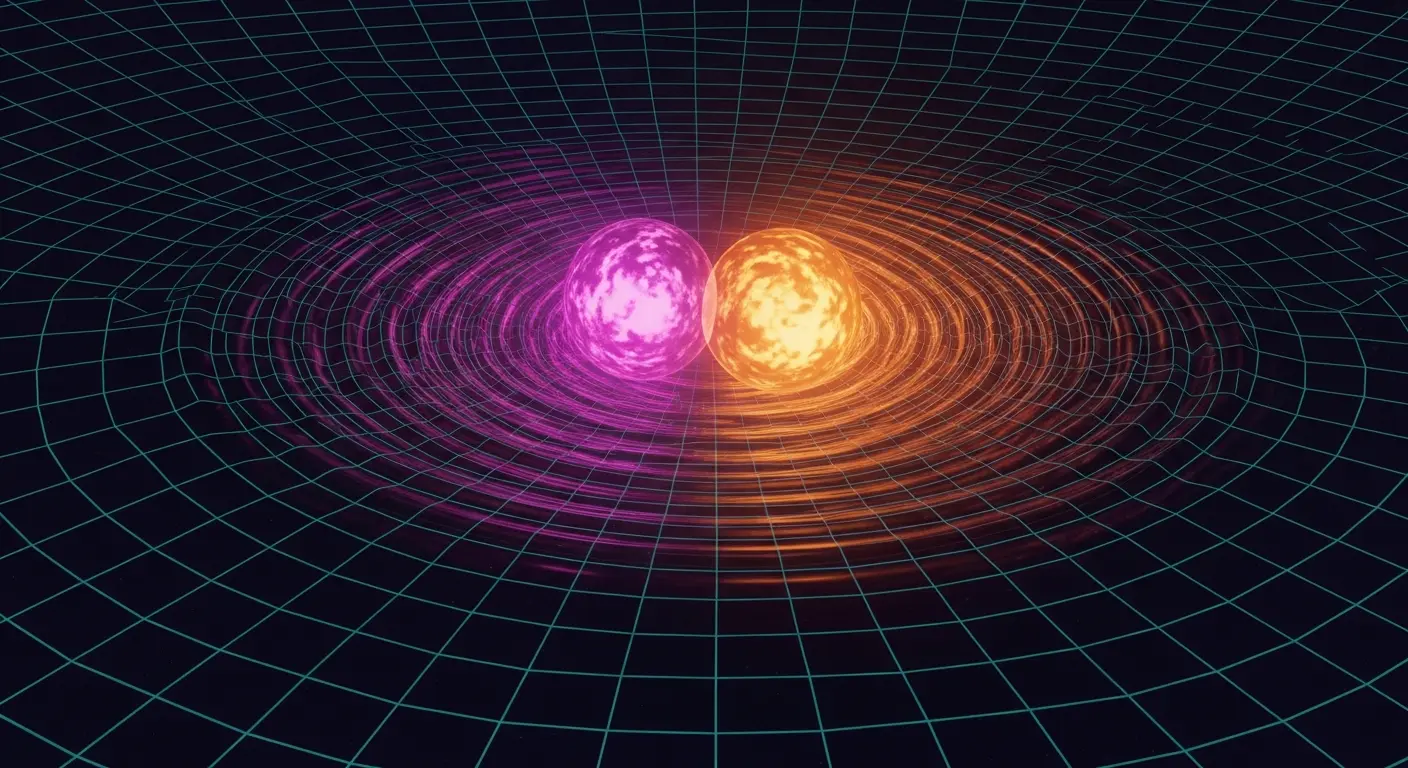
Gravitational wave data from the LIGO, Virgo, and KAGRA collaboration has yielded a precise measurement of a theoretical boundary in stellar evolution, identifying a lower edge of 44.3−3.5+5.9 solar masses as the limit. This finding suggests that stars below this mass are more likely to collapse directly into black holes, while more massive stars are less likely to follow that path. Researchers also extracted a 268−116+195 keV S-factor for the 12C(α, γ)16O nuclear reaction rate, demonstrating a connection between gravitational-wave astronomy and nuclear astrophysics. The data further revealed two populations: a low-spin group with no black holes above the gap, and a high-spin, isotropic group that extends across the full mass range and occupies the gap, consistent with hierarchical mergers in dense stellar clusters.
Pair-Instability Supernovae & the Black Hole Mass Gap
A precise measurement places the lower edge of the pair-instability mass gap at 44.3−3.5+5.9 solar masses. Researchers performed hierarchical Gaussian-process population inference on the fourth LIGO, Virgo, KAGRA gravitational-wave transient catalogue to map black hole spin as a function of primary mass, revealing a distinct separation in black hole populations. The data reveal two populations: a low-spin group with no black holes above the gap, and a high-spin, isotropic group that extends across the full mass range and occupies the gap. The merger rate of this population drops to zero above a certain mass, implying a gap in the mass spectrum of first-generation mergers.
LIGO-Virgo-KAGRA GWTC-4 Catalog Population Inference
Analysis of the latest gravitational-wave catalog, GWTC-4 from the LIGO, Virgo, and KAGRA detectors, is refining our understanding of stellar evolution and the formation of black holes, extending beyond simply detecting these cosmic events. Researchers have pinpointed a lower edge to the predicted gap at 44.3−3.5+5.9 solar masses, a precise measurement of the theoretical boundary where massive stars are less likely to directly form black holes. Beyond mapping the mass gap, the collaboration has achieved a novel feat: extracting information about nuclear reaction rates from gravitational wave signals. The analysis revealed two populations: a low-spin group with no black holes above the gap, and a high-spin, isotropic group that extends across the full mass range and occupies the gap. According to the research team, “The data are consistent with a χ eff distribution that is symmetric about zero and with the expected distribution of second-generation mergers formed dynamically in dense stellar environments.” This supports the idea that black holes can grow through multiple mergers, even within the mass range previously thought to be inaccessible.
Fabio Antonini and colleagues have refined the understanding of the elusive pair-instability mass gap, a theoretical range of black hole masses where stellar collapse should be suppressed. Identifying a lower edge of 44.3−3.5+5.9 solar masses, this is a remarkably precise measurement given the complexity of stellar evolution modeling. This is notable because gravitational-wave data, traditionally used to detect spacetime ripples, provided insights into nuclear burning processes within massive stars.
12C(α, γ)16O Reaction Rate & Stellar Evolution
Gravitational wave astronomy is extending its reach beyond detecting cosmic collisions, now providing insights into the nuclear reactions powering stars. Researchers determined an S-factor of 268−116+195 keV b, a parameter critical for modelling helium burning and stellar evolution. They identified a lower edge to this gap at 44.3−3.5+5.9 solar masses, a precise measurement of a previously theoretical boundary. This precision stems from analyzing the spin distributions of merging black holes detected via gravitational waves, revealing two distinct populations. The data reveal two populations: a low-spin group with no black holes above the gap, and a high-spin, isotropic group that extends across the full mass range and occupies the gap, consistent with this merger scenario.
Low-Spin vs. High-Spin Black Hole Populations
Conventional wisdom suggests a clear divide in black hole formation; massive stars exceeding roughly 65 solar masses should be entirely disrupted by pair-instability supernovae, creating a noticeable gap in the observed mass spectrum. However, gravitational wave detections have increasingly challenged this picture, revealing black holes within the predicted 44.3−3.5+5.9 solar mass range. The data reveal two populations: a low-spin group with no black holes above the gap, and a high-spin, isotropic group that extends across the full mass range and occupies the gap.
Hierarchical Mergers & Isotropic Spin Orientations
44.3−3.5+5.9 solar masses reveals a critical link between gravitational wave data and stellar evolution models, suggesting a lower limit for black hole formation via direct collapse. The data reveal two populations: a low-spin group with no black holes above the gap, and a high-spin, isotropic group that extends across the full mass range and occupies the gap, consistent with hierarchical mergers. Researchers explain, “The presence and location of the PISN lower mass limit can therefore be inferred from the primary mass at which the χ eff distribution transitions to this broad, symmetric form.” This suggests that the observed features, a mass gap, isotropic spins above the transition mass, and a drop in merger rate, are all consistent with pair instability coupled with hierarchical mergers in dense star clusters, providing a more complete picture of black hole growth and evolution.
Gravitational wave astronomy is now refining not only our understanding of black hole mergers, but also the lifecycle of massive stars. Recent analysis of the fourth LIGO, Virgo, KAGRA transient catalogue has revealed a precise lower edge to the predicted pair-instability mass gap, the range where stars are expected to be disrupted before forming black holes, identified at 44.3−3.5+5.9 solar masses. This measurement, detailed in Nature Astronomy, moves beyond theoretical predictions by anchoring the boundary with observational data.
44.3−3.5+5.9 solar masses. Below a certain mass, the data are well described by a single narrow Gaussian χ eff distribution, with a logarithmic standard deviation of −1.15−0.15+0.13, and a small positive mean of 0.04−0.02+0.02, consistent with first-generation black holes. The merger rate of this population drops to zero above a certain mass, implying a gap in the mass spectrum of first-generation mergers.




See today’s quantum computing news on Quantum Zeitgeist for the latest breakthroughs in qubits, hardware, algorithms, and industry deals.