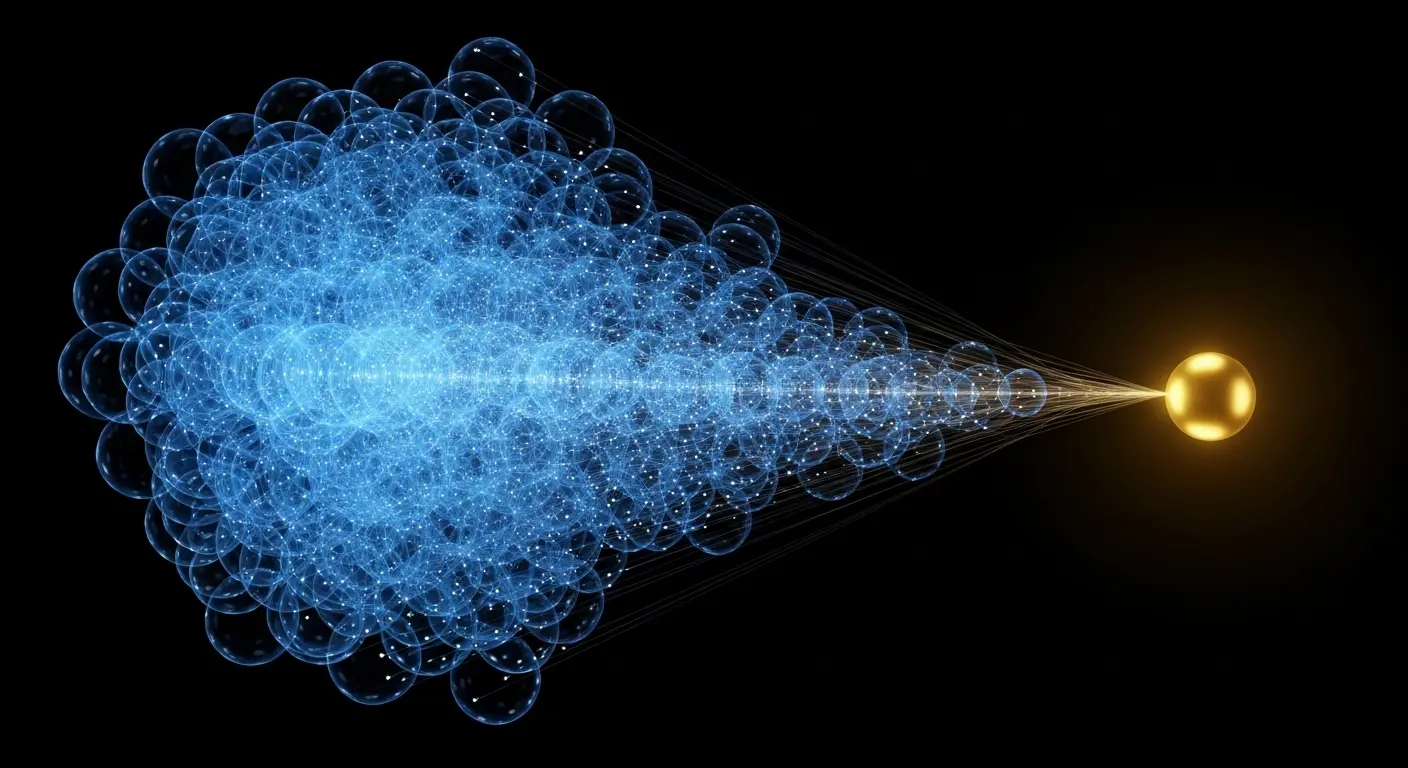
Scientists at Nankai University, H. P. Zhang and Z. Song, have demonstrated how a quadratic well potential alters the behaviour of the Ising chain, a cornerstone model in condensed matter physics and quantum information theory. Their research reveals that, in contrast to the well-understood behaviour of a uniform Ising chain, confining the system within a quadratic well introduces spatially varying quantum phases along the chain’s length. This nuanced behaviour arises from the interplay between the confining potential and the inherent quantum properties of the Ising model. Through a rigorous analysis employing the Majorana representation, the researchers obtained exact solutions for localised modes and identified a topologically degenerate spectrum, offering a novel perspective on the dynamics of complex quantum systems and potentially paving the way for advanced material design.
Confined Ising chains reveal spatially modulated quantum phases and extended localised mode
A significant enhancement in the detectable range of localised modes within an Ising chain has been achieved, extending it from approximately g = 5 × 10⁻⁴ to a substantially broader spectrum. This improvement is directly attributable to confining the Ising chain within a quadratic well potential. The quadratic well, characterised by a parabolic shape, creates a predictably oscillating field that increases and decreases along the chain’s length. This modulation allows for the observation of localised modes, even at moderate positions along the chain, where previously rapid hybridization would have obscured them. Hybridization refers to the mixing of quantum states, which typically broadens and diminishes the observability of localised modes. The finite-size quantum phase region, representing the system’s behaviour with a limited number of constituent particles, exhibits periodic oscillations stemming from the lifting of Kramers-like degeneracy. Kramers degeneracy, a consequence of time-reversal symmetry, dictates that energy levels occur in pairs. Lifting this degeneracy, where once-identical energy levels split, introduces predictable and measurable oscillations in the system’s properties. These oscillations are a direct consequence of the spatially varying potential imposed by the quadratic well.
Exact solutions for these localised modes are revealed through a detailed analysis of the system’s Majorana representation, a mathematical formalism that simplifies the description of interacting fermions. This representation demonstrates that the system possesses a topologically degenerate spectrum when extended to an infinite chain length. Topological degeneracy implies the existence of robust, protected states that are insensitive to local perturbations. Numerical simulations, meticulously tracking key quantum properties such as magnetization, local density of state, and quench fidelity, corroborate these analytical findings. Magnetization provides information about the alignment of spins within the chain, the local density of state quantifies the number of available quantum states at a given energy level, and quench fidelity measures the overlap between the initial and final states after a rapid change in the system’s parameters. The simulations confirm that the lifting of Kramers-like degeneracy directly results in the observed periodic oscillations. Furthermore, the local magnetization and density of states establish a clear connection between the finite-size quantum phase transitions and the behaviour predicted by standard quantum phase transition theory in the thermodynamic limit (i.e., as the system size approaches infinity), demonstrating how the observed behaviour relates to established quantum phenomena and validating the theoretical framework.
Spatial confinement reveals phase transitions impacting future material design
Confining quantum systems within specifically shaped potentials, such as the quadratic well explored in this investigation, represents a powerful strategy for achieving greater control over material properties and, potentially, enabling the development of novel technologies. This research demonstrates that confining the Ising chain within the predictably curving field of a quadratic well reveals non-uniform quantum properties, which differ systematically along the material’s length. This spatial modulation of quantum behaviour is a key finding, as it suggests that the properties of a material can be tailored by controlling its geometry and the confining potential it experiences. However, the current analysis remains limited to a single, simplified model, the one-dimensional Ising chain, raising important questions about how broadly these spatially varying quantum phases will manifest in more complex, higher-dimensional materials. Investigating the effects of quadratic confinement on other quantum systems, such as Bose-Hubbard models or Heisenberg chains, would be a logical next step.
Understanding how quantum behaviour changes within confined spaces is crucial for designing future materials with tailored properties, as the quadratic well represents a common scenario in many physical systems, including quantum dots, nanowires, and optical lattices. The resulting localised modes, exhibiting a strong energy state largely unaffected by minor disturbances, offer a new and potentially robust way to understand and manipulate quantum interactions. These modes could serve as building blocks for quantum information processing, where the preservation of quantum coherence is paramount. This understanding could potentially inform the design of novel quantum materials with enhanced stability and functionality. The ability to engineer spatially varying quantum phases opens up possibilities for creating materials with unprecedented properties, such as tailored conductivity, magnetism, or optical response. Further research is needed to explore the full potential of this approach and to translate these fundamental findings into practical applications.
The research demonstrated spatially varying quantum phases within an Ising chain confined by a quadratic well, differing systematically along its length. This is significant because it shows material properties can be controlled by manipulating the geometry and potential experienced by the material. Researchers obtained exact solutions for localised modes, revealing a topologically degenerate spectrum in the thermodynamic limit, and observed periodic oscillations from a finite-size quantum phase region. The authors suggest further investigation into other quantum systems, such as Bose-Hubbard or Heisenberg chains, to broaden understanding of these effects.
👉 More information
🗞 Periodic dynamics in an Ising chain with a quadratic transverse field
🧠 ArXiv: https://arxiv.org/abs/2604.12276



See today’s quantum computing news on Quantum Zeitgeist for the latest breakthroughs in qubits, hardware, algorithms, and industry deals.