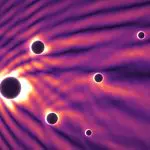
Arul Lakshminarayan and Karol Życzkowski at the Indian Institute of Technology Madras, in collaboration with Jagiellonian University and Polish Academy of Science, show that entropy dynamics, mirroring the role of Shannon entropy in classical information theory, links quantum information processing with the behaviour of quantum chaotic systems. Their findings highlight how positive entropy production characterises these chaotic systems and explores the impact of unavoidable noise, modelled as random quantum operations or environmental coupling, on quantum systems. The research underscores the universal nature of quantum chaotic dynamics and its key implications for advancing the field of quantum information processing.
Polynomial simulation of kicked rotor dynamics via two-qubit decomposition
Polynomial-time simulation unlocks insights into quantum chaos, a feat previously hampered by exponentially increasing computational demands. This advance centres on decomposing complex quantum dynamics into a series of two-qubit gates, the fundamental building blocks of quantum computers, requiring only O(n3) gates and representing a strong reduction in computational complexity. Employing a specific arrangement of these gates effectively mimics the behaviour of a ‘kicked rotor’, a standard model in chaotic systems, without incurring prohibitive costs.
Efficiently simulating these systems allows scientists to generate structures closely resembling the random fluctuations, or ‘noise’, inherent in real quantum devices, offering a new approach to understanding and mitigating errors. The entanglement properties of bipartite pure states were explored, utilising concepts from random matrix theory and the Ginibre ensemble to model coefficient matrices. Analysing these states using the Schmidt decomposition revealed relationships between eigenvalue spectra and entanglement measures like von Neumann and linear entropy. Calculations involved matrices of dimensions N1 and N2, where N1 represents the dimension of one Hilbert space and N2 the other, with the ratio between these dimensions, denoted as Q, serving as a key parameter in determining eigenvalue distributions.
Polynomial Complexity Enables Simulation of Larger Quantum Chaotic Systems
The computational cost of simulating deterministic quantum chaotic systems has been reduced from exponential to polynomial, achieving O(n3) complexity. Detailed analysis was previously impossible due to the exponential growth of resources needed to model systems like the kicked rotor; this new method unlocks simulations of sharply larger and more complex chaotic systems. Consequently, structures that accurately mimic generic quantum noise can now be generated, which is important for developing robust quantum technologies and understanding error correction strategies.
Concepts from quantum chaos, traditionally used to study complex systems, are now being applied to support quantum information processing. The underlying principle connects entropy dynamics, a measure of disorder, with chaotic systems exhibiting positive entropy production, offering a new route to model noise affecting quantum systems. Lindblad generators, used to describe the evolution of quantum states, are statistically modelled using random matrices, techniques also found in randomized benchmarking, a method for assessing the quality of quantum computers. Furthermore, analysis of the quantum standard map, a chaotic system, utilises diagnostics like nearest-neighbour level spacing distribution to reveal universal spectral properties mirroring those predicted by random matrix theory. While these methods allow for increasingly accurate simulations, the current scale remains limited, and demonstrating a practical advantage over existing noise models for large-scale quantum error correction still requires more complex systems.
Utilising quantum unpredictability to enhance stability in quantum computation
Taming the inherent noise that corrupts fragile quantum states is crucial for building stable quantum computers. Scientists are now exploring quantum chaos, the unpredictable behaviour of quantum systems pushed to their limits, as a surprising ally in this endeavour. The team acknowledges, however, that current simulations, while promising, remain limited in scale and struggle to replicate the full complexity of real-world quantum noise. Acknowledging limitations in simulating fully complex noise is vital, given the link between quantum chaotic dynamics and entropy production.
Noise affecting quantum systems can be modelled by random quantum operations or coupling to a chaotic state. All quantum chaotic systems within the same symmetry class exhibit universal properties describable using random matrices. Efficient simulation of deterministic quantum chaotic systems, such as the kicked rotor, offers a route to approximate randomness useful for quantum information theory, allowing these systems to mimic generic quantum noise.
Quantum chaos, traditionally seen as a hindrance, actually boosts stability within quantum systems. This striking finding stems from the distribution of information across multiple quantum states, enhancing durability against disruptive noise. Establishing a connection between entropy dynamics and quantum chaos offers a new way to approach building stable quantum computers. Previously difficult-to-simulate chaotic systems can now be modelled using fewer computational steps, specifically utilising two-qubit gates. As a result, structures that mimic the random disturbances, or ‘noise’, affecting quantum systems can be generated, aiding the development of error mitigation techniques. This raises questions regarding whether these chaotic systems can accurately replicate the complexity of real-world noise and if they can be used to design more resilient quantum circuits.
The research demonstrated that quantum chaos, previously considered detrimental, can actually enhance stability in quantum systems. This is because chaotic dynamics distribute information across multiple quantum states, improving resilience against noise. Researchers utilised simulations of deterministic chaotic systems, such as the kicked rotor, to approximate randomness and model quantum noise with fewer computational steps using two-qubit gates. The team acknowledges that further work is needed to determine if these simulations can fully replicate the complexity of real-world noise.
👉 More information
🗞 Quantum Chaos and Quantum Information: Interactions and Implications
🧠 ArXiv: https://arxiv.org/abs/2604.12267



See today’s quantum computing news on Quantum Zeitgeist for the latest breakthroughs in qubits, hardware, algorithms, and industry deals.