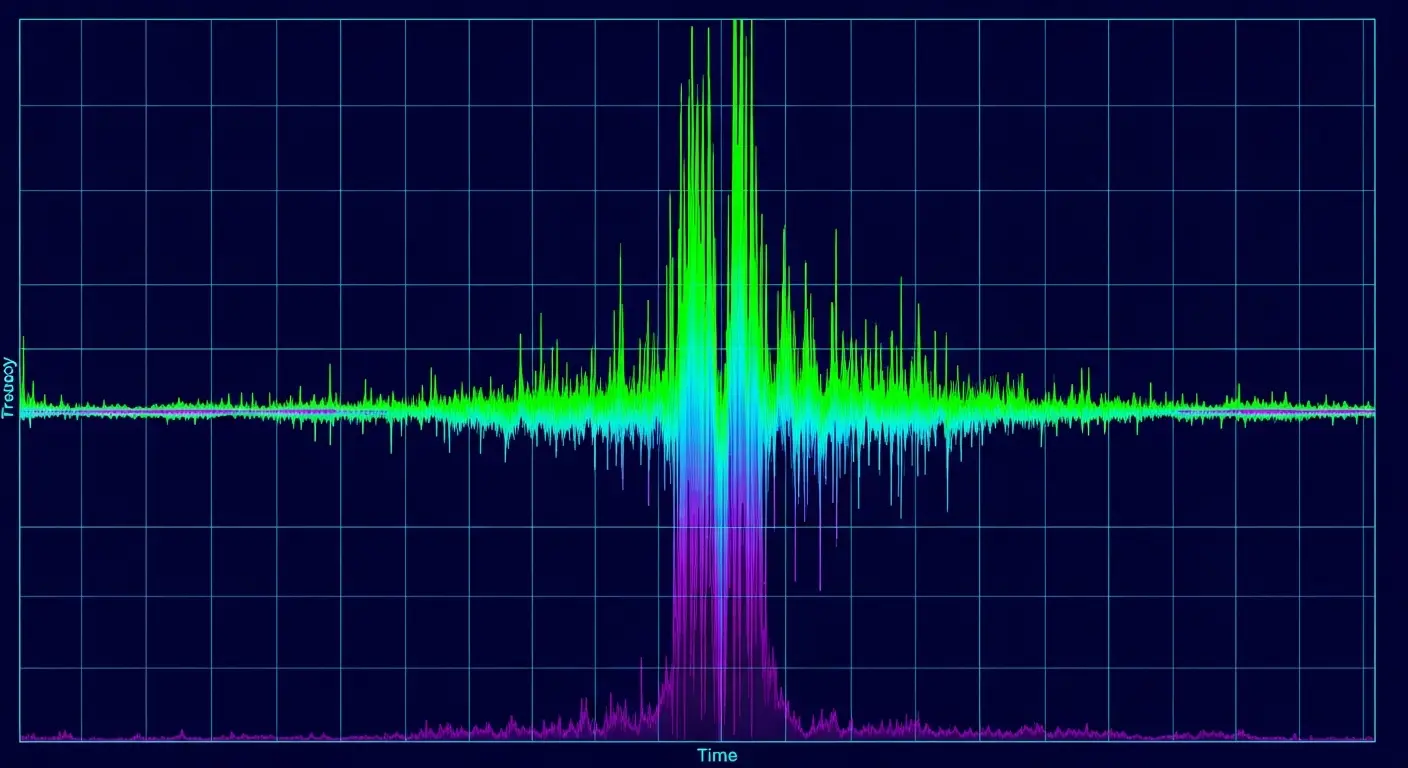
A new approach to real-time noise cancellation is challenging established boundaries in optical communication. Charles A. McLemore and colleagues at University of Colorado show that current limitations on suppressing path length noise are not fundamental and can be overcome by analysing the correlations between optical signals travelling in both directions along a fibre. Their experiments, conducted in both an urban fibre network and a laboratory setting, achieved noise suppression exceeding 6 dB beyond the standard limit, and in some cases surpassing 10 dB. This advancement, achieved through digital signal processing without requiring new hardware, promises sharply improved performance for applications including optical clock distribution, precision measurements for fundamental physics and geodesy, and the development of quantum networking.
Correlated bidirectional signals enable substantial noise reduction in optical fibres
Noise suppression in optical fibre now exceeds previous limitations, achieving over 10 dB of improvement beyond the standard limit in laboratory tests. This breakthrough surpasses a long-held constraint on real-time noise cancellation, previously considered a fundamental boundary in optical communication. Dr Scott Diddams and colleagues at the National Institute of Standards and Technology, alongside collaborating institutions, developed the new technique.
It analyses the temporal correlation between optical signals travelling in both directions along a fibre, allowing for optimised noise cancellation irrespective of noise distribution. Digital signal processing implements this optimisation without requiring new hardware, promising widespread adoption across existing systems and enabling advances in areas like quantum networking and precision measurements. A 6 dB improvement in noise suppression was achieved within a deployed urban optical fibre, exceeding the performance of standard cancellation techniques; this translates to a factor of two improvement in Allan deviation, a measure of frequency stability.
Further laboratory tests, utilising a reconfigurable fibre-optic system, revealed even greater noise reduction, surpassing 10 dB beyond the conventional limit for specific noise patterns. These figures were achieved under controlled conditions and do not yet reflect performance across all fibre types or in highly dynamic, real-world environments with complex and unpredictable noise sources. No new or expensive optical hardware is required for implementation, as the system relies on digital signal processing. This advancement stems from analysing the temporal correlation between signals travelling in both directions along the fibre, optimising the feedback signal used for noise cancellation; the technique cleverly exploits the slight time differences in how noise affects these signals.
Temporal correlation of optical signals enables enhanced noise cancellation
The technique centres on exploiting the relationship between signals travelling to and from a fibre optic cable, similar to shouting into a canyon and hearing the echo. This framework analyses how noise affects both the one-way and round-trip signals simultaneously, rather than simply attempting to cancel noise as it arrives. By examining the temporal correlation, the timing relationship, between these signals, digital signal processing determines an optimal way to counteract noise distortions, requiring no additional hardware.
Improved noise cancellation was demonstrated in both deployed urban optical fibre and a laboratory testbed. Experiments in the urban fibre achieved noise suppression exceeding the standard limit by approximately 6 dB, while the lab-based system showed suppression of over 10 dB for specific noise distributions. This approach digitally shifts the round-trip signal to counteract delays caused by noise along the fibre path.
Real-world fibre networks demonstrate greater noise cancellation potential than previously
The demand for ever-more-precise data transmission is relentless, driving innovation in optical fibre technology for applications ranging from secure quantum communication to fundamental physics research. Current noise cancellation techniques are sophisticated, but operate under a perceived constraint: a limit to how effectively environmental disturbances can be suppressed in real time. However, this work reveals that this accepted boundary isn’t fixed, prompting consideration of how representative laboratory conditions are of the unpredictable noise profiles encountered in real-world fibre networks.
Acknowledging doubts about the translation of lab results to unpredictable real-world fibre networks is sensible. Achieving over 6 decibels of noise reduction in a deployed urban fibre, and exceeding 10 decibels in testing, offers tangible benefits and demonstrates a previously unrecognised potential for improvement in data transmission. Utilising existing digital signal processing, this technique promises wider adoption across applications like secure communication and precision physics measurements.
Conventional limitations on real-time noise cancellation in optical fibre links are not absolute; a previously accepted standard can be surpassed through careful signal analysis. Scientists at the National Institute of Standards and Technology developed a new framework for optimising noise reduction by examining the temporal correlation, the timing relationship, between signals travelling to and from the fibre. Experiments in both urban networks and laboratory settings achieved noise suppression exceeding established boundaries, with improvements of over 6 dB in deployed fibre and more than 10 dB under controlled conditions.
Scientists demonstrated that the established limit for real-time noise cancellation in optical fibre links is not fundamental. By analysing the timing relationship between signals, they developed a new framework to optimise noise reduction and achieved improvements of over 6 dB in a deployed urban fibre and exceeding 10 dB in a lab-based testbed. This technique utilises existing digital signal processing, meaning it can be readily adopted in current systems for applications such as optical clock distribution and fundamental physics research. The authors suggest this approach digitally shifts signals to counteract delays caused by noise.
👉 More information
🗞 Redefining the limits of real-time noise cancellation in optical fiber links
🧠 ArXiv: https://arxiv.org/abs/2604.13985



See today’s quantum computing news on Quantum Zeitgeist for the latest breakthroughs in qubits, hardware, algorithms, and industry deals.