

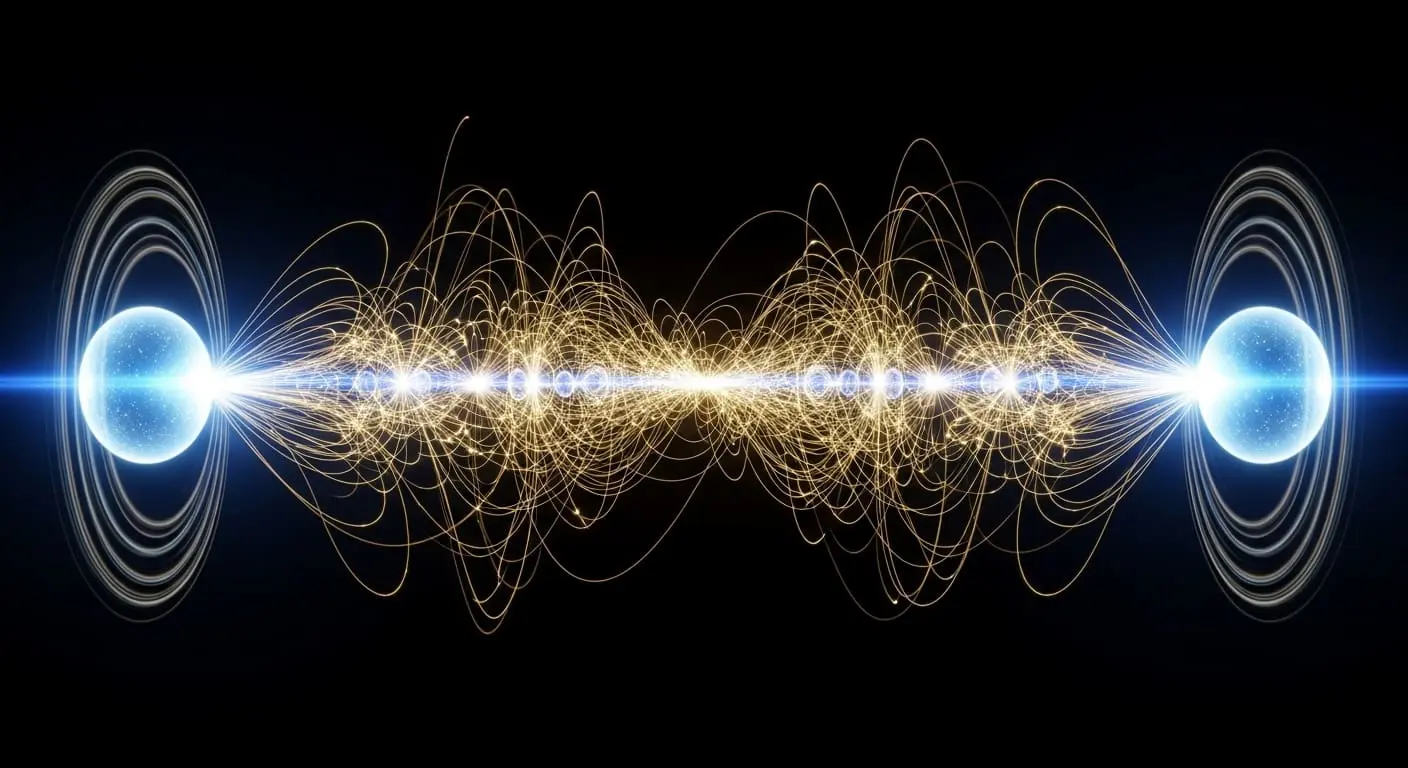
Scientists at Yokohama National University have developed a new theoretical method for generating entangled photons that substantially improves the rate at which they are produced, addressing a key challenge in building practical quantum repeaters. Ryoma Komatsudaira and Tomoyuki Horikiri present results demonstrating that a frequency-multiplexed approach, utilising cavity-enhanced spontaneous parametric down-conversion (cSPDC), offers significant gains in entanglement generation. Their calculations reveal that multiplexing approximately 100 frequency modes boosts heralding probability to around 98% for an elementary link distance of 25 kilometres and increases it from approximately 0.7% to about 38% for 100 kilometres, all while maintaining high fidelity. This analytical work confirms the potential of the method to enhance the performance of quantum repeaters and enable long-distance quantum communication.
Frequency multiplexing boosts long-distance quantum entanglement heralding probability
Entanglement, a fundamental quantum phenomenon, now demonstrates a near-perfect heralding probability of 98% over a 25-kilometre distance, representing a substantial improvement over previously achievable rates. Prior single-mode systems struggled to maintain entanglement even over short distances, a longstanding limitation in quantum communication now overcome with frequency multiplexing and cSPDC. The technique considers each frequency mode as an independent photon-pair state, dramatically increasing entanglement generation efficiency. For 100-kilometre links, heralding probability jumps from approximately 0.7% to 38% while preserving high fidelity, which is crucial for reliable quantum key distribution and other quantum protocols. Analytical results confirm the viability of cSPDC as a key component in future quantum repeaters and long-distance quantum networks, potentially revolutionising secure communication technologies. The concept of heralding probability relates to the certainty with which one can confirm the successful creation of an entangled pair, given the detection of one of the photons.
Approximately 98% heralding probability has been achieved over a 25-kilometre distance, a significant leap in entanglement generation, utilising the technique of cSPDC. Multiplexing around 100 frequency modes reached this near-perfect probability figure, effectively multiplying the potential for successful entanglement by treating each frequency mode of light as an independent photon pair. Maintaining high fidelity, meaning the entanglement quality remained above 0.9, the heralding probability, the likelihood of confirming entanglement, increased dramatically from 0.7% in standard single-mode systems to approximately 38% when extending to 100-kilometre links. The cSPDC source relies on a nonlinear crystal, typically beta barium borate (BBO), generating correlated photon pairs when struck by a pump beam; optimising this process is important for minimising unwanted multiple photon generation, which degrades the quality of the entanglement. The pump laser’s wavelength and power, alongside the crystal’s cut angle and temperature, are all critical parameters in this optimisation process. Furthermore, the cavity enhancement improves the interaction between the pump and the nonlinear crystal, increasing the efficiency of photon pair creation.
Enhancing photon pair generation rates unlocks extended quantum communication distances
Establishing long-distance quantum communication requires overcoming the inherent fragility of entanglement, a quantum link susceptible to signal loss over fibre optic cables. Photon loss, due to absorption and scattering within the fibre, exponentially decreases the probability of successful entanglement distribution over increasing distances. This research offers a promising pathway by demonstrating how to sharply boost the rate at which entangled photon pairs are created, essential for building practical quantum repeaters. Quantum repeaters function by dividing a long distance into shorter segments, establishing entanglement within each segment, and then ‘swapping’ the entanglement to connect the segments, effectively extending the communication range. The current theoretical model, however, relies on approximating the spectral characteristics of the generated photons, introducing a tension between analytical tractability and real-world accuracy. A more complete model would require accounting for the full spectral profile of the photons, which would significantly increase the complexity of the calculations.
Despite depending on approximations of photon creation, these calculations retain significant value. The work clearly demonstrates a pathway to substantially improve entanglement rates, a critical factor for building quantum repeaters which will extend the range of secure quantum communication networks. Increasing the number of frequency modes used, effectively the number of ‘channels’ for sending quantum information, boosts the probability of successful entanglement even over long distances of 100km. This is because each frequency mode represents an independent attempt to establish entanglement, increasing the overall success rate. A significant increase in the rate of creating entangled photons, vital for long-distance quantum communication, has been demonstrated. The implications extend beyond secure communication, potentially impacting areas such as distributed quantum computing and quantum sensing.
They boosted entanglement probability over 100km links by nearly 40 percent by utilising cSPDC. This theoretical work establishes a clear pathway towards practical quantum repeaters by demonstrating the benefits of frequency multiplexing, a technique utilising multiple frequencies of light to enhance entanglement generation. Treating each frequency channel as an independent source of photon pairs, created via cSPDC, significantly improved performance metrics. Calculations reveal that multiplexing around 100 frequency modes achieves a near-perfect 98% probability of successful entanglement over a 25-kilometre distance, a substantial gain over previous single-mode systems. The efficiency of this approach hinges on the ability to accurately separate and detect the photons at each frequency, requiring sophisticated filtering and detection technologies. Future research will likely focus on experimentally validating these theoretical predictions and exploring methods to further optimise the system for practical implementation, including addressing challenges related to spectral filtering and detector efficiency.
A significant increase in the probability of generating entangled photons has been demonstrated through theoretical modelling of cavity-enhanced spontaneous parametric down-conversion. By utilising frequency multiplexing with approximately 100 modes, researchers showed heralding probability improved to 98% over a 25km distance and increased from 0.7% to 38% over 100km, while maintaining high fidelity. This work highlights the effectiveness of this approach for building quantum repeaters, essential components for extending the range of quantum communication networks. The authors suggest future work will focus on experimental validation and optimisation of the system.
👉 More information
🗞 Improvement of entanglement generation rate in frequency-multiplexed quantum repeaters using cavity-enhanced SPDC source
🧠 ArXiv: https://arxiv.org/abs/2604.00434



See today’s quantum computing news on Quantum Zeitgeist for the latest breakthroughs in qubits, hardware, algorithms, and industry deals.



