

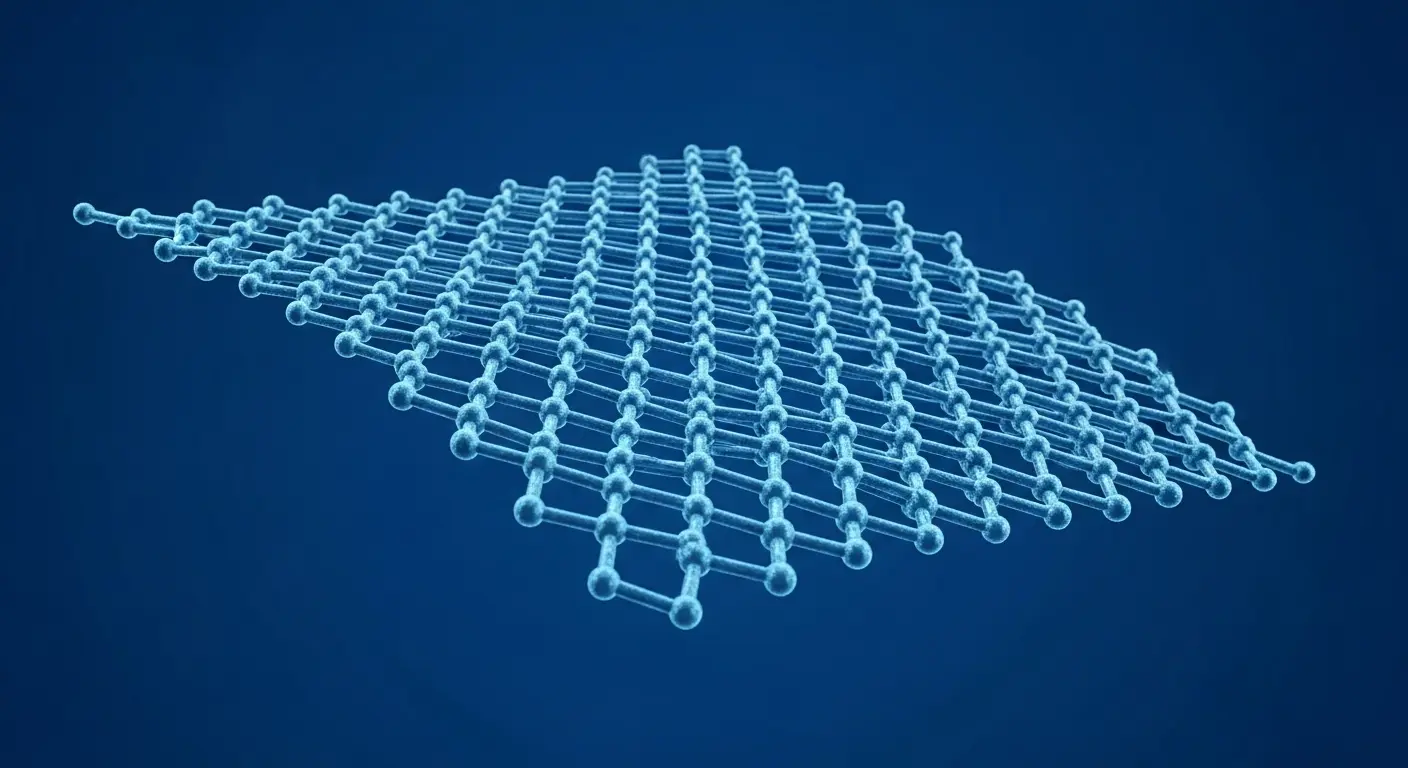
Controlling spin and charge currents now occurs via femtosecond laser light manipulating valley states in two-dimensional altermagnets, specifically Cr2SO. This manipulation enables the generation of nearly 100% spin polarized valley currents, alongside a “ghost Hall” effect where spin and charge currents move at right angles, differing from typical Hall physics. Ruikai Wu of the Max-Born-Institute for Non-Linear optic in collaboration with Free University of Berlin, and colleagues have revealed a new way to manipulate the flow of electrical charge and spin within two-dimensional materials using light. Experiments with Cr2SO demonstrate nearly complete spin polarization, a key principle of spintronics focused on exploiting spin for information technology.
Ruikai Wu and colleagues have uncovered a novel method for manipulating electrical charge and spin within two-dimensional materials using light. Experiments conducted with chromium disulphide oxide reveal the potential to generate nearly 100% spin polarized valley currents; electrons occupy different valleys, offering a degree of freedom beyond simple charge. This spin polarization is akin to sorting marbles by colour, with nearly all aligned, representing aligned electron spins. Furthermore, the team observed a “ghost Hall” effect, a current flowing at right angles to the applied force, but driven by electron spin rather than a magnetic field, differing from conventional Hall physics. These findings establish Cr2SO as a promising platform for ultrafast control of spin and charge, with computational methods and specific results detailed in the following sections.
Complete spin polarisation of valley currents achieved in chromium disulphide oxide
Previously, generating nearly 100% spin polarized valley currents proved unattainable, as conventional materials lacked the necessary symmetry and band structure for complete electron spin alignment. Now, chromium disulphide oxide, or Cr2SO, enables this level of spin polarization, representing a key advancement for spintronics and information technology. Controlling valley states, unique electron locations within a material, femtosecond laser light selectively excites charge at inequivalent valleys dictated by the light’s polarization. This control also creates a “ghost Hall” effect, where spin and charge currents flow at right angles, fundamentally differing from traditional Hall physics and opening new avenues for manipulating electrical charge and spin. Analysis of the charge and spin currents revealed nearly full spin polarization at polarization angles of 0, 90, 180, and 270 degrees, while at 45-degree angles, charge and spin currents are parallel and perpendicular respectively.
Polarization-dependent valley control and spin current generation in chromium tritiosulphate
Femtosecond laser light controls valley states within the two-dimensional altermagnet Cr2SO, exciting charge at inequivalent valleys determined by the light’s polarization direction. This process generates nearly 100% spin polarized valley currents and a “ghost Hall” effect, where spin and charge currents occur orthogonally, bypassing conventional Hall physics. The current investigation focuses exclusively on Cr2SO, leaving open whether these findings extend to other two-dimensional altermagnets or materials.
A Wannier parametrized time-dependent tight-binding scheme and time-dependent density functional theory were employed to explore light-matter coupling, with the Elk code used for the latter, more computationally intensive, method. Calculations were performed with a U value of 3.5 eV applied to the chromium sites during the LDA+U calculation of the band structure. Linearly polarized light pulses selectively couple to specific valleys, exciting charge exclusively at the X and Y points when perpendicular to them, as evidenced by momentum-resolved charge excitation data. Notably, the data reveals a distinct lowering of C2 valley symmetry in charge excitation when using shorter, single-cycle pulses compared to multi-cycle waveforms. The durability or scalability of these effects, essential for potential device applications, remains unaddressed, as does a comparison to other methods of controlling spin or valley degrees of freedom, or a benchmark of performance against existing technologies in spintronics or valleytronics.
Polarization-dependent valley control induces spin currents in chromium trisulphide
Femtosecond laser light, a technique employing extremely short pulses of light to manipulate materials, has demonstrated control over valley states in the two-dimensional altermagnet Cr2SO. This control enables the generation of nearly 100% spin polarized valley currents, where the flow of charge carries a strong spin orientation, and the creation of a “ghost Hall” effect. This work builds upon existing research exploring ultrafast interaction of light and matter in two-dimensional materials, specifically addressing the challenge of controlling spin and valley degrees of freedom. Previous investigations have employed femtosecond laser pulses to manipulate electronic states in two-dimensional materials such as dichalcogenides, selectively exciting valleys to control spin and charge.
A dual approach, consisting of a Wannier parametrized time-dependent tight-binding scheme and state-of-the-art time-dependent density functional theory, was used to explore the physics of light-matter coupling. Future investigations will likely focus on exploring valley physics within the two-dimensional altermagnet Cr 2 SO and establishing these materials as a platform for ultrafast spin- and valleytronics. Two-dimensional altermagnets provide a new route for controlling spin- and charge currents at ultrafast timescales.
Cr2SO, a two-dimensional altermagnet, now demonstrates unprecedented control over electron behaviour via light. Femtosecond laser pulses successfully manipulated ‘valley states’, specific electron locations within the material, with the polarization of the light dictating which valley electrons occupied. This precise control generated nearly fully spin-polarized currents, a key principle for advanced spintronics, and simultaneously created a “ghost Hall” effect, where spin and charge move independently. This discovery moves beyond conventional understandings of electrical charge and spin transport, offering a new pathway for ultrafast electronic devices.
The research demonstrated control over valley states within the two-dimensional material Cr₂SO using femtosecond laser light. This control matters because it allows for the generation of nearly 100% spin-polarized valley currents and the observation of a “ghost Hall” effect, representing a novel way to manipulate spin and charge. The authors intend to further explore valley physics within Cr₂SO, establishing these materials as a platform for ultrafast spin- and valleytronics. This work provides a new route for controlling spin- and charge currents at ultrafast timescales.
👉 More information
🗞 Ultrafast ghost Hall states in a 2d altermagnet
🧠 ArXiv: https://arxiv.org/abs/2604.11361


See today’s quantum computing news on Quantum Zeitgeist for the latest breakthroughs in qubits, hardware, algorithms, and industry deals.



