

A recent journal article aims to show significant advantages of using a quantum neural networks over their classical counter-part. Neural networks and Deep Learning have been one of the most most talked about areas of Machine Learning with the ability to power applications such as personal assistants, self driving cars, translation and a whole host of exciting potential use-cases.
In this latest paper, the authors (Amira Abbas, David Sutter, Christa Zoufal, Aurélien Lucchi, Alessio Figalli and Stefan Woerner) outline how quantum based networks may offer training advantages and better dimensional properties with the ability to learn faster and more effectively than classical networks.
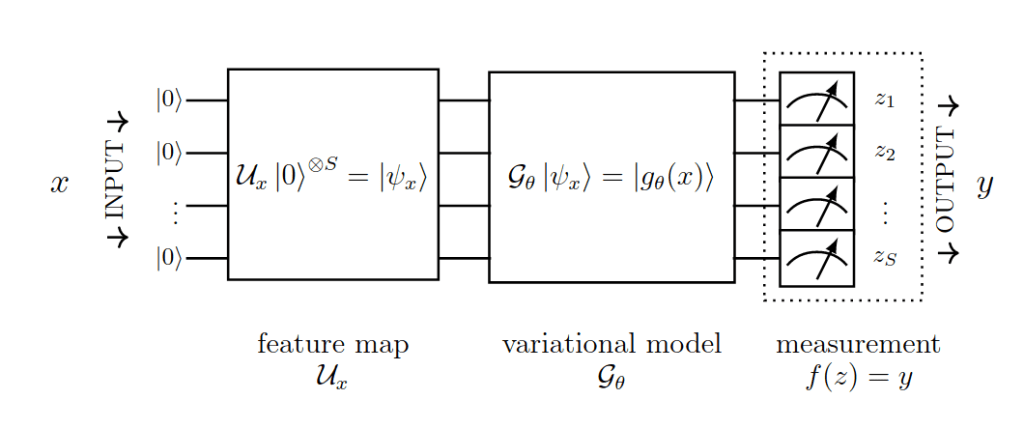
Training on classical data sets the authors have compared a variety of properties such as capacity, dimensional data with the result that quantum networks can effectively store more complex patterns that their classical equivalents.
Overall, we have shown that quantum neural networks can possess a desirable Fisher information spectrum that enables them to train faster and express more functions than comparable classical and quantum models, a promising reveal for quantum machine learning

Quantum Machine Learning (QML) could be one of the greatest use-cases for quantum computing and researchers around the globe are looking at applications where Quantum can offer advantages over classical computing.
Read more from the original article



See today’s quantum computing news on Quantum Zeitgeist for the latest breakthroughs in qubits, hardware, algorithms, and industry deals.