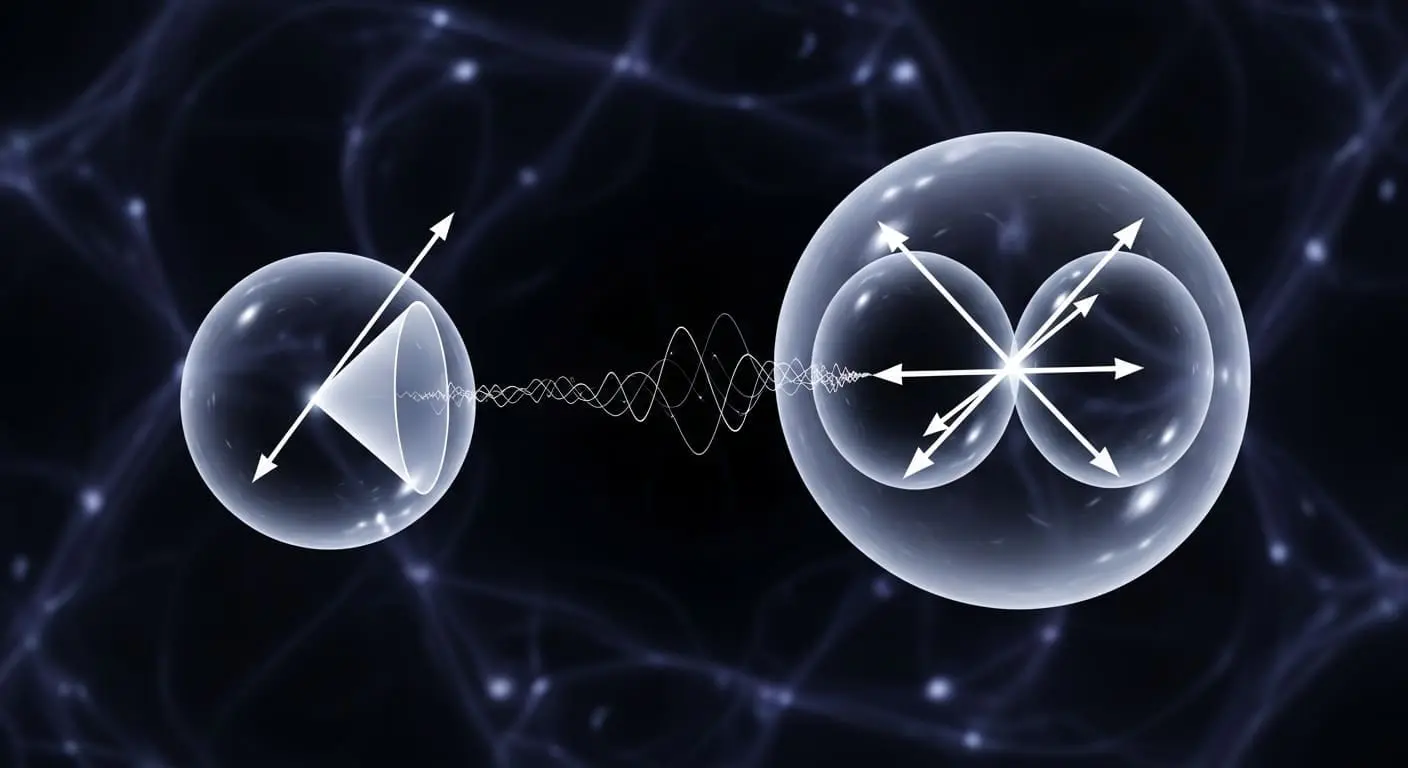
A new qubit platform developed at the U.S. Department of Energy’s Argonne National Laboratory is achieving noise levels thousands of times lower than those found in most traditional qubits, a critical step toward stable and scalable quantum computing. Rather than relying on semiconductors or superconducting loops, the platform traps single electrons on the surface of frozen neon gas, a highly unusual approach validated through a joint study led by Argonne and the University of Notre Dame, with collaboration from the University of Chicago, Harvard University, Northeastern University and Florida State University. “In previous work, we demonstrated the outstanding performance of our electron-on-neon qubit,” said Xu Han, an Argonne scientist and co-corresponding author. “This latest study shows why its performance is so good by thoroughly characterizing the qubit’s noise properties.” This reduction in noise promises to extend qubit coherence times and unlock the potential of quantum computers to tackle complex problems currently beyond reach.
Electron-on-Neon Qubit Platform Minimizes Environmental Noise
The key to this reduced noise lies in the properties of solid neon, which is chemically inert and remarkably free of impurities compared to semiconductors and superconductors commonly used in qubit fabrication. Researchers systematically characterized the qubit’s noise properties at Argonne’s Center for Nanoscale Materials (CNM) by directing microwave pulses through a resonator to manipulate and probe the qubit’s environment. “There’s a particular frequency called the ‘sweet spot’ where the electron qubit becomes relatively insensitive to nearby electrical noise,” explained Dafei Jin, now an associate professor at the University of Notre Dame. “However, in this work, we intentionally looked at frequencies outside this sweet spot.” Our results prove that this technology is promising for quantum information processing at larger scales. While some noise remains due to stray electrons and surface imperfections, ongoing work aims to further refine the system and unlock even greater stability.
1 Millisecond Coherence Achieved with Novel Qubit Design
The pursuit of stable qubits remains a central challenge in realizing practical quantum computers; current devices struggle with maintaining quantum information for even fractions of a second due to environmental noise. Recent advances from a collaborative team, however, demonstrate a significant leap forward in qubit coherence. Researchers have now achieved a coherence time of 0.1 milliseconds using a platform built not from conventional semiconductors or superconductors, but by trapping single electrons on a surface of frozen neon gas. This unconventional approach, spearheaded by scientists at Argonne National Laboratory and the University of Notre Dame, alongside collaborators from six universities, is yielding remarkably quiet qubits. Importantly, the team deliberately examined frequencies outside this sweet spot to fully assess the disturbance caused by the solid neon environment. The results revealed noise levels 10 to 10,000 times lower than those typically observed in semiconducting qubits, rivaling the quietest semiconductor records.
In previous work, we demonstrated the outstanding performance of our electron-on-neon qubit. By thoroughly characterizing the qubit’s noise properties, this latest study showswhyits performance is so good. Our results prove that our technology is promising for quantum information processing at larger scales.
Xu Han, Argonne scientist
Researchers are meticulously probing the limits of qubit stability, and a collaborative effort centered at Argonne National Laboratory is yielding significant results. While many qubit designs focus on minimizing noise at a “sweet spot,” this study deliberately investigated frequencies outside that range, revealing the inherent quietness of the solid neon environment. The findings are compelling; noise levels were found to be 10 to 10,000 times lower than in most semiconducting qubits, and comparable to the best superconducting designs.
There’s a particular frequency called the ‘sweet spot’ where the electron qubit becomes relatively insensitive to nearby electrical noise,” said Dafei Jin, the research project leader.
Solid Neon Fabrication Simplifies Qubit Manufacturing Process
The pursuit of stable qubits has historically been hampered by complex fabrication processes and inherent material limitations; however, a platform developed at Argonne National Laboratory is streamlining qubit creation with an unexpectedly simple foundation: frozen neon. This fabrication simplicity stems from the readily available source material; electrons were sourced from standard light bulb filaments during the qubit’s initial invention in 2022, but current fabrication utilizes different methods. This reduction in noise is critical, as qubits are exceptionally sensitive to environmental disturbances that limit their coherence, the duration for which they can reliably retain information. This enabled us to investigate how the solid-neon environment disturbs the qubit and to compare it with other materials.” Beyond noise reduction, the platform demonstrated a coherence time of 0.1 milliseconds in 2024, nearly a thousand times better than previous semiconducting qubit records.
In previous work, we demonstrated the outstanding performance of our electron-on-neon qubit. By thoroughly characterizing the qubit’s noise properties, this latest study showswhyits performance is so good. Our results prove that our technology is promising for quantum information processing at larger scales.
Xu Han, Argonne scientist


See today’s quantum computing news on Quantum Zeitgeist for the latest breakthroughs in qubits, hardware, algorithms, and industry deals.