On April 16, 2025, researchers demonstrated a novel approach to quantum computing by implementing in-situ mid-circuit qubit measurement and reset operations using metastable states in a trapped-ion system. This advancement simplifies quantum architectures by eliminating the need for shuttling or additional optics, marking a step forward in efficient quantum processing techniques.
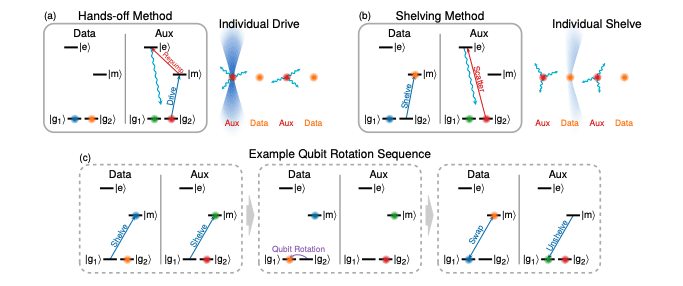
Researchers implemented mid-circuit measurement and reset (MCMR) operations in a trapped-ion system using metastable qubit states. Two methods were introduced: one shelves data qubits into metastable states, while the other drives measured qubits without disturbing others. Both methods were experimentally demonstrated on a two-ion crystal using hyperfine clock and optical qubits, achieving data qubit errors of approximately 0.1% without affecting measurement fidelity. Errors can be reduced to below 0.05% with improved laser noise control. This approach enables MCMR in single-species ion chains without shuttling or additional optics, simplifying quantum computing architectures.
Quantum computing represents a transformative shift in computational power, promising solutions to complex problems that classical computers struggle with. However, challenges such as maintaining coherence and preventing errors have hindered progress toward practical, large-scale systems. Recent research has unveiled an innovative approach addressing these issues, potentially paving the way for more reliable quantum computers.
The breakthrough involves a novel method in quantum computing using trapped ions, which are charged atoms confined by electromagnetic fields. Researchers developed a technique that enhances error correction without causing decoherence, a phenomenon where qubits lose their quantum state due to environmental interference. This advancement allows for high-fidelity quantum operations and the demonstration of fault-tolerant logical qubits, crucial for scaling up quantum systems.
The experiment utilized a linear ion trap with multiple qubits, employing lasers for precise manipulation. A key aspect was the use of Blackman-Tukey methods for signal processing, which helped reduce noise in measurements. This setup enabled researchers to implement feedback mechanisms for real-time error correction, ensuring operations remained stable and accurate.
The results were promising, with high success rates in quantum gate operations exceeding 99%. The system demonstrated the ability to maintain logical qubit states despite errors, a significant step toward achieving fault tolerance. These findings suggest that the new method could be foundational for future quantum computing architectures.
This research marks a substantial advancement in quantum computing by addressing critical challenges in error correction and scalability. By enabling high-fidelity operations and fault-tolerant systems, it brings us closer to realizing practical applications of quantum technology. As this field evolves, such innovations will likely play a pivotal role in unlocking the full potential of quantum computing.
👉 More information
🗞 In-situ mid-circuit qubit measurement and reset in a single-species trapped-ion quantum computing system
🧠 DOI: https://doi.org/10.48550/arXiv.2504.12544



See today’s quantum computing news on Quantum Zeitgeist for the latest breakthroughs in qubits, hardware, algorithms, and industry deals.