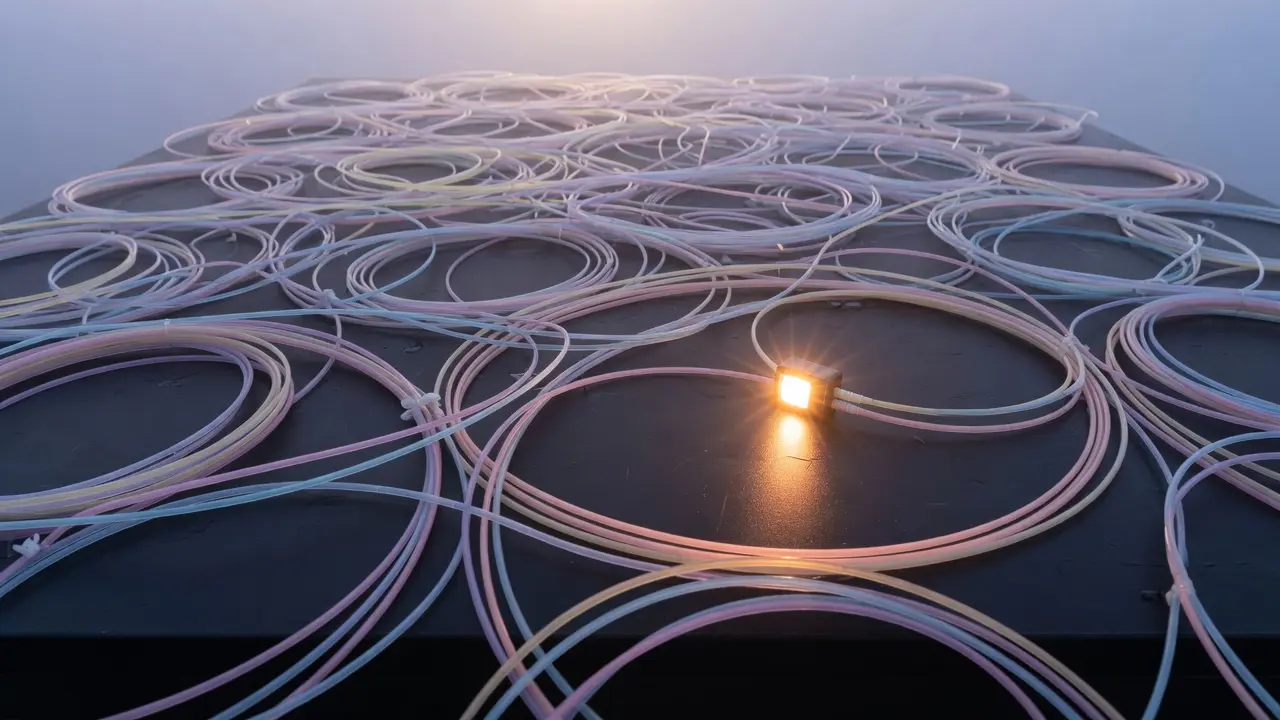
Quantum low-density parity-check (QLDPC) codes offer a promising pathway toward practical fault-tolerant quantum computation due to their potential for reduced overhead, and utilising qudits, quantum digits beyond simple bits, offers key advantages in information representation and code design. Researchers at International Institute of Information Technology, in collaboration with Universidade de Lisboa and V.˜Lalitha is with the International Institute of Information Technology, present a new generalisation of lifted product construction over cyclic group algebras, extending existing hypergraph product codes to arbitrary prime-power dimensions and creating quasi-cyclic CSS codes suitable for various stacking orders.
Fully stacked qudit LP codes built on expander graphs can achieve families containing Θ(log N) logical qudits alongside an almost linear minimum distance of Θ(N/log N), while simulations reveal improved frame error rates compared to equivalent qubit codes, suggesting this approach offers substantial progress toward strong quantum communication and computation.
Quasi-cyclic CSS Codes Enable Sublinear Error Correction Thresholds
Abhay Pornawalla and collaborating institutions developed new quasi-cyclic CSS codes resulting in error rates dropping to Θ(N / log N). This represents a move beyond limitations previously hindering fully stacked code constructions. Achieving such an almost linear minimum distance was unattainable with existing methods. Generalizing lifted product construction using cyclic group algebras enabled these advances across various prime-power dimensions; simulations also demonstrated gains from employing a linear decoder under depolarizing channels, suggesting substantial progress towards strong quantum communication and computation is within reach.
Monte Carlo simulations utilising a depolarizing channel confirmed the improved performance, showing lower frame error rates than those seen with comparable qubit codes when assessing performance via equal symbol error probability. These tests yielded families boasting Θ(log N) logical qudits, where ‘N’ represents code size. A linear decoder provided additional gains on fully stacked constructions, demonstrating potential for improved decoding efficiency. This builds upon earlier work on hypergraph products and LP codes which previously showed scaling of both dimension and minimum distance relative to block length.
Simulating Qudits Reveals Potential For Improved Quantum Error Correction
Qudits offer promising theoretical gains over existing qubit approaches to error correction while using quantum digits beyond simple bits; however, an important question remains: how do these benefits translate into practical hardware. Confirming genuine improvements demands building and controlling complex qudit systems, presenting significant engineering hurdles. Current evaluations rely solely upon Monte Carlo simulations running many trials to estimate performance, but real quantum systems are notoriously noisy and difficult to control perfectly.
Despite this uncertainty, the work represents a valuable step forward by expanding tools for building strong quantum computers through exploration of qudits as alternatives to standard qubits.
The team alongside collaborators, have extended established quantum error correction techniques to utilise them with qudits. This generalisation of lifted product code construction over cyclic group algebras creates quasi-cyclic codes adaptable across different dimensions, offering a pathway towards scalable and durable fault tolerance. By focusing on cyclic structures within these codes, they’ve designed them with potential compatibility for efficient hardware decoders, essential components that translate noisy signals into reliable data; further research will focus on translating these theoretical gains into tangible improvements in the next decade, beginning a new era for strong computation here.
This research successfully generalized existing methods for building quantum low-density parity-check (QLDPC) codes to work with qudits, quantum digits beyond simple bits. The resulting code families scale with approximately linear minimum distance relative to code size N, while supporting up to Θ(log N) logical qudits. Monte Carlo simulations demonstrated that these qudit codes achieved lower frame error rates compared to equivalent qubit codes under depolarizing noise. This work expands available tools for constructing robust quantum computers and provides quasi-cyclic structures potentially compatible with efficient hardware decoders.
👉 More information
🗞 Quasi-Cyclic Qudit Lifted Product Codes with Almost Linear Minimum Distance
✍️ Abhinav Vaishya (Universidade de Lisboa); V. Lalitha (International Institute of Information Technology); Narayanan Rengaswamy (V.˜Lalitha is with the International Institute of Information Technology); Shantom K. Borah, Asit Kumar Pradhan and Bane Vasic
🧠 ArXiv: https://arxiv.org/abs/2611.15952

See today’s quantum computing news on Quantum Zeitgeist for the latest breakthroughs in qubits, hardware, algorithms, and industry deals.